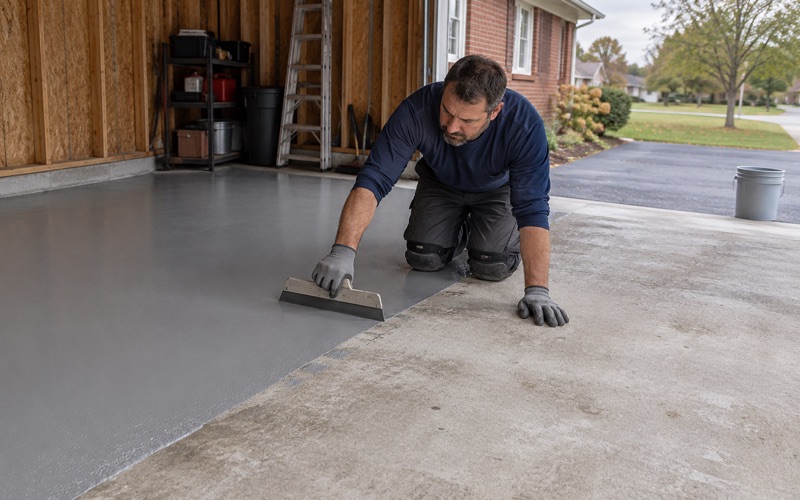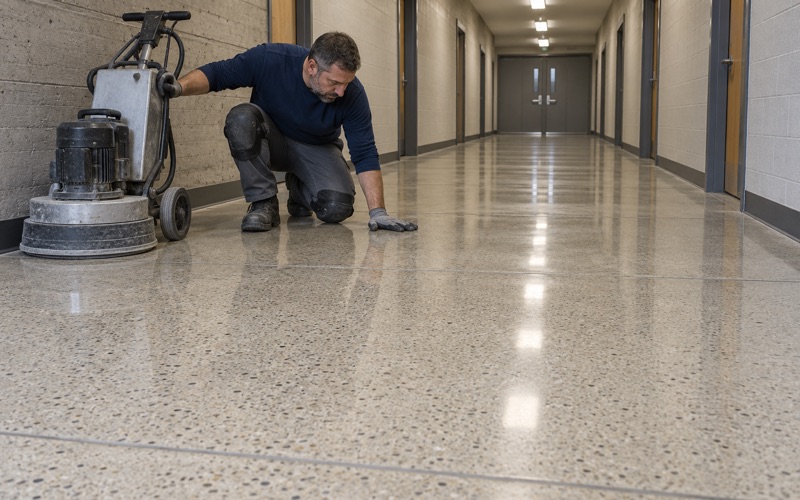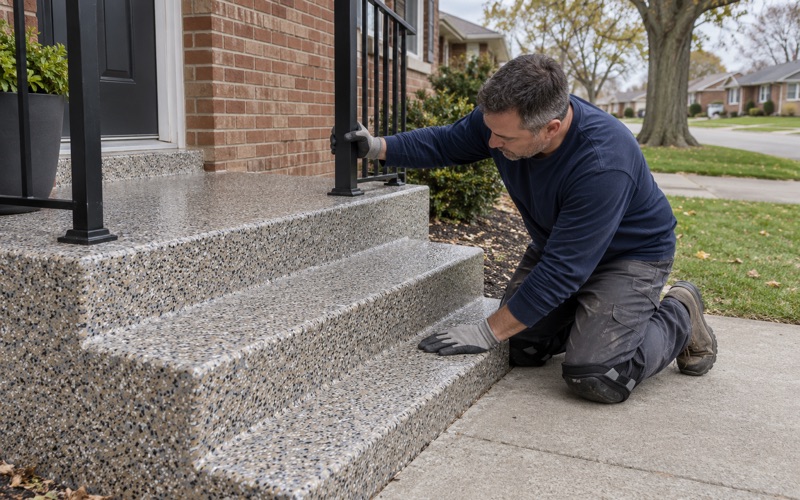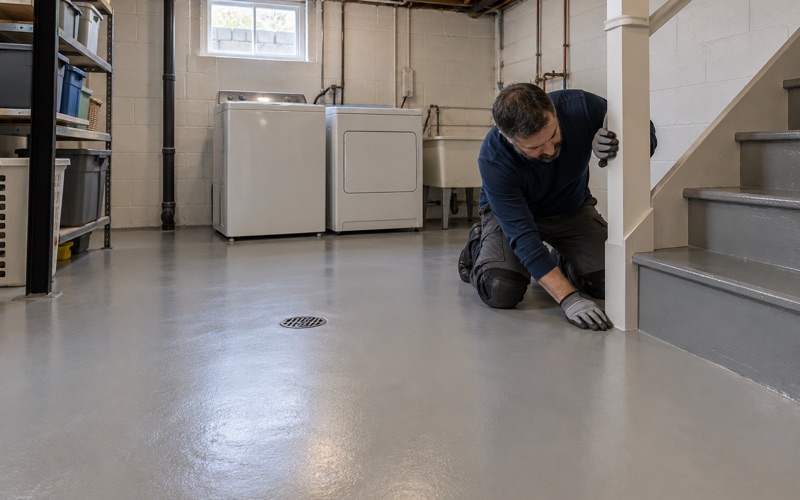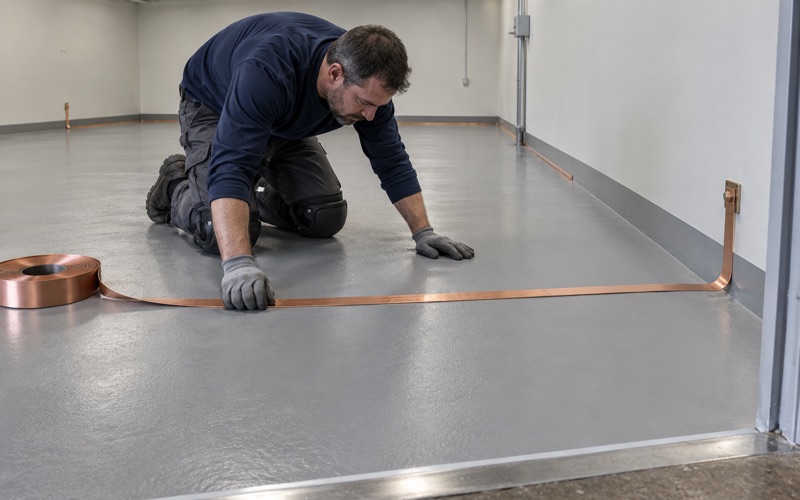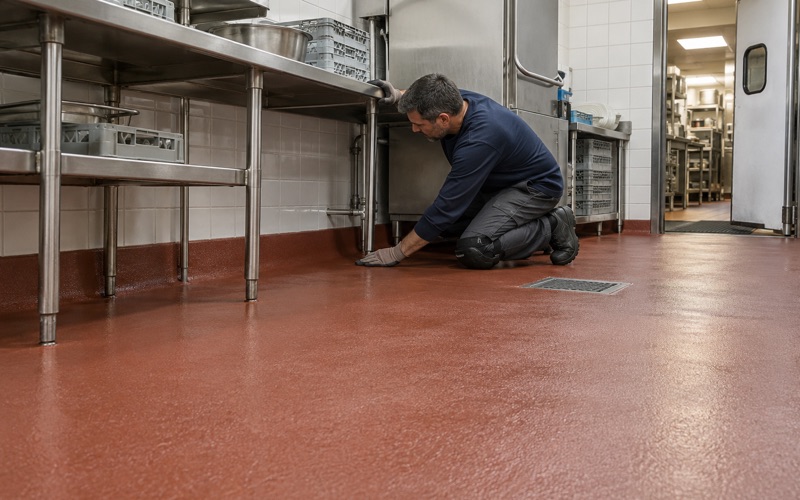
Des Plaines Epoxy Flooring has spent more than 20 years on garage and basement slabs, and our epoxy flooring in Bellwood work starts with a plain question: what happens to this floor the day water comes in under the door? A coating cannot keep a flood out, and we never sell one that way. What it can do is give you a surface that survives the cleanup.
That shifts how we judge a floor. Bare concrete drinks in whatever sits on it, and a loose or peeling finish traps dirty water underneath. A coating bonded to a ground slab can be scraped, hosed, disinfected and dried, then inspected for what it still holds and recoated where it does not. That cycle is the real test.
Every quote we write names the product line, the coat count and the finished thickness, so you can check the floor against the paper. We open the concrete with a diamond grinder or shot blaster rather than an acid wash, and we explain before the sale what a warranty leaves out, starting with moisture.
A Reservoir on Washington Boulevard
What MWRD built inside the village
Bellwood is home to the structure built to hold Addison Creek back. The Metropolitan Water Reclamation District’s Addison Creek Reservoir sits at 2795 Washington Boulevard, inside the village, and holds 195 million gallons. It cost $81 million, was finished in 2023 and includes a control structure, inlet, spillway and pumping station. Downstream, a $77 million channel project is widening the creek and removing restrictions.
MWRD scheduled the channel work to finish by summer 2026. The district expects the reservoir and the wider channel together to reduce overbank flooding for about 2,200 structures from Northlake to Broadview, including about 1,700 expected to be removed from the regulatory floodplain. We could not confirm whether the channel work finished on schedule or whether FEMA has revised the map yet.
Why the village still plans for the creek
The village’s own hazard plan ranks flood first among its risks and describes an extremely large floodplain area susceptible to Addison Creek flooding. It notes that Washington Boulevard floods regularly and that Village Hall, on the same boulevard, has flooded numerous times. A reservoir lowers the odds and the depth of an overbank event, but it does not turn a garage beside the creek into a dry room by decree.
So we treat a floor near the creek as a floor that may see water again, and we scope the job accordingly. That is not pessimism about the project. It is simply how a slab should be finished while the map that decides who sits in the floodplain has not caught up with the work in the ground.
Creek water is not sewer water
Bellwood records two kinds of flooding, and they reach a floor by different doors. The village also reports basement water pushed up through the sanitary system, which arrives from below through the plumbing. Overbank creek water is surface water. It rises at grade and comes in under garage doors, through window wells and across thresholds, carrying the yard and the street with it.
That difference matters for a coating. Backup water starts at a floor drain and spreads outward, while overbank water sweeps in from the door side and leaves its load across the whole slab. On a floor that has taken creek water, we look first at the door edge, the window well side and the low corner where the water stood longest.
Looking for epoxy-flooring closer to River Forest? See Epoxy-Flooring in River Forest.
What Overbank Water Leaves on a Garage Floor
Silt, debris and what the water carried
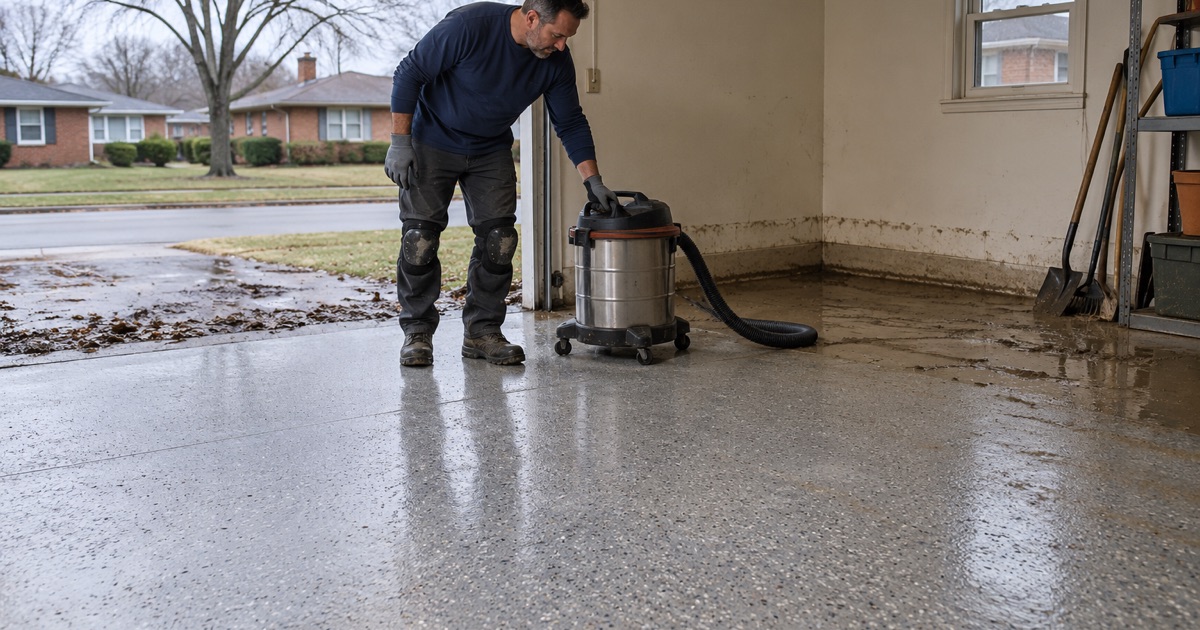
Overbank water drops what it carries as soon as it slows down, and a garage floor is where it slows. Expect a film of fine silt, sometimes a real layer of it, along with leaves, grit and whatever was stored low on the shelves. On bare concrete that silt works into the pores. On a sealed, coated surface it mostly sits on top, waiting to be shoveled and rinsed.
FEMA’s materials bulletin warns that floodwater can carry biological and chemical contaminants, and that buildings have been made unfit to live in by floodwater carrying petroleum products such as home heating oil. Creek water that has crossed streets, yards and driveways is not clean water. We plan every flooded floor as if it carried fuel, fertilizer and sewage traces until the cleanup shows otherwise.
Where the damage hides on a coated slab
A sound coating survives a short soak better than most people expect. The trouble starts at edges and breaks: a chipped spot at the door, a crack that was never filled, a seam where an old coating meets a newer one. Water gets under the film there, and silt follows it. Those are the spots we probe, tap and lift after the floor has been cleaned.
Before any recoat, we map what the water found. Cracks, spalls and lifted coating get drawn on a plan of the slab, and we tell you plainly when a section needs repair or full removal rather than a new topcoat laid over trouble. A floor that took creek water through an old crack will take it again through the same crack.
Bare concrete, old paint and flake systems
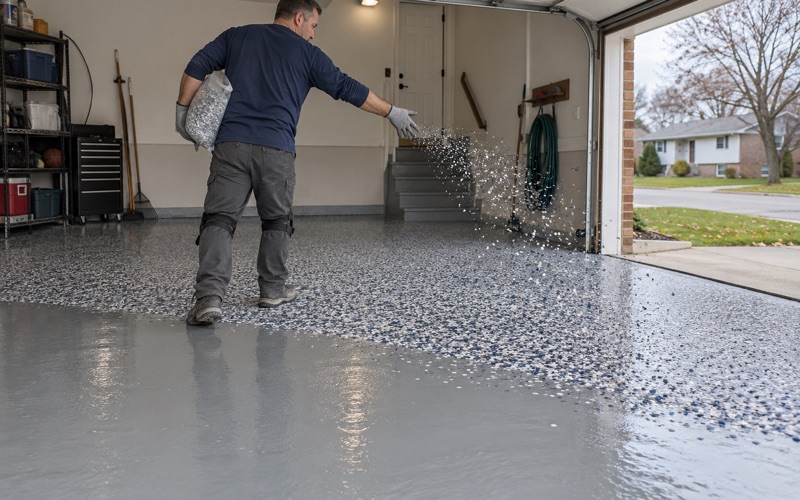
Different floors come out of a flood differently. Bare concrete holds stains and odors in its surface and can be cleaned, but it rarely looks the same afterward. Hardware-store paint tends to lift in sheets once water gets behind it. A ground slab with 100% solids epoxy and a vinyl flake broadcast under a polyaspartic topcoat usually comes through with silt on top rather than under it.
We do not describe that system as anything more than it is. Its advantage is practical: a tight, bonded film with no gaps between tiles or boards gives water and silt fewer places to go. That leaves the owner with a floor to clean rather than a floor to tear out and haul to the curb.
Cleanup on a Coated Slab: Wash, Sanitize, Dry, Recoat
Muck out and wash
Once the water is down, the first job is mechanical. Shovel and squeegee the silt out while it is still wet, because dried creek silt bonds to texture and fills the valleys of a flake floor. Then wash with a detergent solution and a stiff brush, working from the back wall toward the door, and rinse until the water runs clear across the whole slab.
Keep the wash water moving out the door rather than into a floor drain where you can, and never mix cleaners. If the water left a fuel smell or a sheen, stop and treat it as a contaminated floor that needs qualified cleanup before anyone recoats it. Anything soft that sat in the water usually has to go.
Sanitize, then let the slab dry
After washing, sanitize the surface with a disinfectant suited to concrete and respect its contact time. FEMA describes cosmetic repair after a flood as cleaning, sanitizing and resurfacing, and that order is the right one. A topcoat laid over an unsanitized floor simply seals the problem under a fresh film.
Then the slab has to dry, and concrete dries slower than it looks. Surface dryness after a day says little about the water the slab absorbed through cracks and uncoated edges. We take readings before we schedule a recoat, using ASTM F2170 in-situ relative humidity probes or a calcium chloride test depending on the floor, and the result sets the date.
Recoat what the cleanup proves
When the readings allow it, we grind the cleaned surface back to a sound profile, typically ICRI CSP 2 to 3 for a coating system, fill and repair the mapped cracks, and lay the new coats. Sometimes that means a fresh topcoat over intact epoxy, and sometimes a full removal of a delaminated section. The proposal says which before work begins.
Cure is set by slab temperature and dew point rather than the calendar. A garage that flooded in spring may be ready before summer, while an unheated one that flooded late in the year may be told to wait. Rushing a recoat onto a cold, damp slab invites amine blush and a weak bond, and the bond is the whole point of the job.
Before the Map Changes: Timing a Floor Near the Creek
Install now or wait for the remap
Many owners near Addison Creek are waiting to see whether their address comes out of the floodplain. We cannot tell you that, and neither can anyone until FEMA publishes a revised map. What we can tell you is that a bonded coating does not depend on the answer. It is the same floor either way, and the cleanup cycle stays available whether or not the water returns.
The case for waiting is narrower than it sounds. If a garage floor is bare, stained or peeling now, it is already the hardest surface to clean after a flood. If the slab is cracked and settling, repair comes first regardless of the map. The one good reason to hold off is a planned regrade or door change that would alter how water reaches the floor.
What the village checks first
Floodplain rules in Bellwood are administered by the village Building Department under Chapter 152 of the municipal code. A floor coating on an existing slab is ordinarily small work, but repairs after flood damage are tracked against the code’s substantial-improvement definition. We ask the Building Department before a job whether a permit applies rather than assuming either answer.
Illinois does not license flooring or coating contractors, so we check the village’s own contractor registration, bond and insurance requirements before booking. Home jobs above the state threshold get a written contract and the Home Repair: Know Your Consumer Rights pamphlet before grinding begins, as the Illinois Home Repair and Remodeling Act requires.
Planning the edges around the creek
For a garage near the creek, we plan the edge details as carefully as the open floor. That means grinding right to the door line, filling the joint where the slab meets the apron, and carrying the coating a short way up the base of the wall so silt has less of a lip to lodge behind. Grinding dust is vacuumed at the machine, never rinsed toward a drain.
The aim is not a floor that keeps water out, because no coating does that. The aim is a floor you can muck out, wash, sanitize and recoat after the slab has dried, without starting over from bare concrete. Near Addison Creek, that is what makes a coating worth the money, whatever the new map eventually says.
- 20+ Years of Floor Work
- Moisture Test in Every Scope
- Written Proposal, Named Products