Des Plaines Epoxy Flooring has spent more than 20 years on epoxy flooring in Bensenville and the surrounding industrial ground, and the floors we are asked about here tend to be working floors before they are anything else. A repair bay, a maintenance shop or a parts room is judged by whether it survives a dropped part and a week of grease, not by how it photographs.
That changes the order of the conversation. We start with what the slab carries, where it is cut or interrupted, and what spills on it during a normal shift. Only then do we talk about a product line, the number of coats and the finished thickness, all of which go into the written proposal so the floor can be checked against the quote once it is down.
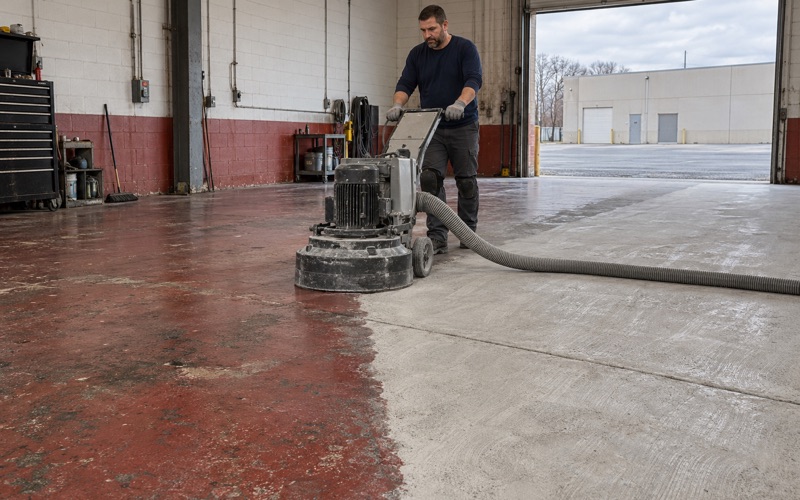
Every slab we coat is opened with a diamond grinder or a shot blaster to a measured concrete surface profile, never an acid etch. The moisture test is written into the scope before the price is final, and the warranty exclusions, with moisture named first, are explained before anyone signs.
A New Car Shop at Bensenville Yard and What It Puts on a Floor
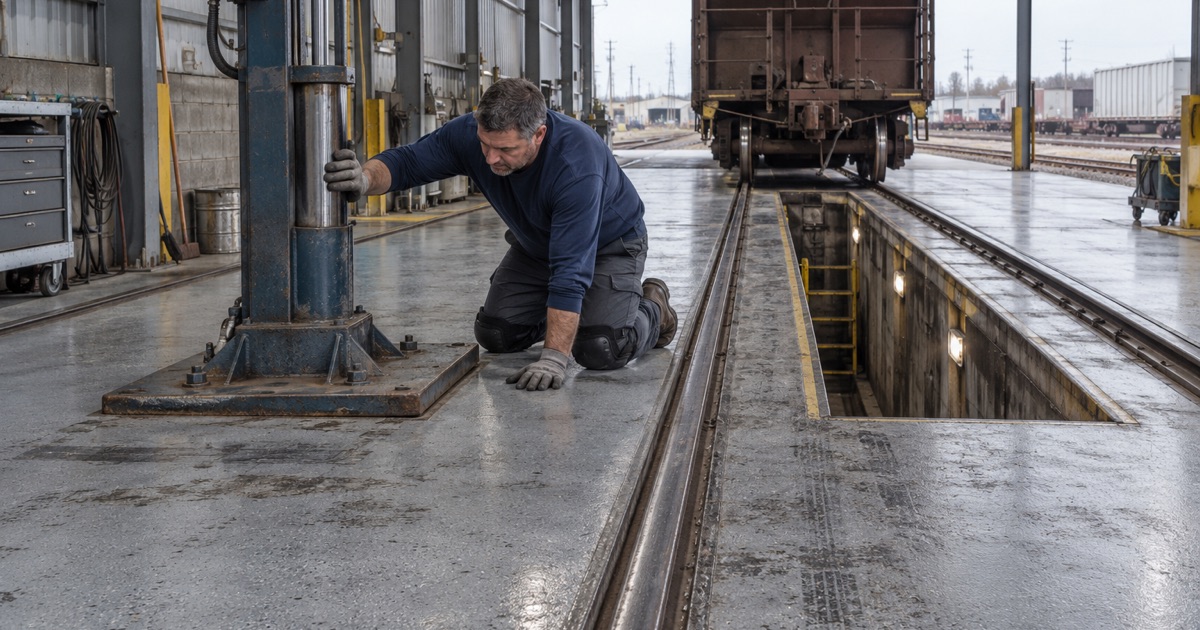
Bensenville Yard is a Canadian Pacific Kansas City hump yard that lies partly inside the village and partly in Franklin Park. It descends from the Milwaukee Road’s first freight yard of 1916 and today runs 55 classification tracks. It is described as CPKC’s largest freight and marshaling yard in the United States, which puts some of the region’s heaviest freight handling on the village’s doorstep.
The shop that opened in November 2025
According to Progressive Railroading, CPKC’s relocated rail-car repair shop at the yard became fully operational on November 1, 2025, after design started in summer 2024 and construction in May 2025. It sits on a 700-by-100-foot concrete working pad, with a 300-by-100-foot shelter carrying integrated utilities. Three repair tracks run through it, each served by new electric-over-hydraulic jacks.
The shop handles brake work, wheel service, cushion-unit replacement and draft-gear work, and a high-speed drop table changes a wheel set in under five minutes. We have not seen CPKC’s floor specification and do not know whether that pad is coated at all, but its layout is a clear model of what a heavy repair floor has to survive.
Reported output rose from 10 to 15 cars a day to 20 to 25, and the bad-order count fell from about 40 a day to 20. That is the point of a faster repair floor: more cycles of lifting, dropping and rolling across the same concrete. A floor in any busy repair shop should be specified for that pace, not for the day it is finished.
Point loads under a jacked freight car
When a freight car is lifted for wheel or truck work, its weight leaves the rails and travels down through a handful of jack pads. A floor that shrugs off forklift traffic can still crush, chip or debond under that kind of concentrated load, because the force lands on a few square feet rather than a tire footprint moving along an aisle.
For a coating, that means thickness and compressive strength matter more than gloss. A thin roll-on epoxy over a weak surface simply mirrors whatever happens to the concrete underneath. In a jacking zone we look at 100% solids epoxy built up with a quartz aggregate broadcast, or urethane cement where heat and impact are both in play, and we say plainly when the slab itself is the limiting factor.
Repeated shocks from steel parts
Wheel sets, brake beams, couplers and knuckles are not set down gently every time. A dropped steel part delivers a sharp impact to a small area, and damage in a repair shop usually starts as a chip at one of those strikes. Coating systems with some flexibility and a broadcast layer tolerate that better than a brittle, glassy film, and they are far easier to patch.
Looking for epoxy-flooring closer to Wood Dale? See Epoxy-Flooring in Wood Dale.
Pit and Drop-Table Edges: Where Repair Slabs Break First
Any shop with a wheel pit or a drop table has openings cut through its working slab, and those openings are where repair floors fail first. The edge of a pit is unsupported on one side, it takes the wheels of carts and jacks rolling over it, and it is often formed with a steel angle or embedded frame that moves differently from the concrete around it.
Mapping the edges before anything is priced
We map cracks, spalls and old coating across the whole slab before quoting, and pit edges get the closest look. Hollow-sounding concrete, rust bleeding from an embedded angle, or a crack running parallel to the opening all tell us the edge needs repair or rebuilding first. Coating over a failing nosing only hides it until the first heavy wheel breaks it loose again.
Detailing the transition
Where a coating meets a pit edge or a steel frame, it needs a terminated, keyed edge rather than a feathered one that a wheel can catch and peel. At a concrete-to-steel joint we cut a saw kerf and build the coating into it, and any joint that has to move is treated as a sealed joint rather than buried under rigid epoxy.
Inside a pit, the walls and floor collect water, grease and grit, and they are hard to ventilate during cure. We plan for that separately, with dew point and slab temperature measured in the pit itself, because the air in a recessed space rarely matches the shop floor above it.
Keeping the drop-table zone serviceable
A drop table lowers and raises a wheel set through the floor, and the area around it sees the heaviest repeat traffic in the bay. We recommend a textured, broadcast finish there so workers and equipment keep their footing when lubricant lands on it, and we leave the moving mechanism, its rails and its clearances entirely to the equipment maker’s requirements.
Crews also stage parts, jacks and tools near the opening, so the band around a pit takes both point loads and dragging. We often run a contrasting safety color around the edge as part of the coating system. It marks the hazard and shows wear early, so touch-ups happen before the concrete underneath is exposed.
Grease, Brake Dust and Dropped Steel
A car-repair floor collects journal grease, draft-gear lubricant and fine brake dust as part of normal work. None of it is unusual, but together they create a slick, abrasive film that grinds into soft concrete and darkens an uncoated slab within months. The coating’s job here is to keep that film on top, where a scrubber can remove it.
Oil resistance and surface preparation
Oil that has soaked into a slab is the reason many shop coatings fail. A floor that has taken years of grease needs degreasing, and often repeated cleaning to draw contamination out, before grinding. We diamond grind or shot blast to an ICRI concrete surface profile matched to the system, and if the oil runs deeper than that profile, we tell you before the job is sold.
Topcoat choice matters too. Polyaspartic and polyurea topcoats resist many oils and cure fast, which helps on a tight shutdown, while a heavier epoxy base gives build and impact tolerance. Because the proposal names the product line, coat count and finished thickness, maintenance staff can check what went down against what was promised.
Brake dust and traction
Brake dust is fine, hard and abrasive. Ground under boots and cart wheels, it wears a high-gloss finish dull in traffic lanes and turns any oil film into something closer to lapping compound. A quartz aggregate broadcast locked in with a sealer coat gives grip and stands up to that wear better than a smooth film.
Texture has a cost, because a rough floor is harder to clean. We set the grit and the number of sealer coats to the shop’s cleaning routine, coarser where people stand at the jacks and smoother in walkways, so the floor stays safe without trapping more grease than a scrubber can lift.
Moisture under an industrial slab
A large pad poured on grade can push vapor up through a coating, and older shop floors rarely have a vapor retarder below them. Before pricing we run ASTM F2170 in-situ relative humidity probes or ASTM F1869 calcium chloride tests, and where readings are high we specify a moisture-mitigation primer rather than hoping the slab stays dry.
The Same Questions in Any Heavy Repair Shop in the Village
Most of our Bensenville work will never be inside a railroad shop. The village borders the southwest corner of O’Hare, is home to more than 1,500 businesses and has one of the largest industrial parks in Illinois. Wherever a shop lifts heavy equipment, has a pit cut into its slab or drips lubricant, the questions raised at the yard apply on a smaller scale.
Rail-served and yard-adjacent shops
Along Franklin Avenue and the streets around the yard, rail-served and yard-adjacent buildings often house maintenance and rebuild work rather than showrooms. Floors in those buildings can carry decades of oil, saw cuts from old equipment layouts and patched pits. We map that history first, and when a slab needs repair or replacement rather than a coating, our written assessment says so.
Working around shifts
A repair shop rarely closes for a week. We phase the floor in sections, bay by bay or track by track where the layout allows, and schedule grinding and coating into overnight and weekend windows when the building cannot stop. Cure times follow slab temperature and dew point rather than the calendar, so a cold bay gets heat or a later date instead of a rushed return to service.
Grinding dust is captured by vacuum at the machine instead of being washed toward a floor drain, which matters in any shop where drains feed an oil separator. Products are chosen inside the Illinois VOC limits for floor and industrial coatings under 35 Ill. Adm. Code Part 223, limits that apply to the person applying them.
Permits, inspections and planning the layout
Bensenville’s Community Development department handles building permits, and we ask before a job whether a floor coating needs one rather than assuming. Illinois has no state flooring license, so the village’s registration and insurance requirements are checked before booking. Non-residential buildings also get annual inspections from Bensenville Fire Protection District No. 2, a taxing district separate from the village, so exit paths and marked aisles belong in the plan.
If your floor sits under lifted equipment, around a pit or beneath a steady drip of lubricant, start with a site visit. We will measure moisture, map the damage and hand you a written scope that says what the slab needs before it says what the coating costs.
- 20+ Years of Floor Work
- Moisture Test in Every Scope
- Written Proposal, Named Products