Des Plaines Epoxy Flooring brings more than 20 years of work to epoxy flooring in Bridgeview, and much of what we are asked to solve here happens on production floors rather than in garages. A plant floor has to carry traffic, survive constant cleaning and keep people upright while the line keeps running. Getting those three things right starts with how the slab is opened and tested, not with the color of the topcoat.
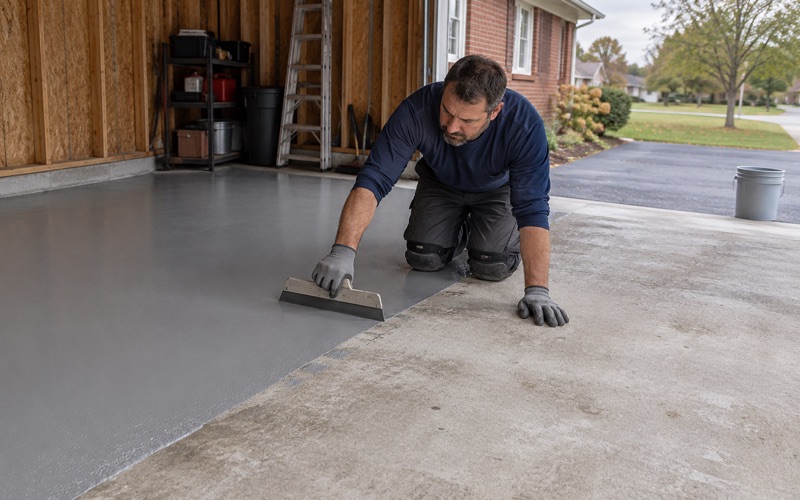
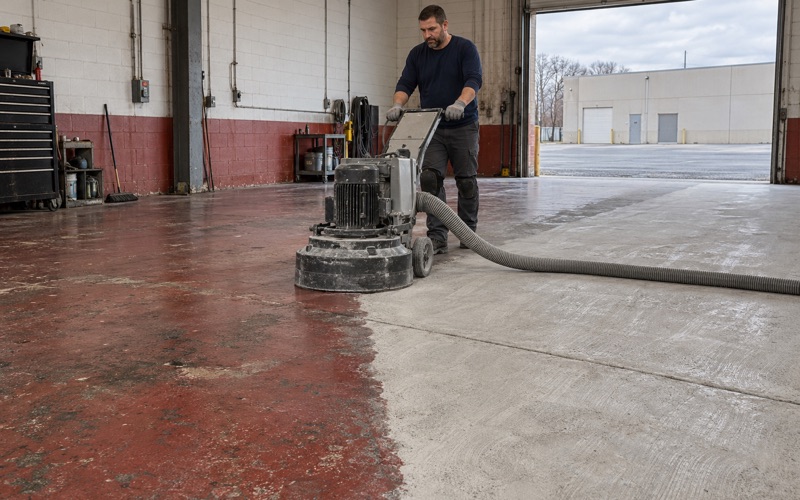
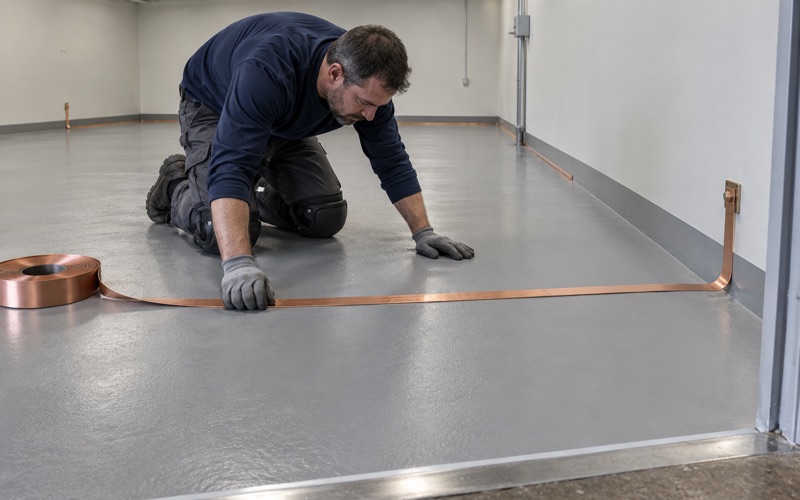
Every slab we take on is opened by diamond grinding or shot blasting to a measured surface profile, never by an acid etch. Before a price is final, a moisture test is part of the written scope. The proposal itself names the product line, the number of coats and the finished thickness, so a plant manager can hold the finished floor up against the quote and check it line by line.
We also map cracks, spalls and failing old coating before recommending any system. When a section of slab needs repair or replacement before it should be coated, we say so up front. Covering a broken substrate only buys a season or two before the same defect shows through the new finish and the floor has to be opened again.
A Plastics Plant on 79th Street and the Pellets It Handles
What Pactiv Evergreen Makes in Bridgeview
Bridgeview is a village in Cook County roughly 15 miles southwest of the Chicago Loop, home to 17,027 people at the 2020 census, and it makes plastic. Pactiv Evergreen’s plant at 7701 W. 79th Street, which geocodes inside the village in Lyons Township, produces thermoformed disposable cups and plates. Job postings for the plant describe sheet extrusion, forming and trimming on thermoforming lines that run 24 hours a day, 7 days a week.
Pactiv Evergreen’s careers site now redirects to Novolex. We have never worked inside that plant and are not describing its floors. We point to it because it shows plainly what an extrusion-and-thermoforming operation asks of concrete, and the same demands apply to any Bridgeview shop that handles resin, regrind or trim.
How Thermoforming Puts Plastic on the Floor
Sheet extrusion starts with resin pellets fed from bulk containers into hoppers, melted and pushed through a die into a continuous sheet. That sheet is heated, formed over molds into cups or plates, and trimmed, leaving skeleton trim that is often ground into regrind and fed back into the process. Every transfer point, from a gaylord being emptied to a hopper loader or a grinder throat, is a place where some material escapes.
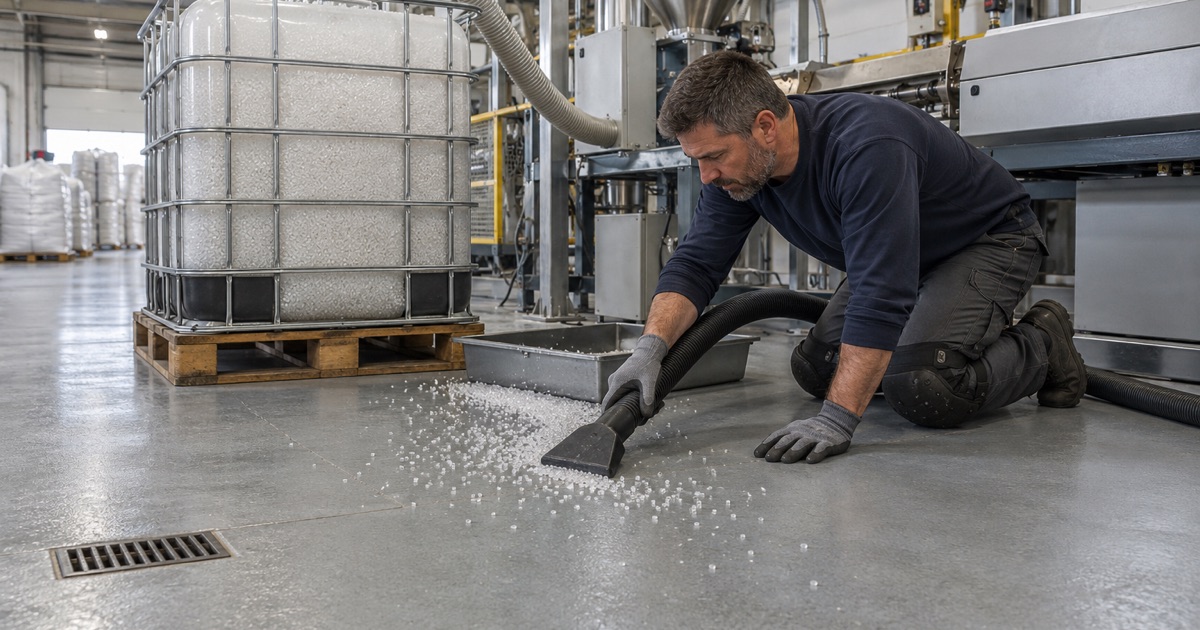
Wherever pellets are handled, some spill. Pellets are small, hard and round, so on smooth concrete they act like ball bearings under a boot heel or a pallet jack wheel. Flakes of regrind and slivers of trim add to the mix, and on a floor running around the clock there is rarely a quiet hour when nobody is walking through the area.
Why the Floor Becomes the Last Line
Pellets that are not picked up do not stay put. Foot traffic and forklift tires carry them along aisles, they settle into cracks and open joints, and they work their way into floor drains, where they can leave the building entirely. A floor that lets pellets hide turns a routine housekeeping job into a containment problem that no amount of sweeping fully solves.
Looking for epoxy-flooring closer to Cary? See Epoxy-Flooring Services in Cary.
What Operation Clean Sweep Asks of a Floor
The Program in Plain Terms
Operation Clean Sweep is a product-stewardship program of the American Chemistry Council Plastics Division and the Plastics Industry Association, aimed at preventing the loss of resin pellets, flakes and powder. Its Resin Management Practices are direct: “Clean up any spills immediately.” The practices call for brooms, dustpans, rakes, shop vacuums and catch trays at every location where spills might occur.
We are not saying any particular Bridgeview plant takes part in the program. We cite it because its practices are a clear, published description of how resin ought to be managed on a working floor. Every one of those practices depends on a slab that cooperates with the crew holding the vacuum, rather than one that fights them in every crack and seam.
Catch Trays, Docks and Spill Points
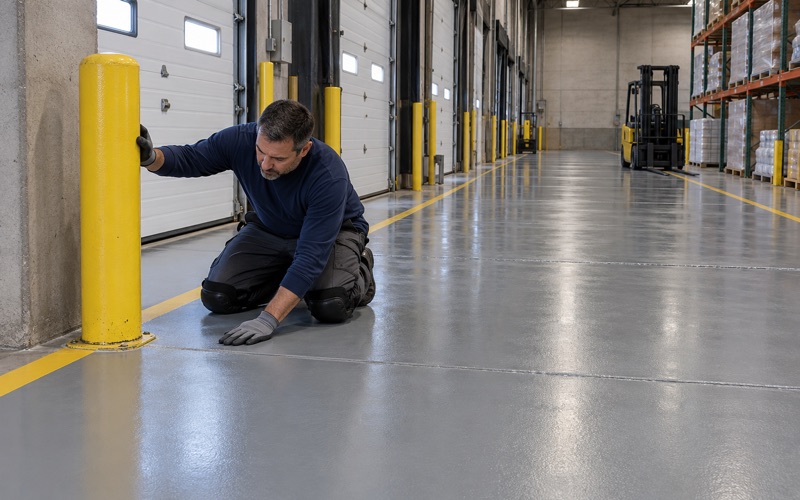
The practices also call for catch trays between dock and trailer at shipping and receiving bays, and for silos, tanks and containers to be kept in good condition “to help avoid holes, cracks or leaks.” Another line warns that wind and traffic can quickly disperse dusts and powders. For the floor, that points at the dock apron, the area around bulk unloading and the zone beneath hopper loaders.
Those are the spots where we look hardest at slab condition before coating anything. A dock edge that has spalled, or a joint that has opened beside a gaylord station, is exactly where a spilled pellet goes and stays. No crew, however diligent with the shop vacuum, can reliably pull material back out of a gap the floor itself has created.
Two Demands That Pull Against Each Other
Read together, the practices ask two things of a coated floor. It needs enough texture that a worker stays upright when pellets are underfoot. It also needs a surface smooth enough that a vacuum lifts every pellet in one pass instead of leaving them nested in the profile. Choosing a system for a resin plant is mostly a matter of resolving that tension zone by zone.
Texture That Grips a Boot but Still Vacuums Clean
Sizing the Broadcast
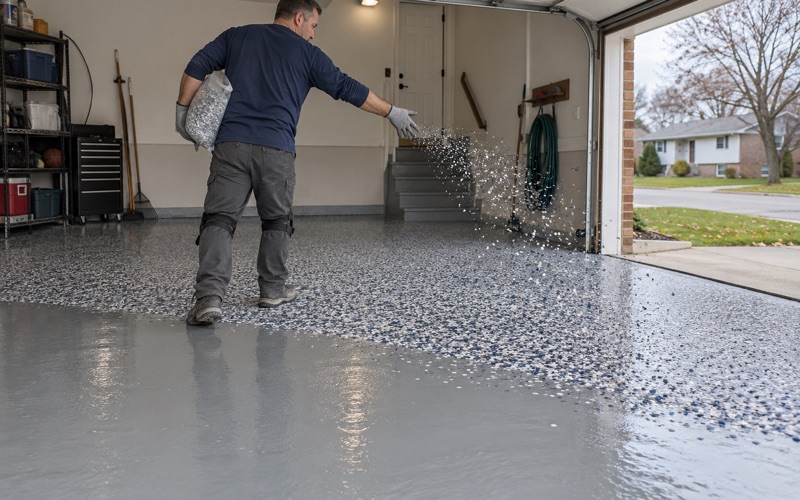
Slip resistance in a resin coating usually comes from broadcast aggregate, scattered into a wet coat and then locked in with a topcoat. The size of that aggregate and how heavily the topcoat covers it decide the finished feel. A coarse, lightly capped broadcast grips hard, but it leaves deep valleys where a pellet can sit below the reach of a vacuum nozzle.
For pellet-handling areas we generally lean toward a finer quartz aggregate broadcast with a full topcoat that rounds the peaks, so the surface reads as textured underfoot without forming pockets. We can lay sample boards with two or three profiles, letting the plant’s own safety and housekeeping leads step on them and run a shop vacuum over spilled pellets before anyone commits to a finish.
Matching Texture to Zone
One texture rarely suits a whole building. Aisles beside extruders and around hopper loaders, where pellets are most likely to be underfoot, can carry more grip. Staging areas and finished-goods storage may run smoother for easier cleaning and pallet jack travel. We draw those zones on a plan with the customer so each transition lands at a logical line rather than in the middle of an aisle.
Systems That Hold Up to Constant Cleaning
A floor cleaned every shift takes steady abrasion from brooms, scrubbers and vacuum heads, on top of forklift, pallet jack and dock plate wheel loads. A 100% solids epoxy base under a polyaspartic or polyurea topcoat is a common pairing, and urethane cement suits areas near heat or frequent washdown. Products are chosen inside the Illinois VOC limits for floor and industrial coatings, which bind whoever applies them.
Each zone gets its own line in the written proposal, naming the system, the coat count and the finished thickness. That gives a maintenance manager something concrete to inspect against when the floor is handed back, and a record to return to years later when a section needs a recoat or repair after heavy wear.
Closing the Hiding Places Without Stopping the Line
Cracks and Joints
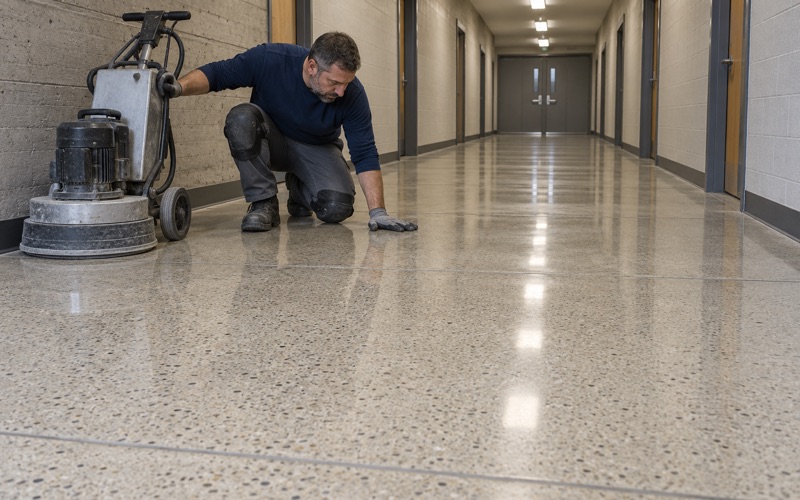
Before coating, we grind the slab to an ICRI concrete surface profile suited to the chosen system and walk the floor to map every crack, spall and open control joint. Cracks are routed and filled, and joints are filled with a material matched to their movement so the coating can either carry across or stop at a clean edge. The goal is a floor with no gap wide enough to swallow a pellet.
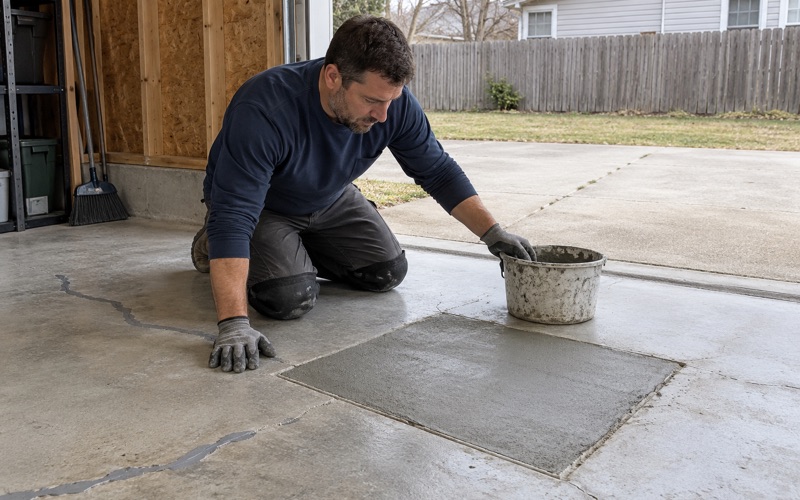
Spalled edges at doorways and dock thresholds are rebuilt rather than coated over. Where old coating is failing or the slab itself needs repair, we report that first. A coating laid over a broken substrate will crack along the same line, and the hiding place reopens within months of the floor going back into service.
Drain Edges
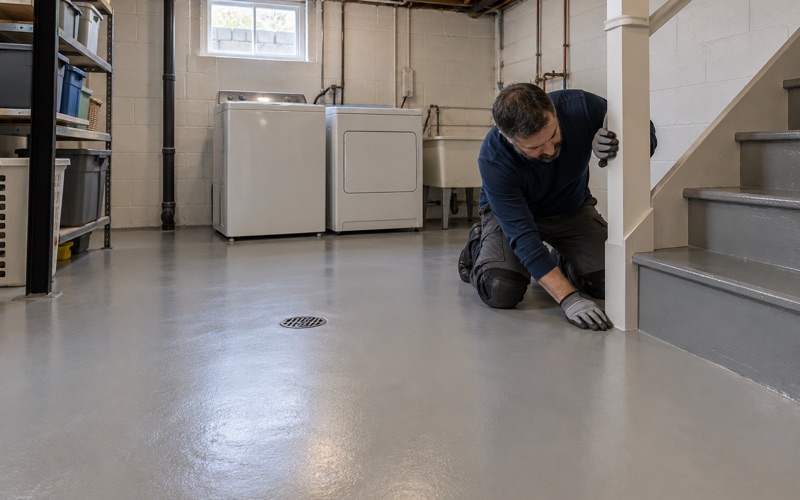
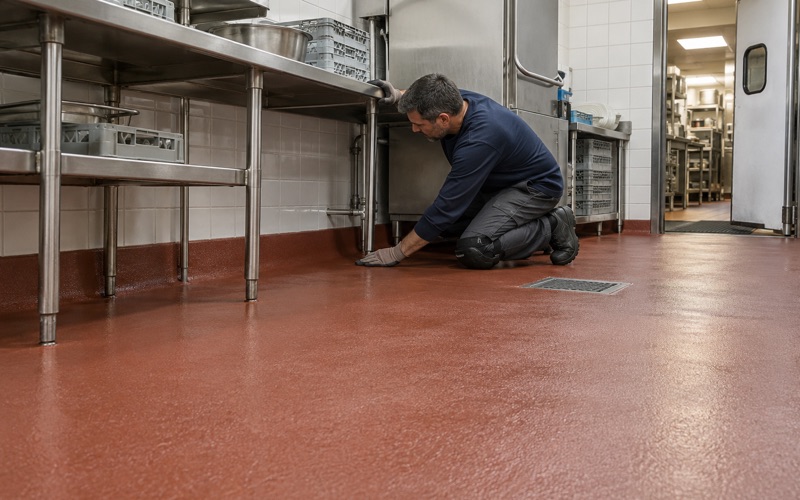
Floor drains are where a pellet that escapes housekeeping leaves the building. The coating should terminate tightly against the drain body, with no lip or ragged edge for pellets to collect behind and no gap that lets them slip under the frame. Where a drain sits in a low spot that gathers spills, we look at how the slope delivers material and talk through whether the plant wants a screen or catch tray there.
Working Around Lines That Run All Day, Every Day
A thermoforming line that runs every hour of every day cannot clear the building for a floor. We phase the work in sections around shifts, changeovers and planned maintenance, using overnight and weekend windows where the plant cannot stop. Grinding dust is vacuumed at the machine, so concrete dust does not drift toward running equipment or get rinsed toward a drain.
Cure times are set by slab temperature and the dew point spread at the surface, not by the calendar, and a fast-return polyaspartic topcoat can shorten the time a section stays out of service. Moisture testing, whether ASTM F1869 calcium chloride or ASTM F2170 in-situ relative humidity probes, is written into the scope. Moisture is also the first exclusion we name when explaining what the coating warranty does not cover.
Illinois has no state flooring license, so we check the village’s own contractor registration, bond and insurance rules before a job is booked. We also ask the Village of Bridgeview Building Department at 7500 S. Oketo Avenue whether the coating needs a permit, rather than assuming either answer, so the paperwork is settled before the first section of floor is taken out of production.
- 20+ Years of Floor Work
- Moisture Test in Every Scope
- Written Proposal, Named Products