Des Plaines Epoxy Flooring has spent more than 20 years on resin floors, and our epoxy flooring in Brookfield work starts from one question about any food or processing room: what liquid lands on this slab every day? On most floors the answer is water and a little grease. Where sugar, syrup or sweetener blends are handled in bulk, the answer changes the whole system we specify.
A coating on a production floor is not decoration. It is the layer that keeps the product away from the concrete, and it only works if it runs unbroken from the wall to the drain. A single open seam or a chipped edge gives liquid a path under the film, and from there the damage spreads where nobody sees it until the floor starts to break up.
Before we price a food floor, we grind a test area, take moisture readings and map every crack and joint on the slab. The written proposal then names the resin line, the coat count and the finished thickness, so a plant manager can check the installed floor against the quote rather than taking our word for it.
A Sugar Plant on Southview Avenue
Sweetener Supply in the Village
Brookfield has a working sugar operation inside its own limits. Sweetener Supply Corporation acquired the bulk sugar transfer and manufacturing facility at 9501 Southview Avenue in 1999, and the company lists Brookfield as its corporate office. The village’s 2023 financial report places it among the village’s ten largest employers, with 45 people. Its products include invert sugars, liquid sugars, brown sugar, molasses, honey and corn sweeteners.
We have not been inside that plant, and we make no claim about which rooms handle liquid product or what is on the floors there. What the address does tell us is that sugar in liquid form is part of daily industrial work in this village, and that work shares a floor problem with every bakery, beverage room or commissary that handles syrup on a smaller scale.
Why Syrup Is Hard on Concrete
A sack of dry sugar spilled and swept up in the same shift is a cleaning job. Sugar in solution is a different matter. A manufacturer’s food-floor guide puts it plainly: oil, sugars and syrups, along with food acids such as lactic, citric and acetic acid, can eat away at inferior surfaces such as concrete, tile grout and the joins in vinyl floors.
Bare concrete is porous, so a syrup spill does not stay on top of it. Liquid sugar, invert syrup and molasses soak into the surface, get spread by every wash-down and erode the slab long after the floor looks clean. Over months that shows up as a rough, sandy finish, exposed aggregate and low spots that hold liquid, which is exactly the kind of floor that is hardest to keep sanitary.
A Floor First Invented for a Confectioner
Resin flooring makers have been solving this problem for decades. In 1982 the British inventor Peter Gibbins was asked by a large, well-known confectioner to develop a floor that would not erode under significant quantities of sugar, and that work led to the founding of Flowcrete. The lesson still holds today: on a sugar floor the resin is not there for looks, because it is the barrier between the product and the slab.
Looking for epoxy-flooring closer to La Grange? See La Grange Epoxy-Flooring.
Where Sugar Gets In: Seams, Edges and Drain Lips
Erosion on a coated floor rarely starts in the middle of a sound field. It starts at a break in the film, where syrup reaches bare concrete and then travels under the coating from the side. Those breaks sit in predictable places, and we walk every one of them before writing a scope, because the details there decide how long the floor lasts.
Saw Cuts, Joints and Seams
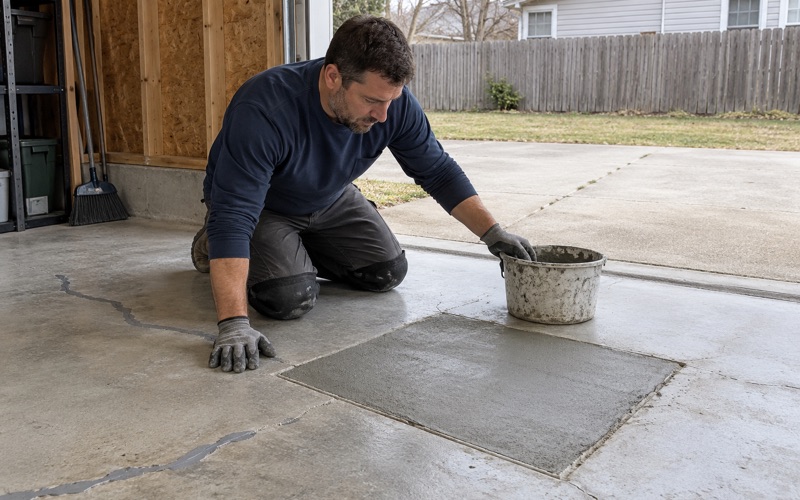
Control joints and construction seams are the first weak point. A joint left open, or filled with a soft caulk that the coating simply bridges, turns into a channel that collects syrup and wash water. We clean joints out to sound concrete, fill them with a semi-rigid filler suited to the traffic, and carry the resin across so the seam is sealed rather than merely covered.
Moving joints are handled differently. Where the slab genuinely needs to move, we honor the joint through the coating and close it with a flexible, chemical-resistant sealant that can be cut out and replaced as routine maintenance. Pretending a working joint is not there only moves the crack a few inches over, into the field where it is harder and costlier to repair.
Chipped Edges, Curbs and Thresholds
A coating that stops at a feathered edge is a coating that will peel. Wherever a floor system ends, at a doorway, a curb or a change to another material, we cut a key into the concrete so the resin terminates at full thickness. Pallet jack wheels and dropped totes then strike a locked edge instead of a thin lip they can pry loose.
Wall junctures matter for the same reason. The FDA Food Code addresses coved, sealed floor and wall junctures in food areas, and an integral resin cove carries the floor up the wall with no seam at the corner. That removes the crack where spilled syrup and wash water would otherwise sit, and it gives the sanitation crew a surface they can actually get clean.
Drain Lips and Trench Drains
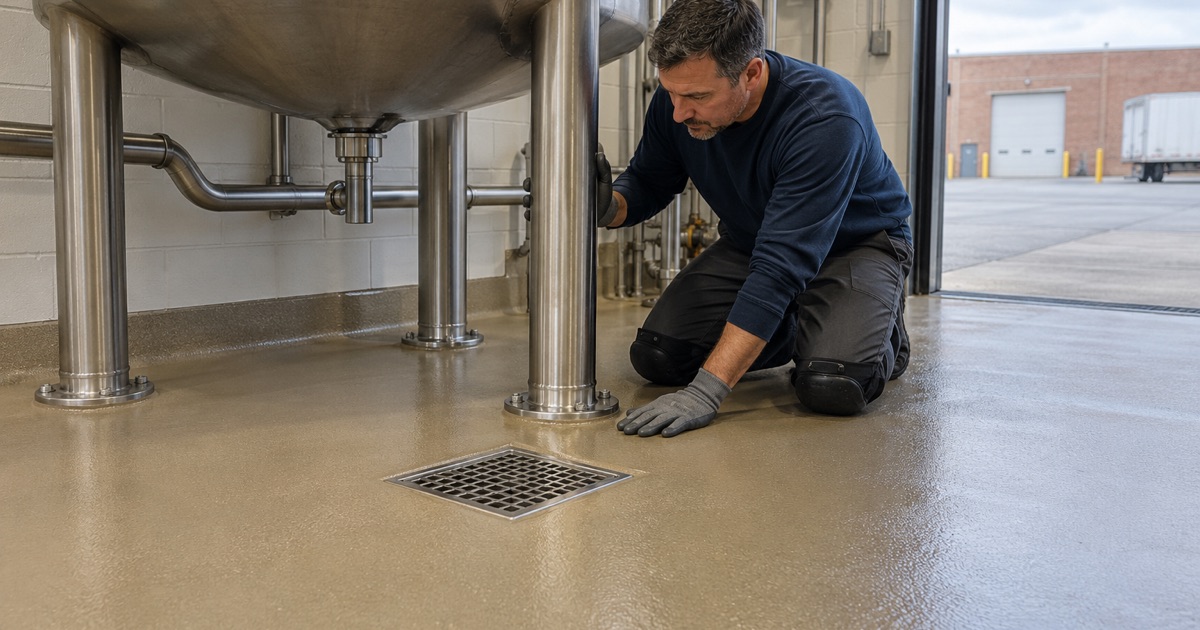
Drains collect everything the floor sheds, so they take the most concentrated sugar exposure on the slab. An uncoated ring of concrete around a floor drain, or a trench drain frame set without a sealed transition, is where we expect erosion to begin. We grind the drain body clean, slope the resin to it and lap the system onto the frame so water leaves the floor without touching bare concrete.
If a drain has to move or be replaced, that is plumbing work, and it comes before the coating. We would rather tell an owner that a drain needs resetting than install a new floor that pitches syrup toward a crumbling lip. We sequence that work with the plumber so the resin goes down once, over a drain that is already right.
Choosing a System Against Your Own Syrups and Cleaners
The right resin is decided by the product and the wash-down, not by a color chart. A floor that sees liquid sucrose at room temperature, hot water flushing and a chlorinated sanitizer needs a different specification from one that only takes forklift traffic and the occasional dropped pail, so we ask for both lists before we propose anything.
Matching Resin to the Product List
We ask for the actual materials that reach the floor: the syrups, sweeteners and blends, the cleaning chemicals, their concentrations and their temperatures. Every resin manufacturer publishes chemical resistance data, and we check the proposed system against that list rather than trusting a generic food-grade label. Where a chemical is missing from the chart, we ask the manufacturer before we commit to it.
Urethane Cement or 100% Solids Epoxy
For rooms with hot wash-down, steam cleaning or temperature swings from cookers and kettles, urethane cement is usually where we start. It tolerates thermal shock that can crack a rigid epoxy, and it is installed at a build that stands up to carts and pallet traffic. It also tends to tolerate damp concrete better than most coatings, which matters in a room that is washed every shift.
In dry storage, packaging areas and rooms that see syrup only as an occasional spill, a 100% solids epoxy built to the right thickness can be the more economical choice. A quartz aggregate broadcast through the body coat adds grip without leaving loose chips to trap product. Both options get the same joint, edge and drain detailing described above, because the resin is only as good as its weakest seam.
Slip, Cleaning and the Finished Texture
Syrup on a smooth floor is a slip hazard, but too aggressive a texture holds product and defeats sanitation. We set the aggregate size and topcoat build on a sample board with the room’s own cleaning routine in mind. The FDA Food Code allows antislip floor surfaces where safety calls for them, alongside its cleanability rules, and that balance is the target for every food floor we texture.
Preparing and Scheduling a Brookfield Food Floor
Grinding, Testing and Repair Mapping
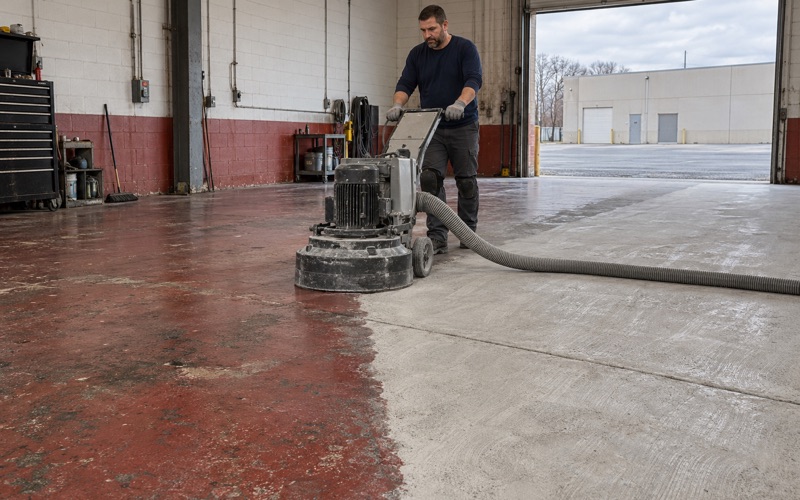
Every system starts on mechanically profiled concrete. We open the slab with a diamond grinder or shot blaster to the surface profile the product calls for on the ICRI CSP scale, and we never use acid etching as a substitute. On an older food floor where sugar has already roughened the surface, grinding also shows how deep the erosion runs and how much sound concrete is left.
From there we map the cracks, spalls, eroded patches and failing old coating, and we say plainly when a section needs repair or replacement before it should be coated. Moisture testing is written into the scope before the price is final, using ASTM F2170 relative humidity probes or ASTM F1869 calcium chloride tests, because a freshly washed floor can disguise a slab carrying more moisture than a resin will tolerate.
Warranty terms are explained before the job is sold, and moisture is the first exclusion we name. If testing shows vapor levels above what a coating can handle, we discuss a moisture-mitigation primer or a urethane cement system rather than hoping the readings were wrong. That conversation happens on paper, before anyone starts a grinder on the slab.
Working Around Production
Food and processing rooms rarely have a convenient week to shut down. We phase the work around shifts and dock schedules, often in overnight or weekend windows, and plan the sequence so each zone is ground, coated and cured before traffic returns. Cure times are set by slab temperature and the dew point spread at the surface, not by the calendar.
Odor and dust are handled as part of the plan rather than as an afterthought. Grinding dust is collected at the machine by vacuum, and the products we select fall within the Illinois VOC limits for floor and industrial coatings, which apply to whoever applies them. That keeps neighboring rooms and packaged product protected while one section of the building is out of service.
Licensing and Village Sign-Off
Illinois has no state flooring license, so we check each town’s own rules before booking a job. In Brookfield every contractor needs a Village of Brookfield Contractor License, typically $150, backed by a $10,000 License and Permit Bond. We confirm the license, bond and insurance are in place, and we ask the village’s Building and Planning division whether a given scope needs a permit rather than assuming either answer.
Where a scope does need inspection, the village asks for at least 24 hours’ notice and advises allowing two to three days in late March, early April and summer. We build that lead time into the schedule so an inspection never eats into a coating window a plant has already cleared for us.
If your Brookfield floor handles syrup, sweeteners or any sugary product, send us the product and cleaning lists along with photos of the joints and drains. We will tell you what the slab needs, which system fits the room, and what the finished floor should measure when we hand it back.
- 20+ Years of Floor Work
- Moisture Test in Every Scope
- Written Proposal, Named Products