Des Plaines Epoxy Flooring brings more than 20 years of slab work to epoxy flooring in Burr Ridge, and some of the floors that matter most here are not garages at all. On a production floor where printed circuits are handled, the coating is part of the static-control program. It is judged in volts and ohms rather than by its shine.
A static-dissipative floor is a different product from a decorative one. It carries a controlled path to ground, it goes over a slab we have opened mechanically, and it is measured before anyone signs for it. Get any of those three wrong and the floor looks finished while quietly working against the people trying to keep charge off their parts.
Below we walk through where this work shows up in the village, the numbers the floor has to read, how the ground system goes in under the coating, and what happens at handover and in the years after. Our written proposal names the product line, the coat count and the finished thickness, so a plant can hold the floor against the quote.
Printed Electronics on Shore Drive and the Static Problem
What gets made at 311 Shore Drive
Burr Ridge sits at the I-294 and I-55 intersection, and its industrial park along Shore Drive and Madison Street lies on the DuPage side of the village, in Downers Grove Township. Nissha GSI Technologies at 311 Shore Drive is a contract manufacturer of printed electronics. Nissha USA acquired GSI’s printed electronics business in October 2017, and a chamber listing still places the company at that address.
The work there is screen printing with conductive material. GSI prints diagnostic and therapeutic electrodes, wearables, medical patches and sensors, heating elements, and RFID and other antennas, on roll-to-roll and automatic sheet-fed screen printing lines. We have not worked inside that building and say nothing here about its floors. It simply shows the kind of production the park holds.
Why a walking person is the hazard
A person crossing a floor builds charge with every step, from the contact and separation between shoe and surface. On an insulating floor that charge has nowhere to go, so it rides on the body until it finds a path. That path may be a sensor, a printed conductor or a tool touching one, and the discharge is the event a static program exists to prevent.
Wrist straps cover a seated operator, but people walk between presses, inspection tables and packing. For anyone on their feet, the floor and the footwear together are the ground path. That makes the floor a working component of the program rather than a background surface, and it is why the floor gets measured instead of simply inspected for gloss and color.
The standard that sets the target
The program most electronics manufacturers follow is ANSI/ESD S20.20. It does not name a flooring product. It sets performance limits that the combination of floor, footwear and person has to meet, and the floor is chosen, installed and verified against those limits, which is a very different brief from a showroom or a two-car garage.
Looking for epoxy-flooring closer to Justice? See Epoxy-Flooring in Justice.
The Numbers the Floor Has to Hit
Body voltage under 100 volts
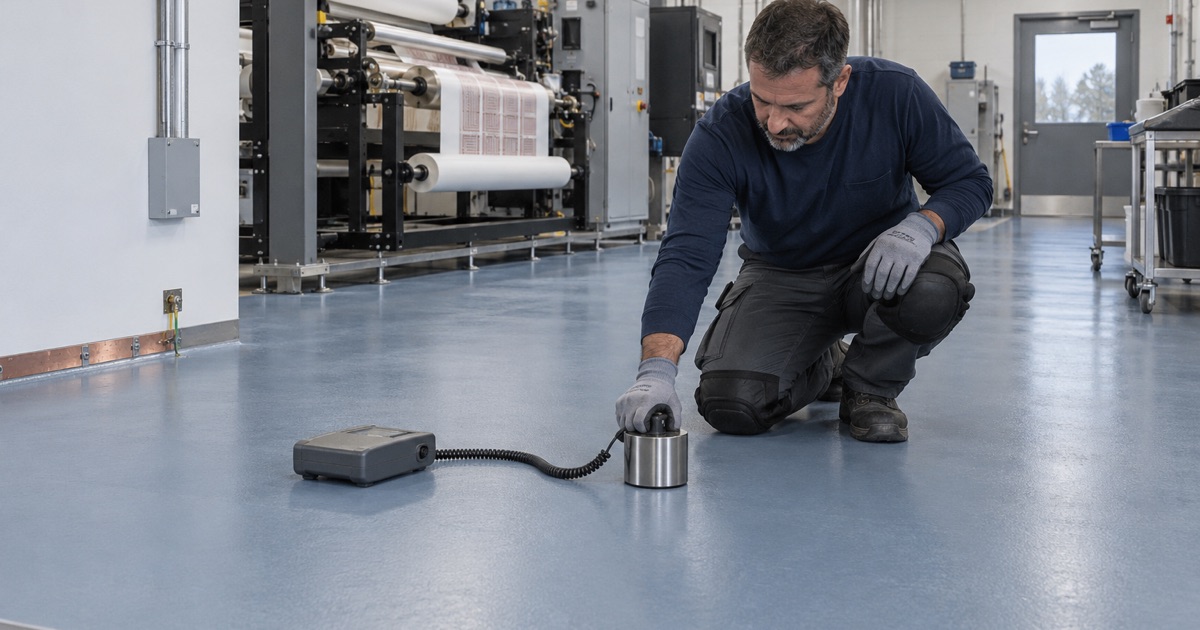
Under S20.20, a person wearing approved, grounded footwear cannot generate more than 100 volts while walking the floor. That is measured as body voltage under ANSI/ESD STM97.2, with a person walking while a meter records the peaks. A floor that only passes with a borrowed pair of test shoes is not a passing floor, so it has to pass with the footwear the staff actually wear.
System resistance under 35 million ohms
The second number is resistance. Measured under STM97.1, an acceptable floor-and-footwear system reads below 35 million ohms, written as 3.5 x 10^7. The reading runs from an electrode in the person’s hand, through the body and the shoe, through the floor and out to ground, so a sound coating paired with the wrong shoes still fails.
That is why we ask about the footwear program before we pick a product. A heel grounder and a full ESD shoe behave differently on the same floor, and the coating has to suit the combination the plant uses. We would rather settle that in the scope than discover it during the first walking test, when the floor is already down and cured.
Thickness belongs in the same conversation. A dissipative system reaches its rated resistance at the thickness its maker specifies, and a floor rolled thin to save material can drift out of range. Because our proposal states the finished thickness alongside the product line and the number of coats, the plant has something concrete to check if a reading comes in high.
The alternate route through the walking test
The ESD Association forum also describes a second path. When the 100-volt walking test passes, a system resistance under 1.0 x 10^9 ohms can be accepted. That gives a plant some latitude in product choice, but the walking test still governs, and we treat it as the number the floor is finally judged on.
Conductive rubber and conductive epoxy floors perform best in elevated-temperature outgassing tests, which matters in rooms where vapor coming off a floor could settle on printed parts. Where outgassing is a concern for a particular line, we bring that test data into the product decision rather than choosing on resistance alone.
Dissipative Epoxy, Ground Points and Copper Tape
Dissipative or conductive
Static-dissipative and conductive epoxies differ in how freely charge moves through them. A conductive floor sits at the lower-resistance end and drains charge fastest; a dissipative floor sits higher and drains it in a more controlled way. Which one fits depends on the parts being handled, the footwear and the numbers the program has to reach, and the chosen resistance range goes into writing.
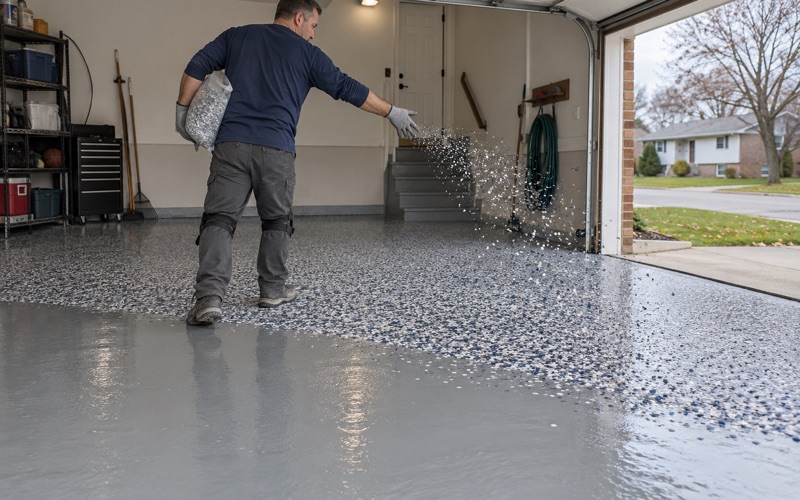
Decorative vinyl flake broadcast and most standard topcoats are left out of an ESD system, because they add insulating material right at the surface. If a plant wants zone colors or floor markings, they have to be laid in a compatible dissipative product. Otherwise they become islands on the floor that fail the meter even when everything around them reads well.
Opening and testing the slab first
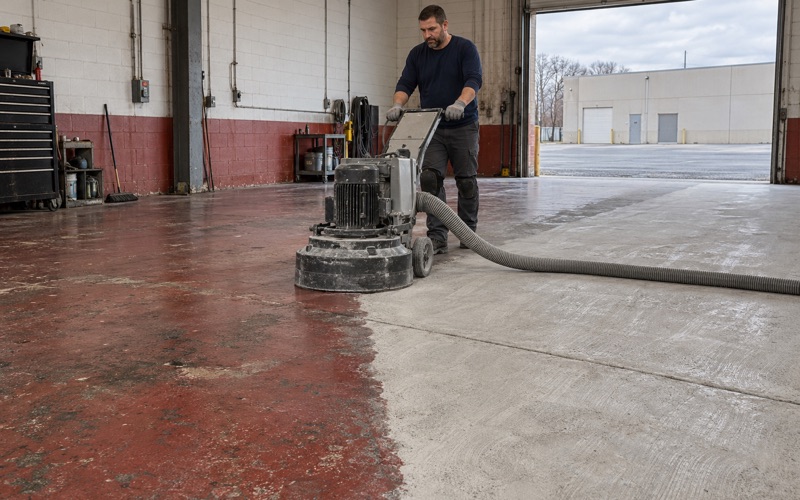
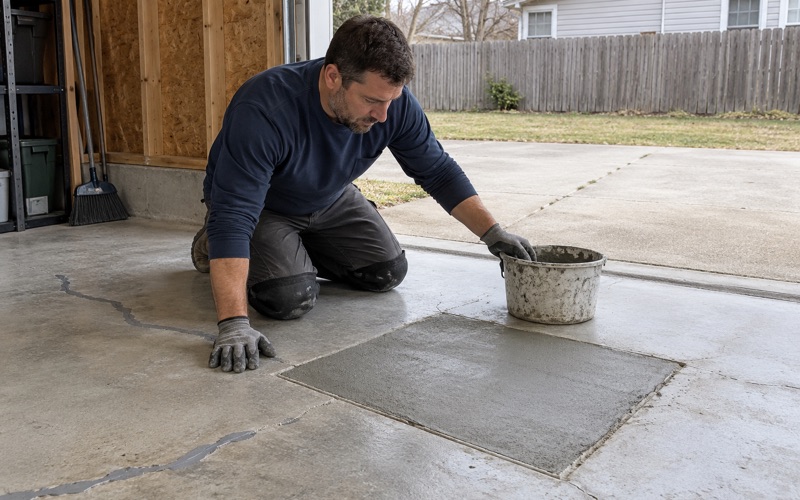
None of this works on a slab that will not hold the coating. We open every floor with a diamond grinder or a shot blaster to the concrete surface profile the primer calls for, and we never lean on an acid etch for that job. Cracks, spalls and old coating are mapped first, and if the slab needs repair before it can carry an ESD system, we say so.
Moisture is tested and written into the scope before the price is final. Depending on the floor, that means ASTM F2170 in-situ relative humidity probes, ASTM F1869 calcium chloride testing or both. Moisture under a coating can lift it, and a lifted ESD floor is also a broken ground path, which is why moisture is the first warranty exclusion we explain.
Copper tape and the ground points
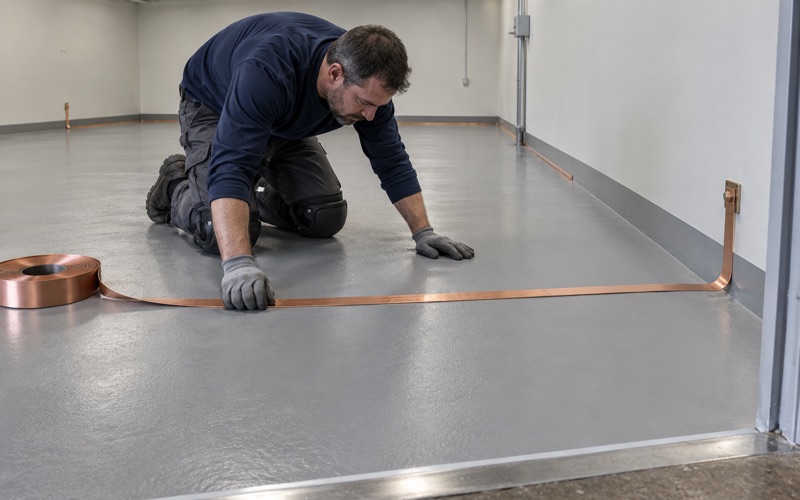
A dissipative coating only drains charge if it has somewhere to send it. On a typical system, strips of copper tape are laid on the prepared slab and run to dedicated ground points, then covered by a conductive primer that spreads the path across the floor. The dissipative epoxy goes over that primer, so every square foot connects back to ground.
Ground point locations are agreed with the plant before work starts, because they tie into the building’s grounding and have to sit where someone can reach and check them. We record where each one lands. If a ground point is later cut off by new equipment or a partition wall, the floor around it quietly drops out of the static program.
Production floors rarely stop for a coating crew. We phase this kind of work around shifts, and where a line cannot go down, we use overnight and weekend windows. One area is coated, cured and tested while the rest of the floor keeps running, then the crew moves to the next.
Testing at Handover, and Where a Regular Coating Goes Wrong
Acceptance testing before sign-off
An ESD floor is not finished when the last coat cures; it is finished when it measures. At handover we take resistance readings across the floor and to the ground points, and the plant’s own walking test with its own footwear confirms the system result. The readings go into the closeout paperwork so the next audit has a baseline to compare against.
Cure affects those readings. We set cure times by slab temperature and the dew point spread at the surface, not by the calendar, and a floor tested before it has fully cured can read differently than it will a week later. Testing on a schedule instead of on cure is an easy way to fail a floor that would have passed.
Retesting after cleaning or wax
The surface the meter reads is the surface the staff walk on. Many floor finishes and waxes are insulators, and a coat of the wrong one over a dissipative epoxy can push resistance out of range while the epoxy underneath is fine. Some cleaners leave a residue that does the same thing more slowly, a little with each mopping.
So the floor gets retested after any change in cleaning products, after the first time a finish is applied, and periodically as part of the program. We hand over cleaning guidance with the test readings. In practice, whoever chooses the mop chemical is maintaining the ESD floor, and they should know it.
Why a high-gloss coating is the wrong floor here
A standard garage or warehouse epoxy, or a high-gloss polyaspartic topcoat, is built to resist chemicals, tires and abrasion. Electrically it is an insulator. Put one down in an ESD area and it does the opposite of what the room needs, holding charge on the people walking it no matter how clean and bright it looks.
The same caution runs the other way when a space changes hands. A former electronics room may carry a dissipative floor the next tenant does not need, or a warehouse coating may sit where an ESD floor now belongs, so we test what is there before quoting over it. Building permits in the village go through Burr Ridge Community Development, and we ask there whether a coating needs one rather than assuming either answer.
- 20+ Years of Floor Work
- Moisture Test in Every Scope
- Written Proposal, Named Products