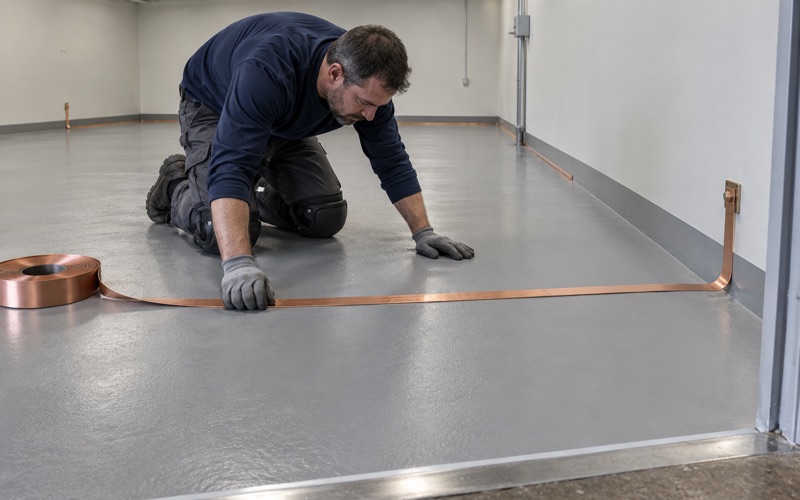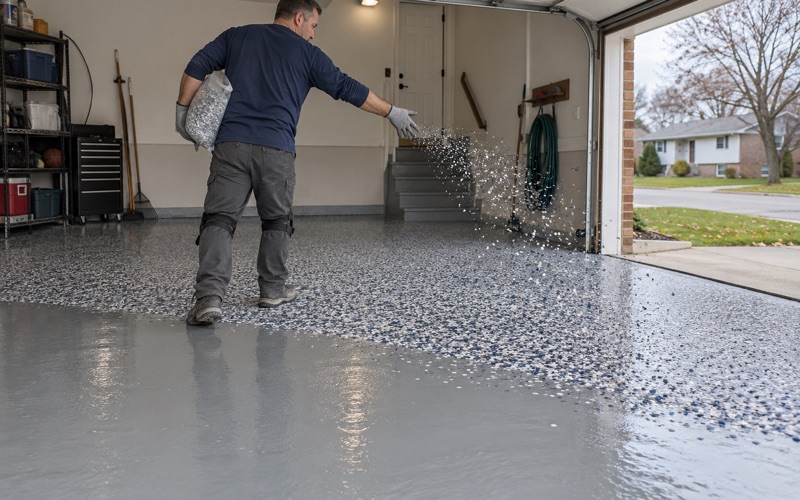
Des Plaines Epoxy Flooring has spent more than 20 years on commercial and residential slabs, and our work on epoxy flooring in Cary often starts with a question about what the floor actually carries each day. A recreation space, a shop and a garage put different loads on concrete, and the coating has to match the traffic rather than the brochure. We start from that traffic and work backward to a system.
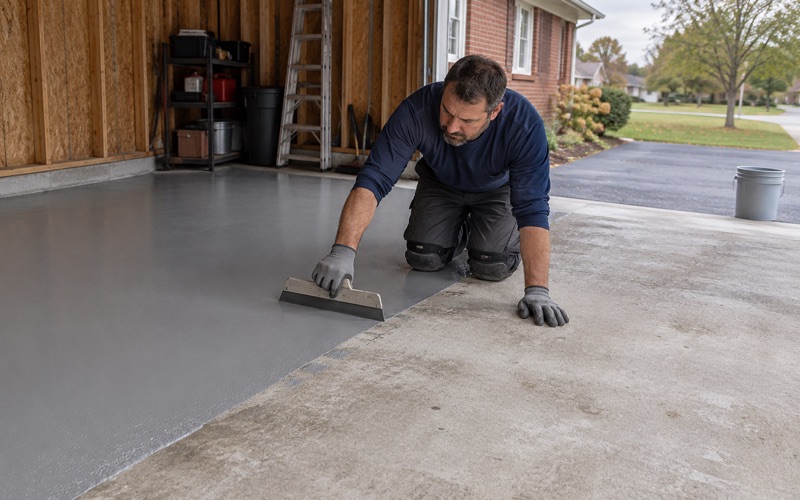
Every slab we take on is opened mechanically, with a diamond grinder or a shot blaster, because an acid etch leaves too little for a coating to grip. Before a price is final, a moisture test is written into the scope. The proposal then names the product line, the coat count and the finished thickness, so whoever manages the building can hold the floor up against the paper.
This page looks at one kind of space in particular: the concrete that surrounds a gymnastics floor. Where mats and pits take most of the room, the coatable area shrinks to the parts the public walks on, and those parts collect a fine white dust that changes how the preparation has to go. The sections below cover what that means for the work.
A Gymnastics Gym on Industrial Drive, and What Is Left to Coat
Classes in an industrial unit
Cary Gymnastics sits at 600 Industrial Drive, Unit 1, inside the Village of Cary in Algonquin Township, McHenry County. The Cary Park District lists classes there, including a Tot Trot program built around an obstacle course, an air-track, a foam pit and other gymnastics apparatus. The gym reopened after a major renovation with a ribbon-cutting on December 13, 2015.
We have not worked on that building, and we have not seen its floors, so nothing here describes its current surfaces. What the listing does show is a familiar arrangement: a recreation use set inside an industrial unit. That pairing shapes a coating job in ways a garage or a warehouse floor does not, and it is worth thinking through before anyone schedules a grinder.
An industrial unit is usually built for storage or light manufacturing, and its slab can reflect that. It may carry saw-cut control joints, old forklift wear or residue from a previous tenant’s sealer. Those details decide the grind depth and the repair list long before color comes up, and we price them openly rather than discovering them halfway through the job.
Mats, foam pit and sprung floor
In a gym laid out like this, sprung floor, landing mats and a foam pit typically take up most of the slab. None of that is coated; the apparatus area is a separate system with its own construction. A coatings contractor who quotes the whole footprint without asking what sits under the mats has misread the job before arriving.
What remains is usually smaller than the building suggests. Lobbies, spectator or viewing areas, restrooms, the entry and any party room or office are the concrete a coating can serve. Those are also the rooms a parent sees first, which is why a tidy, cleanable floor there matters more than the square footage implies.
Mapping the slab before a number
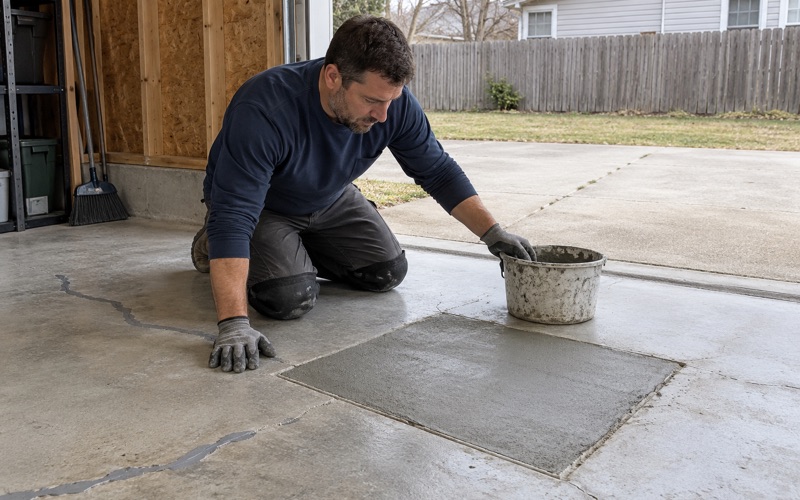
Before we write a price for spaces like these, we walk the exposed concrete and map cracks, spalls, old coating and patched areas. Industrial units often carry history from earlier tenants, and some of that history needs repair, or occasionally replacement, before a coating belongs on it. When a slab falls in that group, we say so plainly rather than coating over a problem.
Looking for epoxy-flooring closer to Prospect Heights? See Epoxy-Flooring in Prospect Heights.
Chalk Dust and Why It Has to Come Off First
What gymnastics chalk does to a bond
Gymnastics chalk is magnesium carbonate, and it does not stay on the hands that use it. It drifts off athletes, settles on bags and shoes, and travels into every room that touches the training area. On bare concrete it fills the surface pores, which is exactly where a primer needs to bite.
Chalk dust acts as a bond breaker. A coating rolled over a chalked slab adheres to the powder rather than to the concrete, and the powder has no strength of its own. The usual result is a film that looks fine for a while and then lifts in sheets where foot traffic flexes it, often starting near doorways.
Grinding down to clean concrete
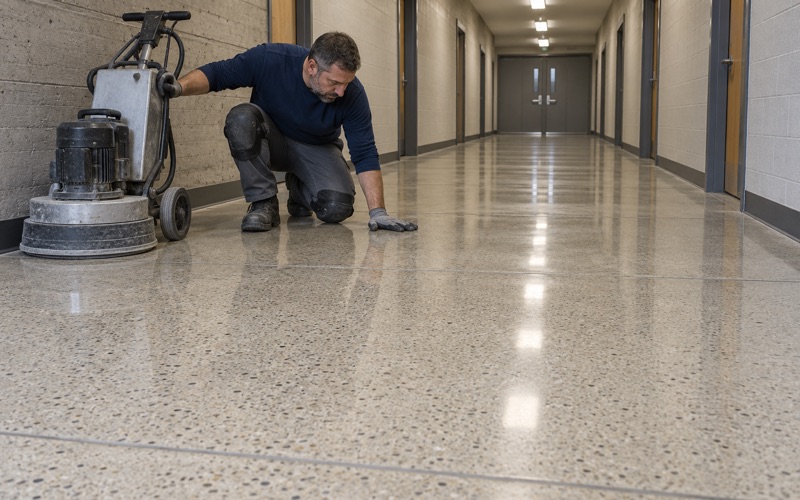
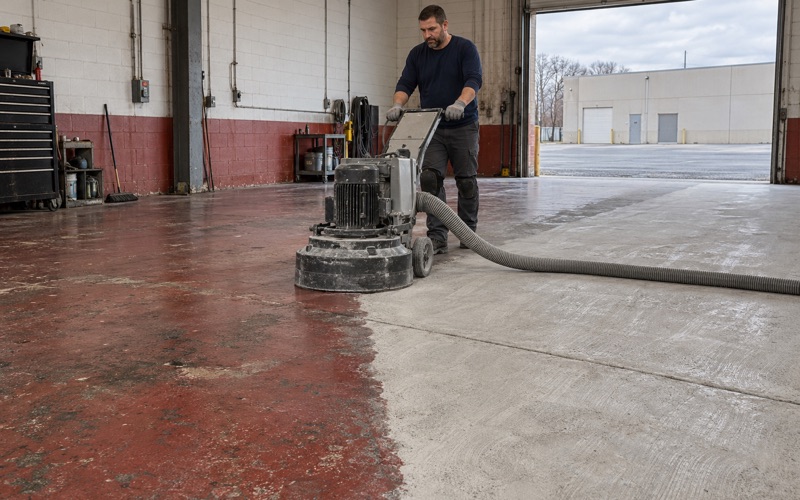
Sweeping and mopping move chalk around; they do not pull it out of the pores. Our preparation is a diamond grind or shot blast that takes the surface down to clean, sound concrete at a profile matched to the system, typically in the ICRI CSP range the manufacturer calls for. Grinding dust is captured by a vacuum at the machine, not swept or rinsed toward a floor drain.
After grinding, we check the floor before primer goes down. A wipe test with a dark cloth shows whether fine powder is still sitting on the profile, and any area that fails is reground or vacuumed again. Chalk tracked back in from the training floor during the job is a real risk, so we close off the prepared area until the first coat is on.
Moisture first, then products
A clean surface still has to be a dry one. Every scope we write includes a moisture test, such as ASTM F1869 calcium chloride or ASTM F2170 in-situ relative humidity probes, and that result is in hand before the price is final. A high reading can call for a moisture-mitigation primer, and moisture is the first exclusion we explain when we walk through a coating warranty.
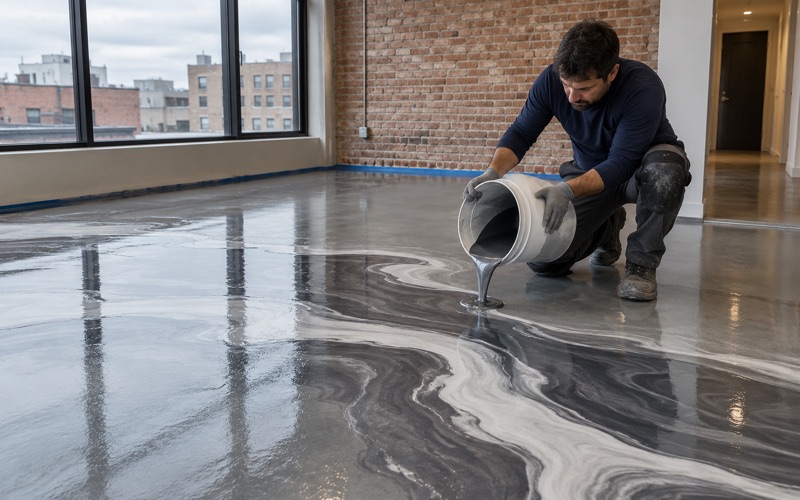
Product choice then follows the room. A 100% solids epoxy base with a polyaspartic topcoat suits most lobbies and viewing areas, and we select products inside the Illinois VOC limits for floor coatings, which apply to whoever does the applying. That matters in an occupied building where families will be back within days.
Viewing Areas, Restrooms and Stocking Feet
Where spectators stand and sit
Viewing areas carry chairs, strollers, bags and long waits. Chair feet scratch soft coatings, and spilled drinks sit until someone notices them. A hard topcoat with a fine texture holds up to that traffic and keeps cleaning to a damp mop, which is the realistic maintenance standard for a front-of-house floor that staff clean between other duties.
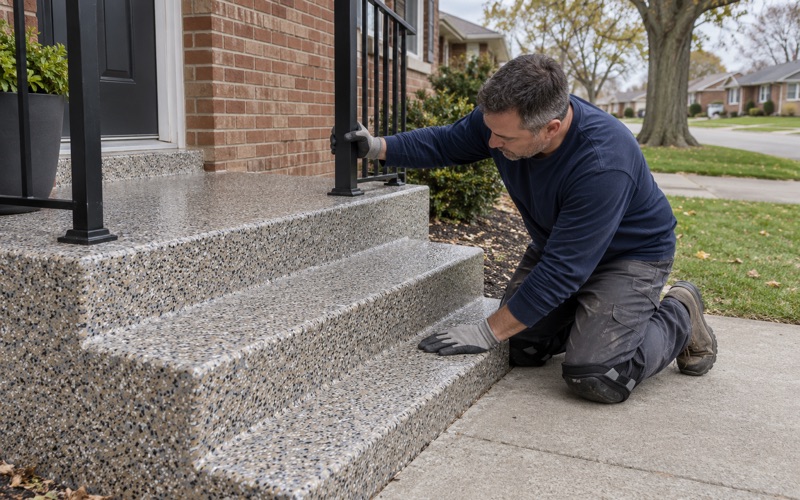
Color and finish in a viewing area also do practical work. A mid-gray or speckled vinyl flake broadcast hides the faint film of chalk that settles between cleanings, while a solid light color shows every footprint. The chips are locked under a clear topcoat so their edges do not catch dust or wear through at the busiest seats.
Stocking feet and slip texture
Gymnastics families move between the mats and the lobby in socks or bare feet more than visitors to most commercial spaces. A glossy floor with chalk on it can be slick under a sock. We tune texture with a light aggregate broadcast, often quartz, so the surface reads smooth underfoot but still grips, and we review a sample with the owner before the topcoat goes down.
The texture choice is a balance. Too coarse, and the floor traps chalk and is harder to clean; too fine, and it gives little grip once powder has settled. We usually show two or three sample boards so the people who run the space can feel the difference in person, in socks if they want, rather than choosing from a photo.
Restrooms and the entry
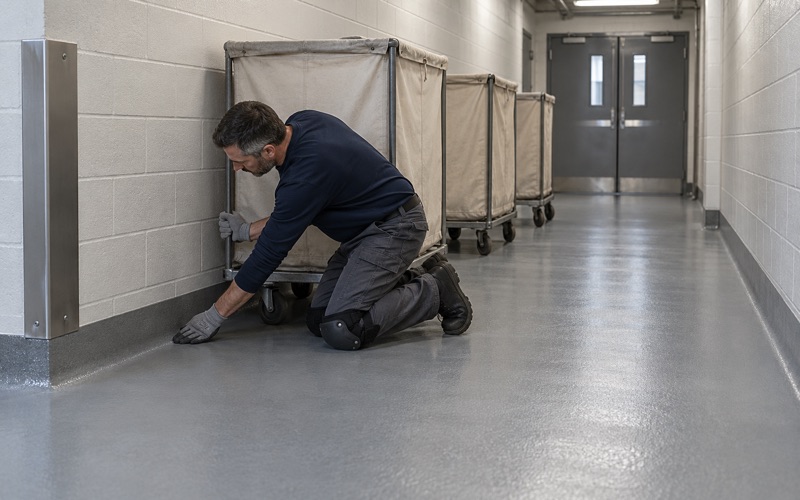
Restrooms take daily cleaning chemicals, wet mops and splash around fixtures. A seamless coating with the edges turned up at the walls keeps water from sitting at the joint, and the chemical resistance of the topcoat should be checked against the cleaners actually in use. Entries collect grit from the parking lot and need a surface that sheds it rather than holding it.
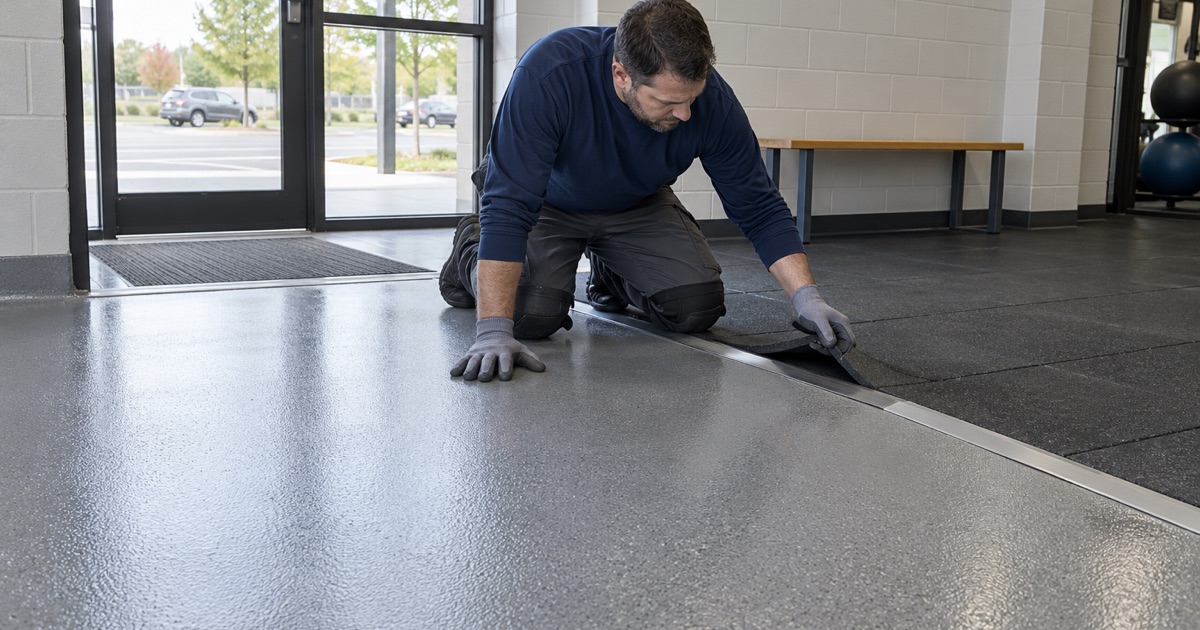
The entry is also where the coating meets other materials: a door threshold, a walk-off mat, sometimes tile or carpet in an adjoining office. Transitions get a clean termination, ground into the slab rather than feathered, so the edge does not chip under strollers and rolling equipment. That detail is small, and it is where many commercial floors fail first.
Fitting Floor Work Between Classes
Working around a class schedule
A space with park-district classes on its calendar cannot simply close for a week. We phase the work, coating the lobby on one pass and the restrooms or viewing area on another, and use overnight or weekend windows when a building cannot stop. Each phase is sealed off from the training floor so chalk does not drift onto fresh primer.
Cure times are set by slab temperature and the dew point spread at the surface, not by the calendar. A polyaspartic topcoat can allow foot traffic sooner than many epoxies, which helps when classes resume the next morning, but a cold, damp slab slows any chemistry and can raise amine blush on epoxy. When conditions are wrong, we move the date.
Who signs off in Cary
Industrial Drive sits inside the village, so building questions go to the Village of Cary, and fire protection comes from the Cary Fire Protection District, a separate district with two stations rather than a village department. We ask the village before the job whether a coating needs a permit, rather than assuming. Illinois has no state flooring license, so we also check the village’s contractor registration, bond and insurance requirements.
It also helps to separate the park district from the village. The Cary Park District serves about 21,450 people across Cary, Trout Valley, part of Oakwood Hills, Lake in the Hills and unincorporated McHenry County. A facility with a Cary address can sit outside the village line, and the district’s own Foxford Hills Golf Club, in unincorporated Algonquin Township, is one example.
Cary, Illinois, not the Cary in North Carolina
Searches for Cary recreation facilities often return projects from a larger town of the same name in North Carolina, and nothing on this page relates to it. Our work covers Cary, Illinois, a village incorporated in 1893 on the Fox River, about 6.60 square miles, with a 2020 population of 17,826.
For a gym, studio or similar recreation space here, the starting point is a site walk and a moisture reading. From there we write a proposal that names the system, the coats and the thickness, and we lay out a phasing plan that keeps classes running. That way the people on the mats barely notice the floor work happening around them.
- 20+ Years of Floor Work
- Moisture Test in Every Scope
- Written Proposal, Named Products