
Des Plaines Epoxy Flooring repairs concrete floors in Des Plaines, IL, serving surrounding cities including Prospect Heights, Schiller Park, Bensenville, Wood Dale and Norridge. Most of our repair work happens just before a coating or polish goes down, because more than 20 years of floor work have taught us that the coating is only as good as the slab it sits on.
Before we price a job, we map the cracks, spalls, pits and old coatings on the floor. That map tells us what can be repaired, what will need watching, and when a slab is too far gone to coat at all. We would rather tell you a floor needs repair or replacement up front than install a beautiful coating over damage that pulls it apart within a year.
Repairs are made with materials designed to be coated, ground flush with the surrounding slab, and listed in the written proposal so you know what was fixed and with what.
Crack Repair
Hairline and Shrinkage Cracks
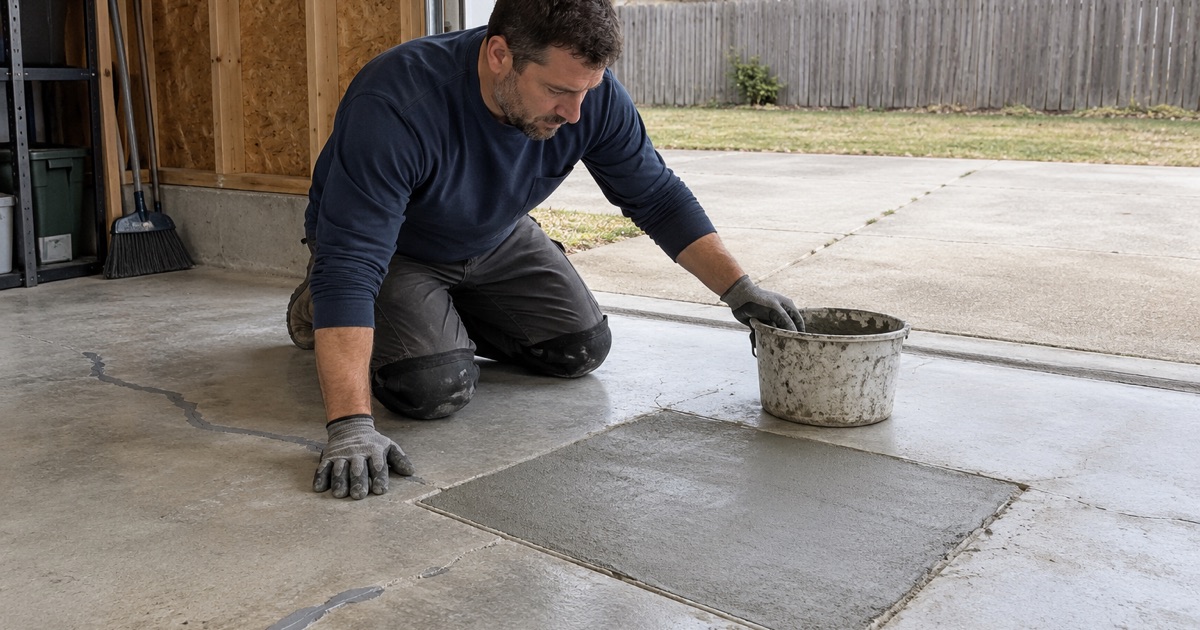
Nearly every slab has fine cracks from drying shrinkage. They are usually stable and cosmetic, and we open them slightly with a grinder or crack chaser, clean them out and fill them with a rigid epoxy or polyurea crack filler. Once ground flush, they disappear under most flake systems.
We still note them on the slab map. Even a quiet crack is information about how the slab has behaved, and it helps us choose where control lines or flexible fillers belong.
Structural and Moving Cracks
Cracks that are wider, still growing, or offset with one edge higher than the other indicate movement under the slab, such as settling soil or a washed-out base. Filling them cosmetically does not stop the movement, and a coating over them will crack again. We point these out, explain the likely causes and recommend whether the floor needs a structural repair or replacement before coating.
Control Joints and Saw Cuts
Control joints are meant to crack, so the slab cracks there rather than randomly. Under a coating, some owners want joints filled for a seamless look while others keep them open. We fill stable joints with a semi-rigid filler and leave joints that clearly move open or honored with a flexible sealant, explaining the trade-off of each.
Spalls, Pitting and Surface Damage
Spalled Joints and Broken Edges
Forklifts, pallet jacks and hard wheels chip the edges of joints, and car tires and snow shovels do the same in garages. Spalled edges are cut back to sound concrete and rebuilt with a repair mortar or epoxy mortar so wheels roll over a solid, flush edge rather than a widening hole.
In commercial aisles and dock areas, we use semi-rigid joint fillers that support wheel loads, because an unfilled joint keeps breaking down under traffic. Filled joints also stop debris from packing into the gap and jamming small wheels.
Salt Scaling on Garage Floors
In this climate, brine from rock salt and calcium chloride soaks into bare garage concrete, then freezes and thaws through the winter. The surface flakes away, exposing aggregate and leaving a rough, pitted floor. We grind off the scaled layer, rebuild the surface with a polymer-modified repair mortar, and then coat it so brine stays on top of the floor instead of in it.
Pits, Bug Holes and Old Fastener Holes
Small pits, air voids and holes left by old anchors, posts or equipment are filled with a fast-setting epoxy paste or patch and ground flat. On decorative floors such as metallic epoxy or polished concrete, we take extra care with these, since a small flaw shows clearly through a reflective finish.
Resurfacing and Leveling
Thin Resurfacers for Worn Slabs
When a slab is broadly worn, scaled or patched but still structurally sound, a polymer-modified resurfacer can restore a uniform surface before coating. It is applied over a ground, profiled slab and produces a clean base that takes coatings consistently.
Self-Leveling for Uneven Floors
Grinding takes down high spots but cannot fill low ones. Where a floor needs to be flat for a metallic coating, polished finish or new flooring, a self-leveling underlayment fills dips and ponding areas. We prime and profile the slab first, because a leveler bonded to a dusty or sealed surface will debond.
Sloped Floors and Drains
Garage and commercial floors are often sloped toward a door or drain on purpose. We repair around that slope rather than leveling it out, so water still leaves the floor the way it was designed to.
When a Floor Needs Replacement Instead
Signs a Slab Is Past Repair
Large hollow-sounding areas, widespread crumbling, heaved sections, and slabs that stay wet despite drainage work are poor candidates for a coating. We tell you when repairs would only delay a failure, even if it means we do not do the coating job.
Replacement and Cold-Weather Rules
When part of a slab must be replaced, new concrete has to cure before it can be coated, often for weeks. The City of Des Plaines also has a cold-weather policy for concrete flatwork that limits pours when temperatures are predicted below 40 degrees and requires protection while the concrete cures, so late-season replacements are scheduled with that in mind. We coordinate with the concrete contractor and time the coating for when the new slab is ready.
- 20+ Years of Floor Work
- Moisture Test in Every Scope
- Written Proposal, Named Products