Des Plaines Epoxy Flooring has spent more than 20 years on concrete, and epoxy-flooring in Deerfield brings us a kind of floor most homeowners never think about: the one an animal lives on. Kennel runs, exam rooms, grooming bays and daycare play floors take urine, disinfectant and a hose every day, and that routine decides which coating system belongs on the slab long before color does.
We approach these floors the way we approach any slab, only with less room for shortcuts. The concrete is opened mechanically, moisture is measured before a price is final, and cracks and old coating are mapped so an owner knows what has to be repaired first. The written proposal then names the product line, the coat count and the finished thickness, so the result can be checked.
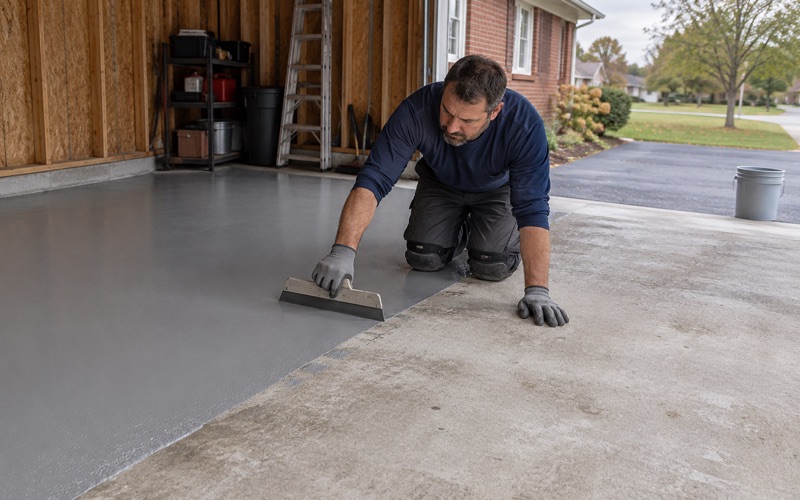
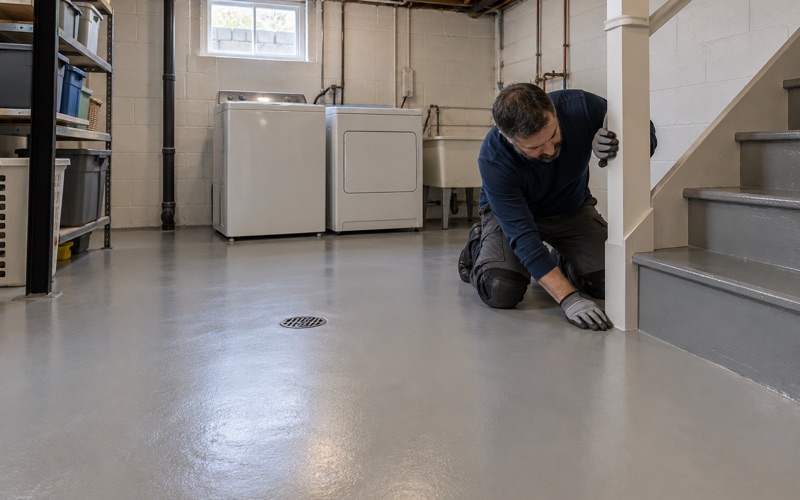
Garage floors and basements in the village still make up much of our residential work, and we coat them too. This page, though, is about animal-care space: veterinary clinics, boarding kennels and daycare floors, where a state rule sets the expectation and a closed wing costs an operator money every day it is down.
Two Animal-Care Buildings and the Rule Behind Their Floors
Deerfield already has two large animal-care buildings close to Lake-Cook Road, and they show the range of floors this work covers. Both addresses sit in the small Cook County part of the village, south of the county line. Neither business is a customer of ours, and we have not seen their floors; they are useful here as examples of the scale and use a coating has to serve.
Deerfield Animal Care Center on Waukegan Road
At 150 Waukegan Road, Deerfield Animal Care Center occupies a 22,900-square-foot building that its architect, RFA, describes with a full-service animal hospital, a grooming center, cat playrooms, dog daycare and training on the third floor, and three rooftop exercise yards. The design description also lists 178 boarding runs on the second floor. The hospital’s own website today lists surgery, preventive care, diagnostics and emergency care rather than boarding.
That mix is the point for a coatings contractor. A surgery suite, an exam room and a run each ask something different of a floor, and a building planned with runs upstairs puts wet, sloped floor work above occupied rooms. One building can need three or four floor systems, and the scope has to say plainly which one goes where.
The Dog Stop on Lake Cook Road
The Dog Stop opened at 495 Lake Cook Road on June 26, 2021, with more than 24,000 square feet of boarding, daycare, grooming and retail space, described as fully climate controlled. Its two outdoor play yards are surfaced with antimicrobial artificial turf, so the indoor floors carry the rest of the load: dogs running, accidents and cleaning crews through every shift.
A daycare floor is a different problem from a clinic floor. Large groups of dogs mean claws, constant traffic and frequent spot cleaning between full wash-downs, which favors a textured, broadcast surface over a smooth gloss that turns slick when wet. Grooming bays add water, shampoo and dryers running for hours, and the coating has to take all of it without a seam for liquid to find.
What 8 Ill. Adm. Code 25.20 Says
Illinois Animal Welfare Act rules, at 8 Ill. Adm. Code 25.20, require floors of buildings housing animals to be of permanent construction to enable thorough cleaning and sanitizing. Dirt and unfinished wood are not allowed, cages must be impervious to urine and water, and runs in new or remodeled space must be surfaced with concrete or other impervious material. Cleaning happens daily or more often.
The rule names no coating product, and it does not require epoxy. Sealed concrete can be one answer to it. What a resinous system adds is a surface without open pores, which matters when the same floor is soaked with urine and disinfectant every day for years. Whether a given facility meets its own obligations is a question for the operator and the state, not for us.
Looking for epoxy-flooring closer to Winnetka? See Epoxy-Flooring Services in Winnetka.
Urine, Disinfectant and a Hose Every Day
Why Urine Is the Real Test
Urine is the condition we design an animal floor around. It is acidic when fresh, it breaks down into ammonia, and on porous concrete it soaks in, leaving odor no mop reaches. A coating that is only a thin film over an etched slab tends to lift at the edges of a run, and once liquid gets underneath, the odor and the peeling both get worse.
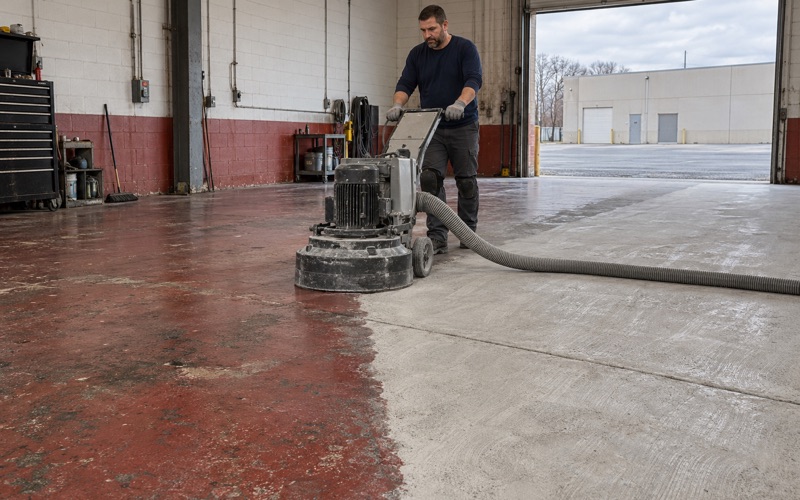
That is why we open every slab with a diamond grinder or shot blaster to an ICRI concrete surface profile matched to the system, never an acid etch. On a run floor we usually look at 100% solids epoxy or urethane cement, built thick enough to bridge minor surface flaws, with a chemical-resistant topcoat that stands up to the cleaning program actually in use.
Disinfectant Wash-Downs and Texture
Kennel staff often rotate disinfectants, and some of them are hard on coatings over time. Before we specify a topcoat we ask for the products and dilutions the facility actually uses, and we check them against the manufacturer’s chemical resistance data rather than assuming. A polyaspartic or urethane topcoat can be the right answer in one building and the wrong one in the next.
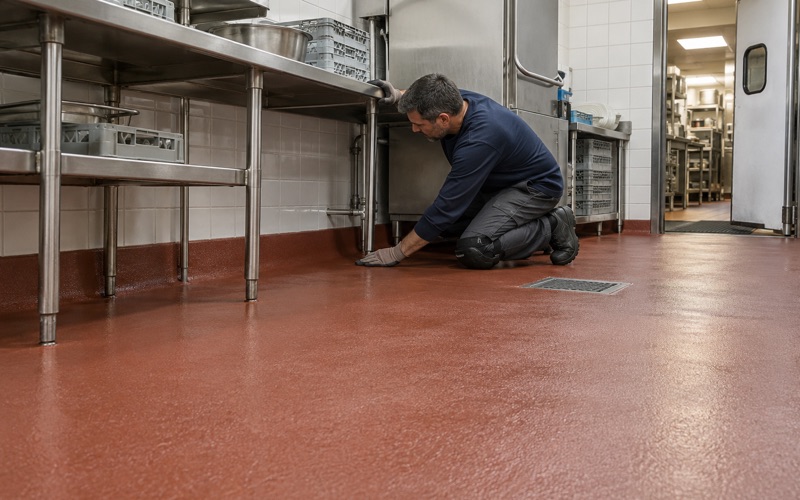
Texture is the other half of a wash-down floor. A quartz aggregate broadcast locked under the topcoat gives paws and staff boots grip when the floor is wet, and it can be tuned finer in an exam room than in a run. Too coarse a profile traps hair and debris and makes cleaning harder, so we sample it with the operator before committing.
Cure Set by the Slab, Not the Calendar
Cure time on these floors is set by slab temperature and the dew point at the surface, not by the calendar. A coating that goes down cold or damp can develop amine blush, a waxy film that weakens the next coat’s bond. In a climate-controlled building that is usually manageable, but a run near an exterior door or a loading area gets measured on its own.
Runs, Gutters and the Floor Drain
The same Illinois rule asks for adequate drainage, including gutters and discharge of fluid into a sewer, septic tank or filter field. In practice, that means a run floor is a sloped, wet surface that ends at a gutter or drain, and the coating has to carry water there without leaving puddles or open seams along the way.
Slope and Drain Detailing
We do not correct a floor’s slope with coating. If water ponds in a run today, the fix is a sloped underlayment or a urethane cement build, placed and checked before the topcoat, not a thicker layer of epoxy hoping to level it. At the drain we cut the coating to a clean edge and terminate it around the drain body so water cannot work under it.
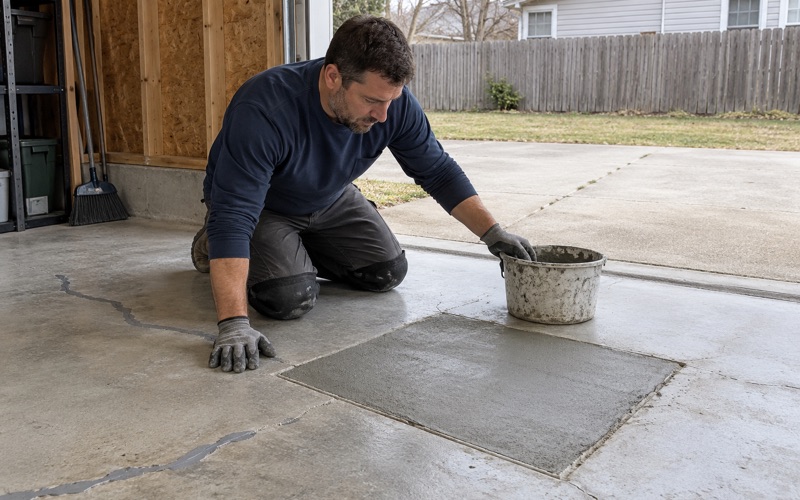
Cracks get the same attention. We map every crack, spall and patch of old coating on the slab before pricing, and a moving crack running into a gutter is noted as a repair item, not hidden under a fresh broadcast. Some floors need concrete repair or replacement before any coating is worth applying, and we say so in writing.
Coving Up the Run Walls
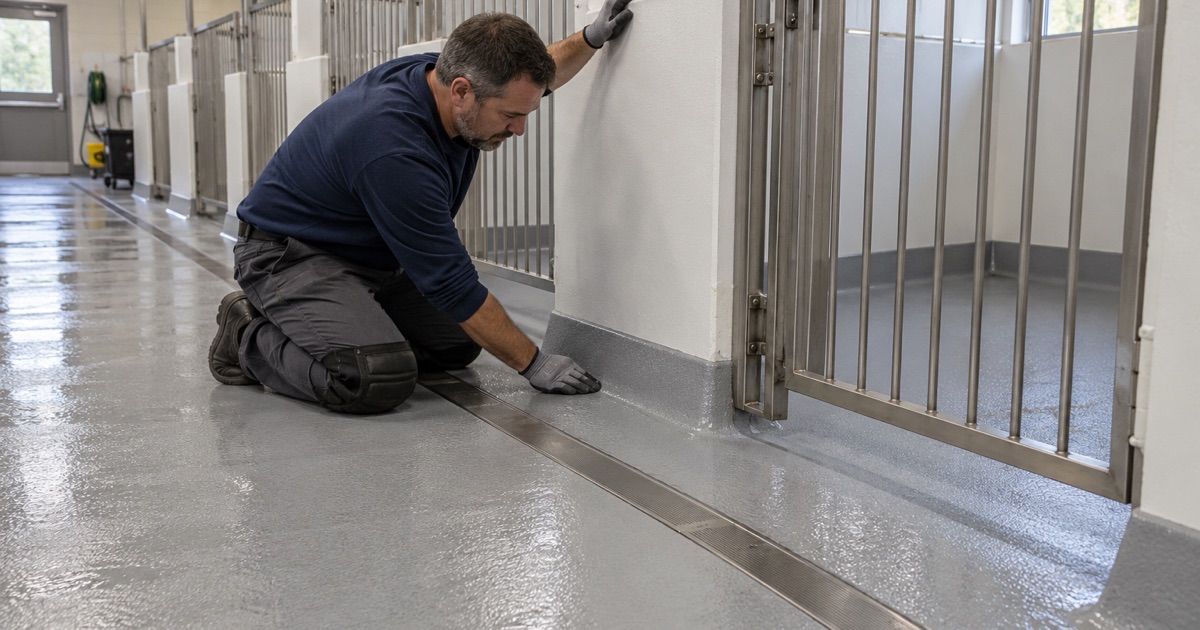
Liquid in a kennel does not stay on the floor. Dogs mark walls, and wash-down water hits the base of every partition. An integral cove base that carries the floor system several inches up the wall removes the joint where floor meets wall, which is where odor and bacteria tend to collect, and it lets the hose-down actually reach the corner.
Boarding Runs on an Upper Floor
Runs on a second floor, like the ones RFA describes for the building on Waukegan Road, raise the stakes on every detail. A leak at a drain or a crack there does not just stain a slab; it reaches the ceiling of the rooms below. On an elevated floor we ask about the existing membrane and drain assemblies first, and we keep our coating work clear of anything that belongs to a plumber.
A coating does not waterproof a structure, and we do not sell one as if it did. If an upper-floor run has a history of leaks, the drain bodies, flashing and any membrane are investigated before we price a topcoat over them. Our work is the wear surface, and we are plain with the owner about where it stops.
Coating a Kennel Without Closing It for Weeks
An animal-care business rarely has an empty building to hand us. Animals are boarded, patients arrive, and daycare runs every weekday. The practical question an operator asks first is how long a room or wing will be out of service, and our answer starts with phasing and with how fast each system can take traffic again.
Phasing Room by Room
We phase the work by wing or by bank of runs so the rest of the building keeps operating. Grinding dust is captured at the machine with a vacuum rather than rinsed toward a floor drain, and work areas are sealed off from occupied rooms. Where the schedule allows, we work overnight and on weekends, when animals can be consolidated in another part of the building.
Odor and fumes matter around animals. We select products inside the Illinois VOC limits for floor and industrial coatings, which bind the applicator as well as the manufacturer, and we discuss ventilation and reoccupancy with the operator before work begins. Fast-curing polyaspartic topcoats can shorten the turnaround on a run, but only when slab moisture and temperature allow it.
Moisture Testing and the Written Scope
Moisture testing is written into the scope before the price is final. Depending on the slab, that means a calcium chloride test under ASTM F1869, in-situ relative humidity probes under ASTM F2170, or both, compared with the thresholds the coating manufacturer publishes. A slab at grade with no vapor retarder can push enough moisture to blister a coating, and a moisture-mitigation primer is priced in only if the readings call for it.
The proposal then names the product line, the number of coats and the finished thickness for each room type, so an owner can check the floor against the quote. We also explain what the warranty excludes before the job is sold, and moisture is the first exclusion we name. The test readings travel with the proposal so the numbers behind the system are on paper.
Permits and Contractor Registration
Illinois has no state license for flooring or coatings contractors, so we check the Village of Deerfield’s own contractor registration, bond and insurance requirements before booking a job there. We also ask the village’s building staff whether a coating project in a commercial building needs a permit, rather than assuming either answer. Anything about the operator’s own animal-care licensing stays between the operator and the state.
- 20+ Years of Floor Work
- Moisture Test in Every Scope
- Written Proposal, Named Products