
Des Plaines Epoxy Flooring installs ESD flooring in Des Plaines, IL, serving surrounding cities including Prospect Heights, Schiller Park, Bensenville, Wood Dale and Norridge. Electrostatic discharge can damage electronic components, corrupt data and, in some settings, ignite vapors or dust. An ESD floor gives that charge a controlled path to ground, and with more than 20 years of floor coating work behind us, we know the result depends on preparation, grounding and testing as much as on the coating itself.
Our area has real demand for these floors. Diagnostics manufacturing, process-technology research, air freight handling electronics and data and telecom rooms all sit within a short drive of the airport. Each has its own specification, and we build to the numbers your quality team or equipment supplier sets.
Every ESD job begins with the slab. We grind it open, test it for moisture, repair cracks and joints, and plan grounding points before any conductive material is mixed. The proposal names the system, the resistance range it is built to meet and the test method, so acceptance is measured rather than assumed.
How ESD Flooring Works
Static Charge and Why It Matters
People build up static charge simply by walking, especially on dry winter days with low indoor humidity. A discharge too small to feel can still damage sensitive electronic parts or cause equipment errors. A properly grounded floor, combined with the right footwear, drains that charge continuously so it never builds to a damaging level.
Conductive and Static-Dissipative Ranges
ESD floors are defined by electrical resistance. Conductive floors sit in a lower resistance range and drain charge quickly, while static-dissipative floors sit in a higher range and drain it more gradually. The right range depends on what you are protecting and on your ESD control program, so we build to the range written into your specification and confirm it by testing.
The Floor as Part of a System
An ESD floor works with ESD footwear or heel straps, grounded workstations, and carts and chairs fitted with conductive casters. We can help identify the pieces that touch the floor, but your ESD coordinator or program defines the system. The floor’s job is to provide a consistent, measurable path from those items to ground.
Building an ESD Epoxy Floor
Surface Preparation and Moisture
ESD coatings are thin, specialized films, and they fail like any coating if the slab is poorly prepared or wet. We diamond-grind or shot blast to the specified profile, remove old coatings fully, and test moisture with calcium chloride or relative humidity methods. Where vapor is high, a moisture-mitigation primer goes down before the conductive layers.
Grounding Strips and Conductive Primer
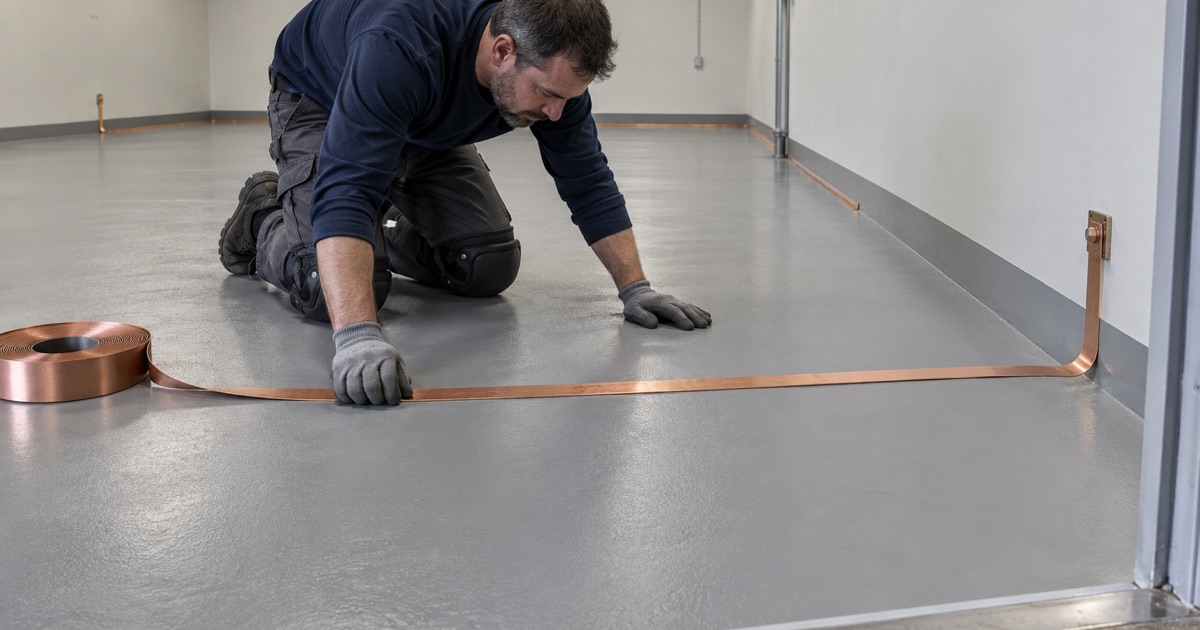
Copper grounding strips are laid on the prepared slab and connected to the building’s ground at planned points. A conductive primer spreads that connection across the floor, so every area of the topcoat has a path to ground. We place grounding points with your electrician or facility team, since the floor is only as good as its connection to earth ground.
ESD Topcoat and Finish
The final layer is a static-dissipative or conductive epoxy with carbon fibers or other conductive fillers that carry charge through the film. These finishes come in a limited range of colors, often with visible fibers, and they can be textured for grip. The coating is applied at the thickness the manufacturer specifies, because building it thicker or thinner changes its resistance.
Testing and Acceptance
Resistance Testing After Cure
Once the floor has cured, we test resistance to ground and point-to-point at locations across the area, using the test method named in your specification. Readings are recorded on a floor plan and handed to you, so you have a baseline to compare against in future audits.
Humidity and Seasonal Effects
Indoor humidity affects how static behaves and, to a degree, how floors test. Dry Chicago-area winters raise static risk, which is when a reliable floor matters most. We note the temperature and humidity at the time of testing so later readings can be compared fairly.
Where ESD Floors Are Used
Electronics Assembly and Repair
Circuit board assembly, repair benches and electronics warehouses need floors that protect components from discharge at every step. Static-dissipative epoxy combined with grounded workstations and footwear is the common approach.
These spaces also see carts, rolling racks and frequent rearranging, so the floor has to resist abrasion while keeping its resistance. We plan the grounding layout around where benches and storage actually sit, and leave room for the layout to change without losing a path to ground.
Labs, Diagnostics and Cleanrooms
Laboratories and diagnostics production areas often need floors that are both static-controlled and chemical-resistant, easy to clean and free of seams that trap contamination. We pair ESD systems with integral cove base where cleaning requires it.
Data Centers, Server Rooms and Control Rooms
Server rooms, telecom closets and control rooms protect expensive equipment from discharge. ESD floors under racks and in walkways reduce that risk. On raised-floor rooms, we coat the slab or work around the access floor system as the design requires.
These rooms rarely go dark, so we work in sections, keep dust contained with extraction at every grinder and protect equipment that has to stay running. Low-odor products and coordination with the facility’s air handling keep fumes away from intakes during cure.
Caring for an ESD Floor
Approved Cleaners Only
Wax, polish and many general-purpose cleaners leave films that insulate the surface and raise resistance. Clean with products approved for ESD floors, use clean mop water, and avoid anything that leaves residue.
Periodic Retesting
Testing the floor on a regular schedule, and after any spill, repair or change of cleaner, confirms it still performs. A dull area that tests high often recovers with proper cleaning, and worn traffic lanes can be recoated with an ESD topcoat when needed.
- 20+ Years of Floor Work
- Moisture Test in Every Scope
- Written Proposal, Named Products