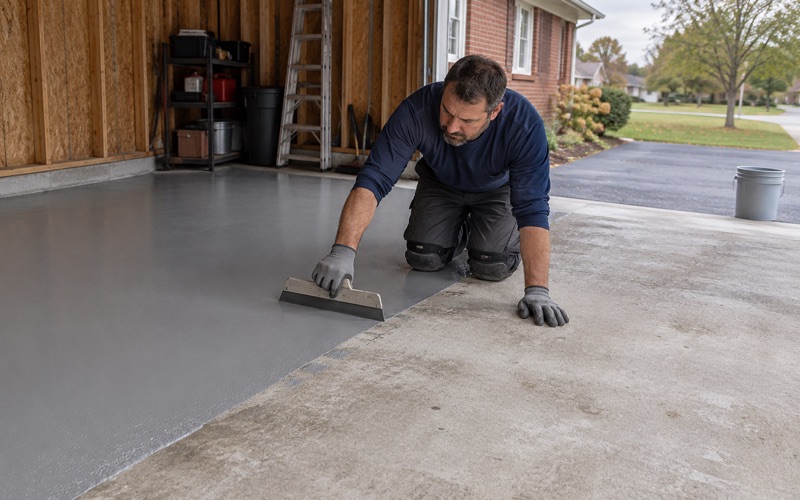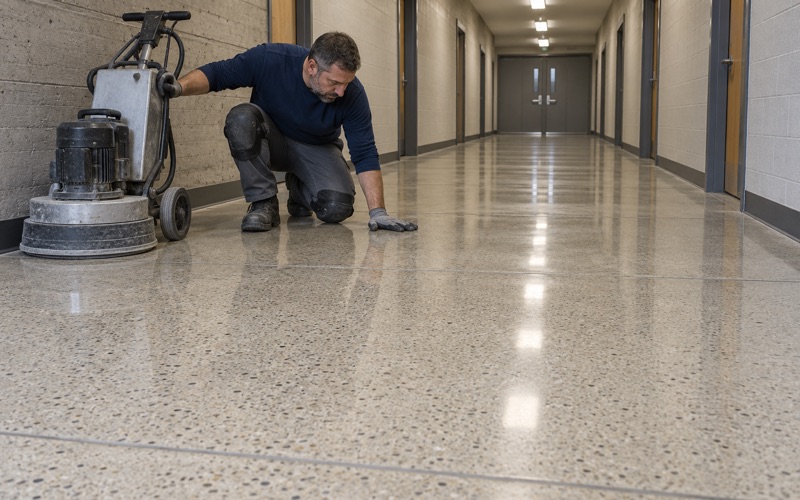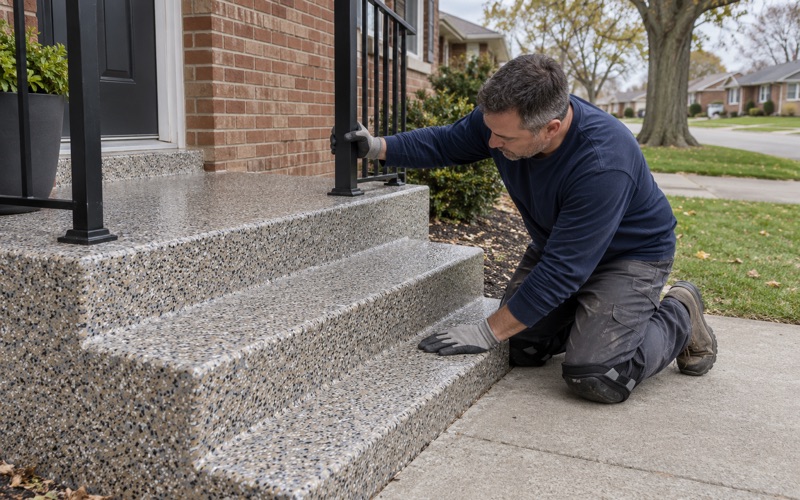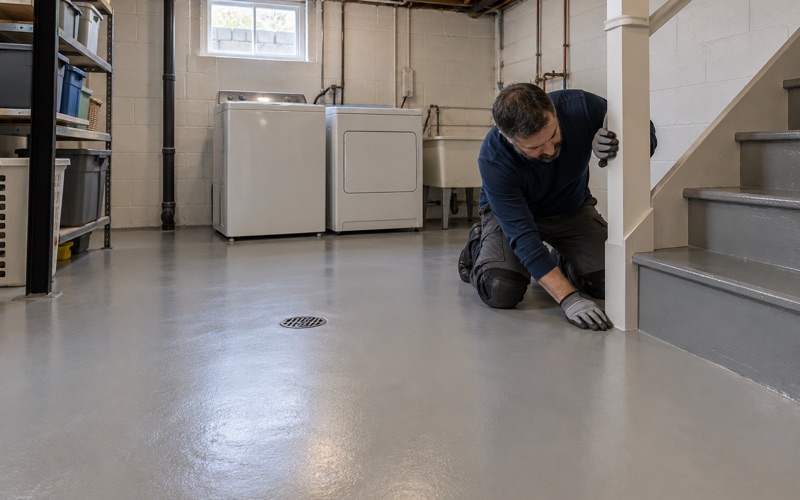
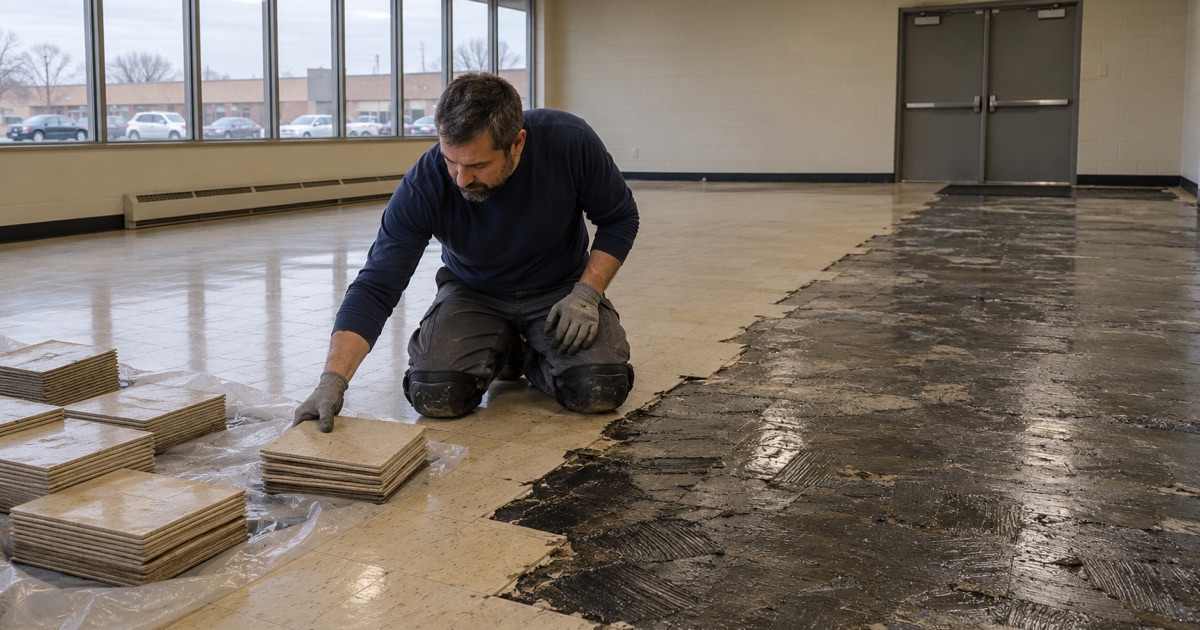
Des Plaines Epoxy Flooring brings more than 20 years of slab work to epoxy-flooring in Forest Park, and a good share of the floors people ask us to coat are not bare concrete yet. They are covered in old vinyl or asphalt tile, sheet goods, or several layers of both, glued down with a dark adhesive. Before a grinder ever touches that slab, someone has to decide how the old floor comes up.
That decision is the subject of this page. A federal rule governs how older resilient flooring is removed, and it changes the order of a coating job in ways a quote should spell out. We are a coating contractor, not an abatement firm, so what follows explains the rule and where our work starts, rather than offering to remove anything regulated ourselves.
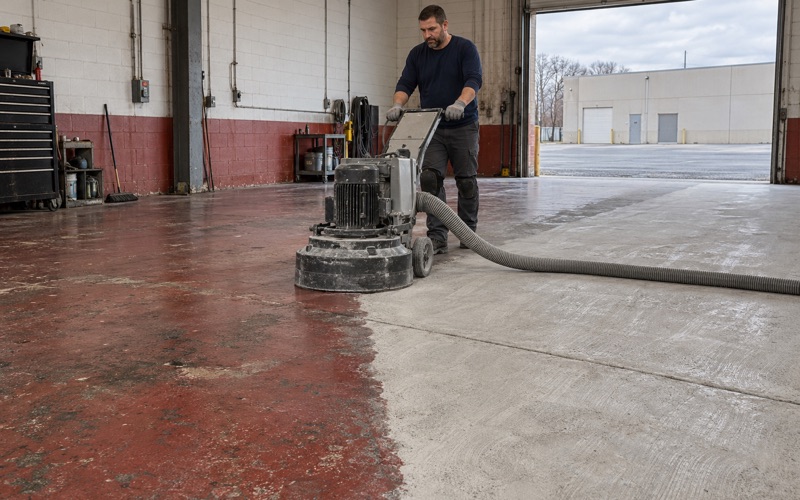
Once the slab is clear, our part looks the same as it does anywhere else. Every floor is opened with a diamond grinder or shot blaster instead of an acid etch, and we map the cracks, spalls and old patches before quoting the coating itself. The written proposal then names the product line, the number of coats and the finished thickness, so you can hold the result against the paper.
A 1971 Mall Turned Church Campus on Roosevelt Road
From ordnance plant to shopping center to sanctuary
The former Forest Park Mall at 7600 W. Roosevelt is a good way to picture the problem. It opened in 1971 on part of the WWII Naval Ordnance Plant site, and Living Word Christian Center bought the 33-acre property in December 1997. The church held its first services in the old Courtesy Store and completed a new 2,500-seat sanctuary in April 2000.
Today the south side of the property houses church ministries, while the north side is leased to retail tenants. That mix of worship space, classrooms, offices and storefronts under one roof is exactly the kind of building where floors get replaced room by room over decades. Some rooms end up on their third finish while others still carry the floor they were built with.
What a building from that era means for a floor
To be clear, we have never seen or tested a floor at 7600 W. Roosevelt, Living Word is not a customer of ours, and much of the complex has been renovated since 1997. We use it only because it shows the pattern plainly: a commercial building put up in the early 1970s, reused and remodeled, with floors of very different ages sitting side by side.
Vinyl and asphalt tile were common finishes in commercial interiors of that period, usually set in a black mastic. Anywhere in Forest Park that a storefront, church hall, office suite or basement still carries a floor laid in 1980 or earlier, a coating job begins with a question about that floor, not with the grinder. The rest of this page is about answering it in the right order.
Looking for epoxy-flooring closer to Westchester? See Westchester Epoxy-Flooring.
When the Coating Job Starts With a Tear-Out
What OSHA says about flooring installed by 1980
The federal construction asbestos standard, 29 CFR 1926.1101, addresses old resilient flooring directly. Paragraph (k)(1) says asphalt and vinyl flooring material installed no later than 1980 must also be considered asbestos-containing, unless the employer determines under the standard’s own procedure that it is not. In practice, untested older tile is handled as if it contains asbestos until a result says otherwise.
That sentence is separate from the standard’s definition of presumed asbestos-containing material, which covers thermal system insulation and surfacing material rather than floors. Flooring is pulled in by its own line in (k)(1). The distinction matters mostly to people who write specifications, but the practical result for an owner is simple: an old floor of unknown makeup carries the same caution either way.
The work practices that follow
Paragraph (g)(8)(i) sets the methods for removing vinyl and asphalt flooring that contains asbestos, or that sits in a building constructed by 1980 and has not been verified. The flooring and its backing shall not be sanded, and dry sweeping is prohibited. HEPA vacuums and wet methods are required, and tiles are to come up intact unless intact removal is shown not to be possible.
The same paragraph says all scraping of residual adhesive and backing shall be performed using wet methods. Removing asbestos-containing floor tile, sheeting and construction mastics is classified as Class II work under the standard. That is a regulated scope with its own training and supervision requirements, not something a coating crew should improvise with a long-handled scraper and a shop vacuum.
Where our work sits in that sequence
We hold no asbestos abatement license and no OSHA certification for that work, and we do not remove regulated flooring. What we do is recognize when the question exists, write it into the scope, and keep our equipment off the old floor until it is settled. A diamond grinder run across untested tile is, in effect, sanding it, which is the first thing the rule forbids.
That is also why we never quote a coating on top of old tile as a shortcut. Grinding or shot blasting is how we give every slab a profile that a coating can hold, and neither method can be used until the floor covering and its adhesive are gone. The tear-out is not a side task; it is the first step of the coating job.
Test First: Tile, Backing and Black Mastic
What a sample has to answer
An old floor is rarely one material. There is the tile or sheet itself, a backing on many sheet products, and the black mastic that held it down, and a result for one layer does not answer for the others. Where a room has been refloored more than once, there may be two or three generations stacked up, each needing its own answer.
So the useful question before tear-out is specific: which layers are present, how old they are, and what testing says about each. Until that is known, the rule above treats the 1980-or-earlier layers as asbestos-containing. Testing is what lets the owner, the removal crew and our crew all plan from the same facts rather than from a guess about when a floor went down.
Who handles each outcome
If sampling shows the layers are not asbestos-containing, the old floor comes up as ordinary demolition and we move on to slab preparation. If it shows they are, or if the owner chooses not to test, removal follows the standard’s methods and is done by a firm that does that work. The owner hires that firm directly, and we schedule our grinding around its finish date.
For a church hall, storefront or office in an older commercial building, the property manager or owner may already hold survey records from an earlier remodel. It is worth asking before anyone takes a new sample. Those records can settle some rooms immediately and narrow testing to the spaces that were never checked, which saves time on a phased job.
How it shows up in our proposal
Our written proposal names the existing floor covering and states, in plain terms, that the coating price assumes a bare, cleaned slab. The removal itself is listed as excluded work by others when testing calls for it. That way nobody discovers mid-job that the tile was never really part of anyone’s scope, and the coating number does not quietly absorb a regulated task.
A moisture test is also written into the scope before the price is final, and on a floor that has been covered for decades it can only happen after the covering is off. We say so up front. What a coating warranty excludes is explained before the job is sold, and moisture is the first exclusion we name, so the test result carries real weight in the decision.
Why the Grinder Waits Until the Floor Is Bare
Profile on clean concrete only
Once the old floor is out and the adhesive is gone, we profile the slab with diamond grinding or shot blasting to the ICRI concrete surface profile the coating calls for. A 100% solids epoxy base coat needs that open, sound surface to bond. Grinding through leftover mastic smears it rather than removing it, gums up the diamonds and leaves a film no coating should be trusted to hold.
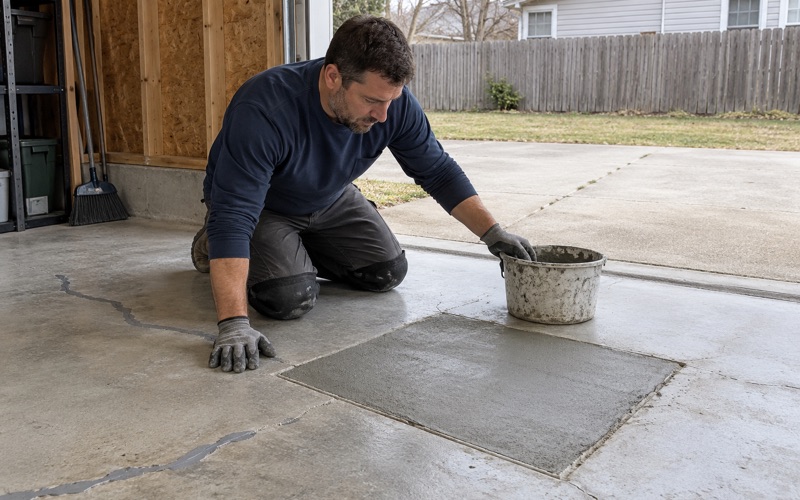
With the slab exposed, we map what decades under tile have hidden: cracks, spalls, old patches and low spots. Some of that can be repaired as part of the coating job, and some of it means a section needs repair or replacement first. We tell you which before quoting the finish, rather than burying a damaged area under a fresh coat.
Moisture and cure once the slab is open
A slab that has sat under vinyl for years has not been breathing the way a bare floor does, so we test it as it is now. ASTM F2170 in-situ relative humidity probes or ASTM F1869 calcium chloride testing tell us whether a standard primer will do or a moisture-mitigation primer belongs in the system. That result goes into the proposal before any material is ordered.
Cure is scheduled by slab temperature and the dew point spread at the surface, not by the calendar. A room that has just lost its old floor and had its heat turned down for the work may need time to come back up before we coat. For a building that cannot close, we phase rooms around services, tenant hours or weekend windows.
The same question in an older Forest Park basement
The rule is not only about commercial buildings. A Forest Park basement or rec room finished with 9-inch tile decades ago raises the same question before it can be coated, because the OSHA standard governs the crews doing the work. It applies to our crew in a basement exactly as it does in a storefront, so we treat older tile there the same way.
On a home job over the state threshold, you get a written contract and the Illinois consumer-rights pamphlet before any grinding starts. We also ask the Village Building Department whether the coating needs a permit rather than assuming the answer. And a floor coating is never sold as waterproofing; if a basement has taken water, the drain and the drying come before the tile question does.
- 20+ Years of Floor Work
- Moisture Test in Every Scope
- Written Proposal, Named Products