Des Plaines Epoxy Flooring brings more than 20 years in business to epoxy flooring in Hinsdale, and the first question we ask of any slab is whether its top layer is strong enough to hold anything at all. A floor that sheds powder when it is swept will shed a coating in the same way, only more expensively. That single check settles more about a finished floor than the color chart ever does.
We open every slab mechanically, with a shot blaster or a diamond grinder, and we do not lean on an acid etch to give a coating its grip. Before a price becomes final, a moisture test is written into the scope, whether the floor is in a basement or a garage. The proposal then names the product line, the number of coats and the finished thickness, so you can hold the floor up against the paper.
This page follows one problem from start to finish: concrete with a weak, dusting surface. It covers how that surface forms, how it comes off, when a hardener is enough, when a coating has to follow, and why we price a house one floor at a time instead of all at once.
The Village Coated Its Own Floors
A 2026 contract at 225 Symonds Drive
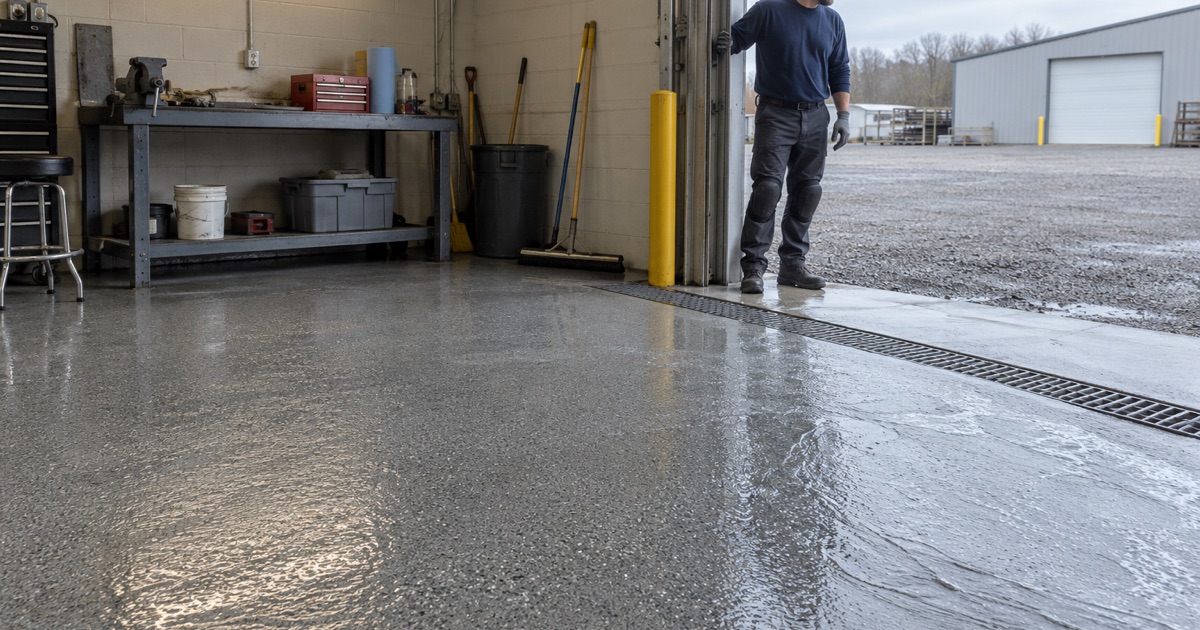
On May 19, 2026, the Village of Hinsdale awarded a $68,185 contract to Nue Concrete Finishing of Lombard to apply floor coatings to the lower level and the mezzanine of its Public Services Building at 225 Symonds Drive. The stated purpose was to improve the durability and maintenance of the building’s concrete floors. The award was project-based, with no renewals, and it surfaced through a public-contract listing rather than the board packet itself.
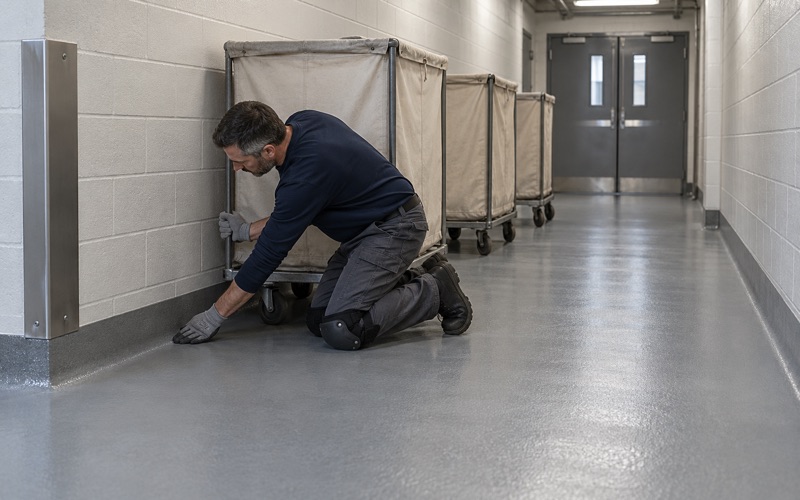
That building is home base for the village’s Public Services and Engineering Department, the crews who design, build and maintain roads and water systems and who manage the parks and the urban forest. A base for outdoor crews is the kind of building where concrete carries steady foot traffic, carts and tracked-in grit. When a public owner decides bare concrete there is worth coating, the reasoning is worth a homeowner’s attention.
What the award tells a homeowner, and what it does not
We had no part in that job, and the listing does not describe the coating system, the condition of the slab or how the mezzanine is built, so we will not guess at any of them. What it does show is plain enough. A village chose to pay for coatings so its concrete would last longer and be easier to keep clean, and it named two specific areas rather than the whole building.
Those are the same two reasons most of our residential calls start with: a floor that wears and a floor that is hard to clean. In a village where 89.9 percent of occupied homes are owner-occupied, the person deciding on a basement or garage floor is usually the person who will live on it for years. That makes the slab underneath the coating the part worth understanding first.
Looking for epoxy-flooring closer to Winfield? See Epoxy-Flooring in Winfield.
Why a Working Slab Turns to Powder
What dusting actually is
The National Ready Mixed Concrete Association’s guidance, CIP 1, defines dusting, also called chalking, as loose powder formed when the surface of hardened concrete disintegrates. Such a surface powders under any kind of traffic, and it can be scratched with a nail or even by sweeping. In the guidance’s own words, a concrete floor dusts under traffic because the wearing surface is weak.
That last point matters more than it sounds. A dusting floor is not dirty, and cleaning will not fix it; the top fraction of an inch simply never developed the strength of the concrete below it. Anything applied to that layer, whether paint, adhesive or epoxy, is bonded to the weakest part of the slab, and the guidance notes that floor-covering adhesives will not bond to a dusting floor.
How a weak surface gets made
Most causes trace back to the day of the pour. CIP 1 lists finishing while bleed water is still on the surface, condensation in cold weather that gets troweled into the top, and insufficient curing. Each of those leaves a thin layer with too much water or too little hydration, and the slab looks fine when the finishers leave.
The guidance also names carbonation from unvented heaters or gasoline engines running in an enclosed space while the concrete is placed. A basement poured in winter with a salamander heater going, or a garage slab finished with a generator nearby, can end up with a soft skin for that reason. None of it shows until years of foot traffic and sweeping start lifting the powder.
A quick check before you call
You can learn a lot in five minutes. Drag a nail or a key across an out-of-the-way spot and see whether it scores a groove or just leaves a light line. Sweep a small patch and look at what collects, and run a dark glove across the bare slab afterward.
A fine gray powder that keeps coming back after every sweep points to a weak surface rather than ordinary dust. It does not mean the slab is failing structurally, and it does not mean every older floor will behave this way. It does mean a coating priced without surface removal is priced for the wrong floor, which is why we test before we quote.
Taking Off the Weak Layer, Then Hardening or Coating
Shot blast or grind it off
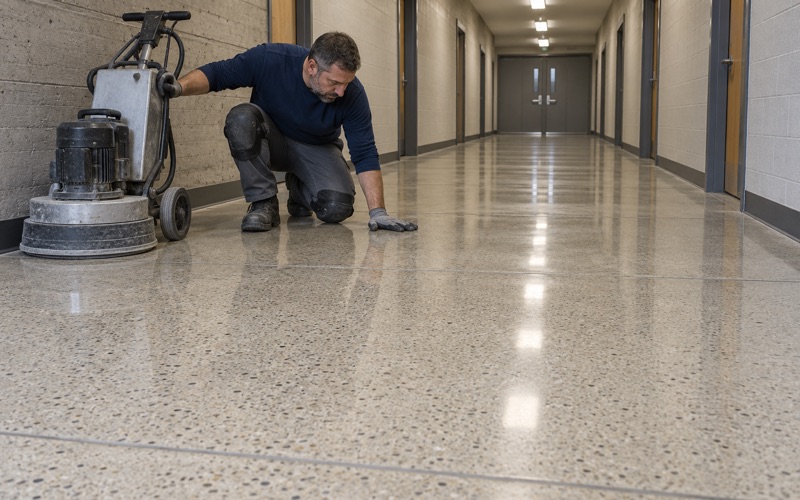
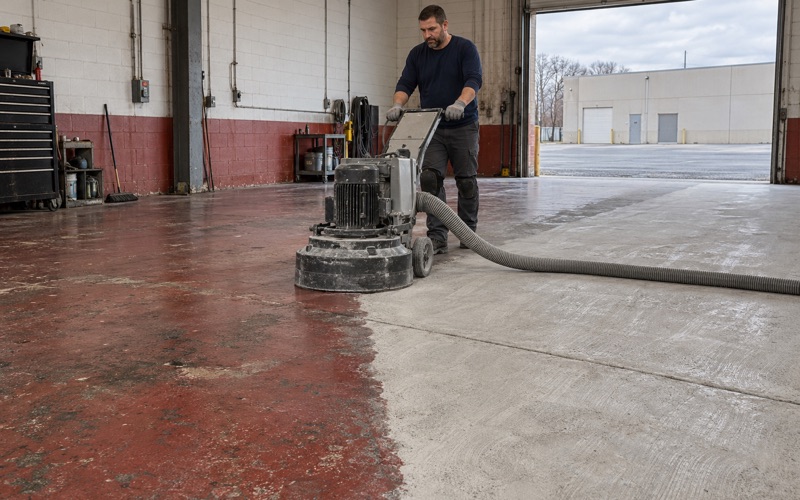
The repair CIP 1 describes starts by removing the weak surface layer with sandblasting, shot blasting or a high-pressure washer. For a coated floor we use a shot blaster or a diamond grinder, which takes off the soft skin and leaves a profile we can match to the ICRI concrete surface profile scale the coating calls for. An acid etch does not remove a weak layer in the same controlled way, so we never rely on one.
Blasting and grinding make dust, and in a finished basement or an attached garage that dust has to go somewhere. Ours is vacuumed at the machine as it is cut, not rinsed toward a floor drain or out onto the driveway. Once the surface is open, we can see what the sound concrete looks like, including cracks and spalls that were hidden under the powder.
A hardener comes first
The next step in the guidance is a chemical floor hardener, such as sodium silicate or a zinc or magnesium fluosilicate, applied to thoroughly dried concrete. A lithium silicate densifier works on the same principle, reacting inside the surface to tie it together. On a storage room or a utility area where the only complaint was powder, a blasted and hardened slab can be the whole job.
The word dried in that instruction is doing real work. A hardener applied to a damp slab will not penetrate the way it should, so the moisture reading we take for a coating is just as useful here. If the numbers are high, we say so and plan around them before anything goes on.
A coating when dusting persists
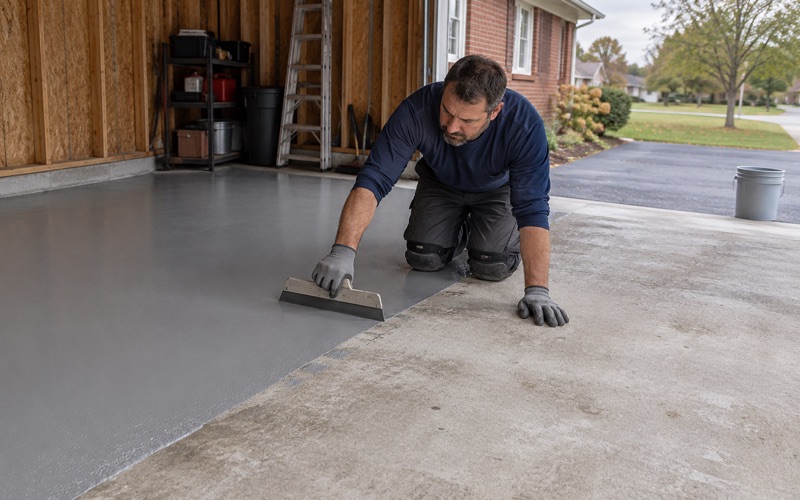
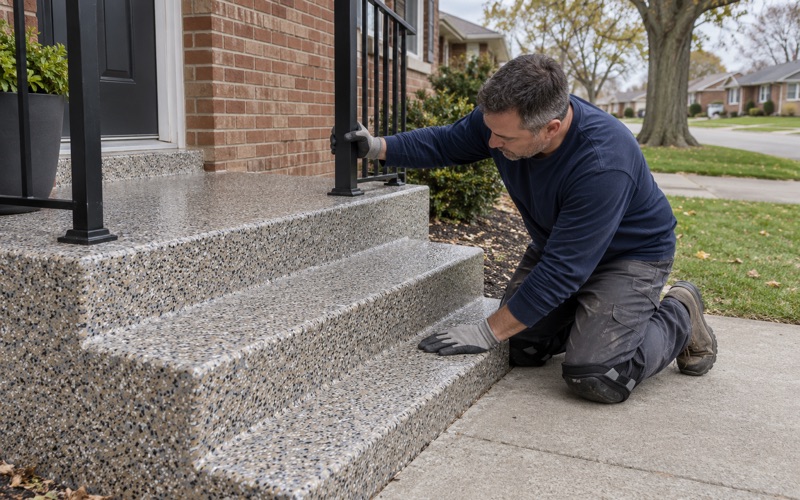
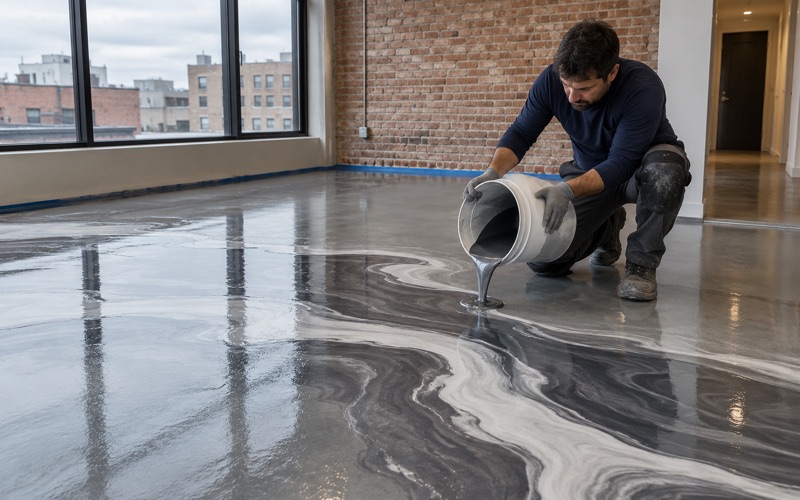
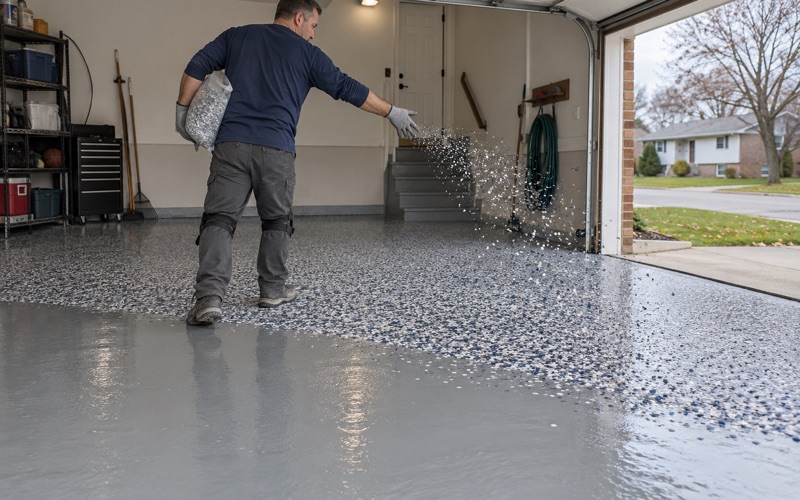
CIP 1 is direct about the last resort: if dusting persists, use a coating, and it names latex formulations, epoxy sealers and cement paint. For a floor meant to take real wear, we usually go further, with a 100 percent solids epoxy base, a vinyl flake or quartz broadcast and a polyaspartic topcoat. On a garage, that system is chosen to stand up to the brine and rock salt that ride in on tires all winter.
Every product we put down is selected inside the Illinois VOC limits for floor and industrial coatings, which apply to the person applying them. Before the job is sold, we also walk through what the coating warranty excludes. Moisture is the first exclusion we name, because it is the one most likely to matter on a slab that has already shown weakness.
Scoping the Job One Floor at a Time
Price the room, not the house
The village named two areas of its building rather than coating every floor, and that is the right instinct at home too. A basement and a garage share a house but almost nothing else: different moisture, different traffic, different chemicals on the surface. Pricing them as one job tends to give one of the two the wrong system.
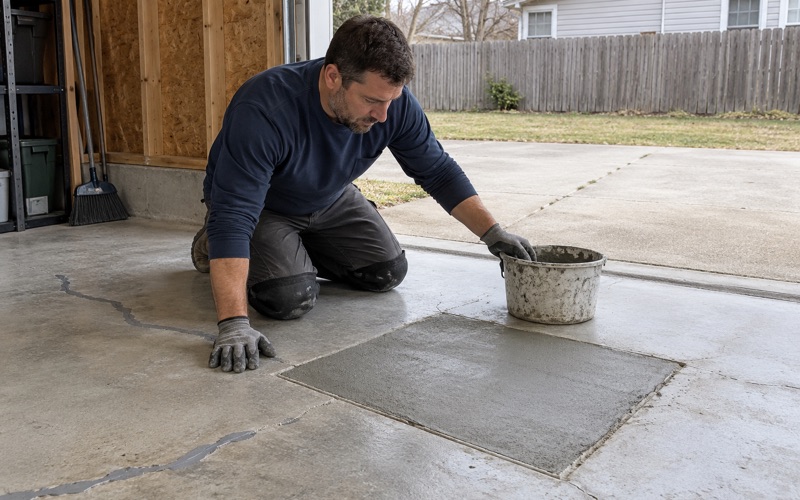
So we map each floor separately, marking cracks, spalls, old coating and any dusting areas, and we will tell you when a slab needs repair or replacement before it should be coated at all. Sometimes the garage is ready and the basement is not, or the reverse. Splitting the scope lets you do the floor that is ready now and leave the other until it is.
Moisture testing written into each scope
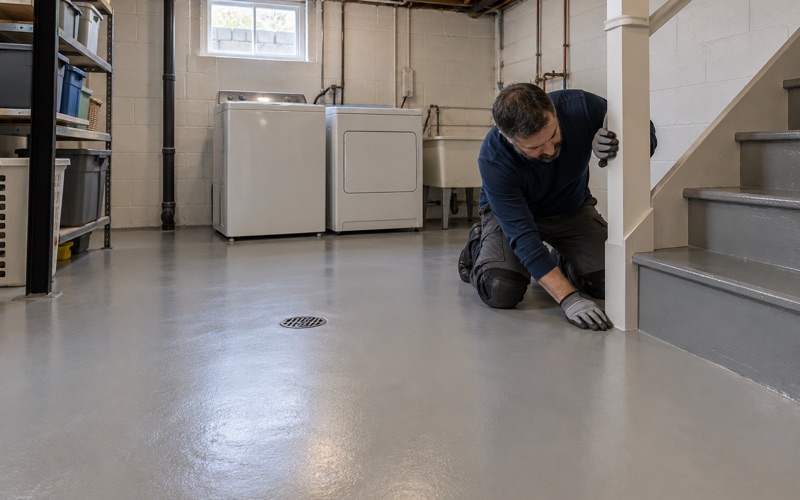
In a basement, moisture moving up through the slab is the main threat to a coating, and hydrostatic pressure under the floor can push it harder after a wet season. We use ASTM F2170 in-situ relative humidity probes or ASTM F1869 calcium chloride tests, depending on the slab, and a plastic sheet check under ASTM D4263 as a first read. If readings call for it, a moisture-mitigation primer goes into the proposal.
We do not sell a floor coating as waterproofing, and we never sell one as radon reduction, because in Illinois that is licensed mitigation work. If a basement has taken in water, the drain, the valve and the drying come first. A coating on a wet slab is a warranty claim waiting to happen, and we would rather lose the job than install one.
Timing, cure and paperwork
Cure times on our jobs are set by slab temperature and the dew point spread at the surface, not by the calendar. An unheated garage in January is told to wait, because a cold slab can sweat under fresh epoxy and leave amine blush on the finish. A heated basement can usually go ahead through the winter.
Before the job, we ask Village of Hinsdale Community Development whether the coating needs a permit, rather than assuming either answer. Illinois has no state flooring license, so we check the village’s own contractor registration, bond and insurance rules before booking. Home jobs over the state threshold under the Home Repair and Remodeling Act get a written contract and the consumer-rights pamphlet before any grinding starts.
- 20+ Years of Floor Work
- Moisture Test in Every Scope
- Written Proposal, Named Products