Des Plaines Epoxy Flooring installs industrial epoxy flooring in Des Plaines, IL, serving surrounding cities including Prospect Heights, Schiller Park, Bensenville, Wood Dale and Norridge. The O’Hare edge of our area holds air freight terminals, distribution warehouses, food plants and manufacturing floors, and over more than 20 years we have learned that each one wears a floor differently.
Industrial floors take loads and abuse that no home garage sees: forklifts turning on the spot, pallet jacks dragging across joints, dock plates slamming onto the slab edge, chemicals, oils and constant cleaning. A floor that works in an office fails quickly in those conditions, so we design the system around the traffic and exposure your floor actually carries.
We start with a walk-through alongside your operations or maintenance team. We map damaged joints, spalls, old coatings and oil-soaked areas, test the slab for moisture, and ask about equipment, chemicals and cleaning. The proposal then lists the system for each area, its thickness and the phasing plan, so production keeps running while the floor is done.
Floors for Freight, Warehousing and Manufacturing
Air Freight and Truck Terminals
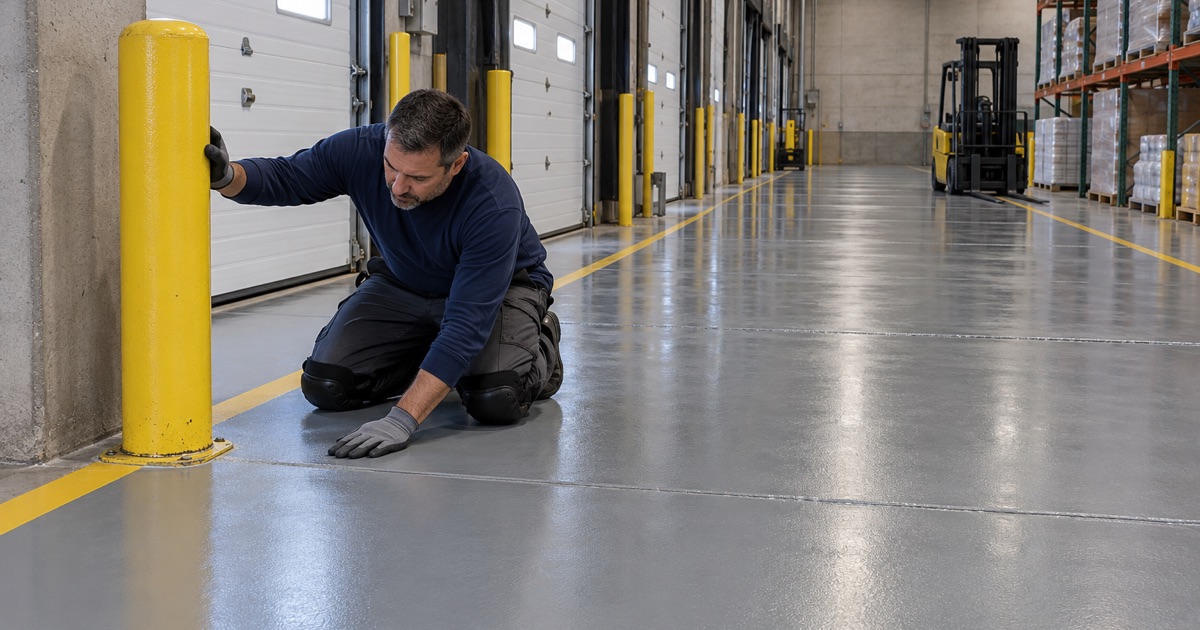
Air freight terminals along Touhy Avenue and Wille Road, and the truck terminals that serve them, move freight through dock doors around the clock. Dock plates, pallet jacks and forklifts concentrate heavy loads on small wheels, and the dock edge takes the worst of it. We rebuild spalled dock edges and joints, then apply thick, impact-resistant systems in lanes and staging areas.
Winter adds road salt and slush tracked in from trailers. A sealed floor keeps that brine from working into the concrete and makes cleanup faster.
Distribution Warehouses With Racking
Warehouse floors carry racking anchored through the slab, narrow aisles and constant forklift traffic. We coat aisles, staging and pick areas around existing racking or coordinate with racking contractors on new layouts. Built-in aisle lines and pedestrian walkways help with safety programs and last longer than painted lines.
The heaviest wear in a warehouse is rarely spread evenly. Turning points at aisle ends, the lanes in front of dock doors and the paths to charging stations take most of the traffic, so we build those areas thicker or with a quartz broadcast while lighter zones get a thinner, more economical system.
Manufacturing and Process Floors
Manufacturing floors face oils, coolants, solvents, dropped parts and rolling equipment. We match the coating to the specific chemicals and temperatures involved, from standard 100% solids epoxy to novolac epoxies for stronger chemical exposure, and add texture where floors stay wet or oily.
Industrial Coating Systems
High-Build 100% Solids Epoxy
A 100% solids epoxy applied in thick coats gives strong adhesion to ground concrete and good resistance to abrasion and many chemicals. It suits warehouses, workshops and plant floors with moderate traffic and is often topped with a polyaspartic or polyurethane layer for added wear and color stability.
Epoxy Mortar and Slurry Systems
For heavy impact and rough slabs, epoxy mortars and slurry systems build a thick, troweled or self-leveled layer that resurfaces the floor while coating it. They handle forklift traffic, dropped loads and damaged concrete well, and can be broadcast with quartz for texture.
Urethane Cement for Heat and Washdown
Where floors see hot water, steam cleaning, thermal shock or harsh sanitizers, urethane cement outperforms epoxy. It is common in food processing and beverage plants and in washdown areas of distribution centers that handle food.
Chemical-Resistant Novolac Epoxies
Novolac epoxies resist stronger acids and solvents than standard epoxies. We use them in battery rooms, chemical storage areas, secondary containment and process areas where ordinary coatings would soften or stain.
Preparing an Industrial Slab
Shot Blasting and Grinding
Large industrial floors are often shot blasted to clean and profile the concrete quickly, with edges and tight areas diamond-ground. We prepare to the surface profile the coating system requires, typically heavier for thick mortars and urethane cement than for thin coatings.
Oil Contamination
Years of forklift and machine oil soak deep into a plant floor. We degrease, grind or blast through contaminated concrete and test for oil bleeding back. Areas that stay contaminated may need cutting out and patching, because oil in the slab breaks a coating’s bond.
Joints, Cracks and Moisture
Joints damaged by wheel traffic are rebuilt and filled with semi-rigid filler. Cracks are mapped and repaired, and moisture is tested, since many older industrial slabs lack a vapor retarder. Where vapor is high, a moisture-mitigation primer goes down before the main system.
Scheduling Around Production
Phased Installation
Industrial floors rarely get to shut down. We divide the floor into zones, install overnight and on weekends, and sequence work around dock schedules and production lines. Each zone is handed back on an agreed date before the next begins.
Inventory moves, temporary relocation of racking and rerouting of forklift paths are planned with your supervisors ahead of time, and we confirm each night’s scope before the crew arrives. A written zone plan keeps everyone working from the same map, from the shift lead to the crew grinding the floor.
Fast-Cure Options
Fast-cure polyaspartic and urethane cement systems shorten downtime when a zone has to reopen quickly. We explain the trade-offs of speed, thickness and chemical resistance so you can choose for each area.
Compliance and VOC Limits
Industrial maintenance and floor coatings applied in Illinois must meet the state’s VOC limits, which apply to the person applying them. We select compliant products and coordinate ventilation with your facility team, especially in occupied buildings and near air intakes.
- 20+ Years of Floor Work
- Moisture Test in Every Scope
- Written Proposal, Named Products