Des Plaines Epoxy Flooring has spent more than 20 years on epoxy flooring in Justice and across our service area, and the jobs that teach us the most are the ones where a floor has to be cleaned a particular way. A coating is not only a finish. On some floors it decides whether the daily cleanup can be done the right way, or whether someone ends up reaching for a broom that should stay on the hook.
That is the lens for this page. We grind or shot blast every slab before anything is applied, test the concrete for moisture before the price is settled, and put the product line, coat count and finished thickness in writing so the result can be checked against the quote. Those habits matter more on a working shop floor than almost anywhere else.
Below we walk through a kind of shop Justice is known for, what its work leaves on the concrete, and how we would approach a floor that has to be washed or vacuumed instead of swept. Homeowners with garages will find the prep and cure sections apply to them as well, minus the stone dust.
Monument Makers on Archer Road
A working row beside Resurrection Cemetery
Archer Road in Justice carries a cluster of monument dealers beside Resurrection Cemetery. Czarnik Memorials sits at 7300 Archer Road, half a block south of the cemetery, and has served Chicagoland since 1920 with headstones, monuments and custom memorials. The village itself says it has no major industries, which makes this row of stone businesses one of the more distinctive commercial stretches in town.
Monumental Art Works, at 7590 Archer Road, is the one that describes its production plainly. Its own site says all of its work is done at its production shop on Archer Road, and that because everything is made on site it keeps its products under strict quality control. Its listed services include monuments, markers, etchings, cemetery lettering and on-site sandblasting in granite.
Granite cutting and sandblast lettering
A shop that cuts, polishes and letters granite is doing work that sends stone out in pieces. Saws and polishers throw slurry and fine particles, and sandblast lettering drives abrasive against a stencil until the letters are cut into the face of the stone. Every one of those steps ends with material on the floor that someone has to pick up before the next job.
Granite is roughly 40 to 60 percent quartz, according to OSHA and NIOSH hazard material, and quartz is crystalline silica. Chipping, sanding, drilling and polishing stone releases respirable crystalline silica dust. Blasting adds spent grit to the mix, so a monument shop floor collects a layer that is part fine dust, part coarse abrasive and part stone chips.
Why the slab underneath matters
Bare concrete is porous. Fine dust works into the open surface, settles into saw cuts and pitted areas, and comes back up every time the floor is disturbed. A worn, dusting slab also makes its own powder as wheels and carts grind at it, adding concrete dust to the stone dust and making the whole floor harder to get truly clean.
We are not describing any particular shop’s floor here, and we have not inspected one on Archer Road. The point is the mechanism: when the material on the floor is hazardous to breathe, the surface underneath decides which cleaning methods are practical. A floor that fights a mop or a vacuum quietly pushes a busy crew back toward the broom.
Looking for epoxy-flooring closer to Wauconda? See Epoxy-Flooring Services in Wauconda.
The Silica Rule’s Housekeeping Line
What paragraph (h) says
OSHA’s general industry standard for respirable crystalline silica, 29 CFR 1910.1053, sets a permissible exposure limit of 50 micrograms per cubic meter as an eight-hour time-weighted average, with an action level of 25. The standard does not apply where exposure stays below 25 micrograms per cubic meter under any foreseeable conditions, and that determination belongs to the shop, not to a flooring contractor.
Paragraph (h) covers housekeeping. It says an employer shall not allow dry sweeping or dry brushing where it could contribute to employee exposure, unless wet sweeping, HEPA-filtered vacuuming or other methods that minimize exposure are not feasible. It also bars compressed air for cleaning clothing or surfaces where it could add to exposure, unless a ventilation system captures the dust or no alternative is feasible.
Where the floor comes in
Read that way, the rule leans on the floor. Wet sweeping and HEPA vacuuming both work best on a surface that is smooth, tight and continuous. Water on porous concrete soaks in and leaves a film of slurry as it dries, and a vacuum head skips over pits and open joints where the finest dust collects.
A coating cannot make a shop meet the standard, and we will not tell a shop owner otherwise. Exposure is measured in the air, and controls, ventilation and work practices are the employer’s program. What a floor can do is make the cleanup methods the rule prefers practical to use every day, instead of a chore that gets skipped when the shop is busy.
What we ask before quoting
Before we price a stone shop floor, we ask how the crew cleans now, where the wet saws drain, where the blast booth sits and how spent abrasive is handled. Those answers shape the system more than the square footage does. A floor that sees daily wash-downs needs different detailing at walls, drains and equipment bases than one that is mostly vacuumed.
A Floor You Can Clean Wet
Seamless and sealed
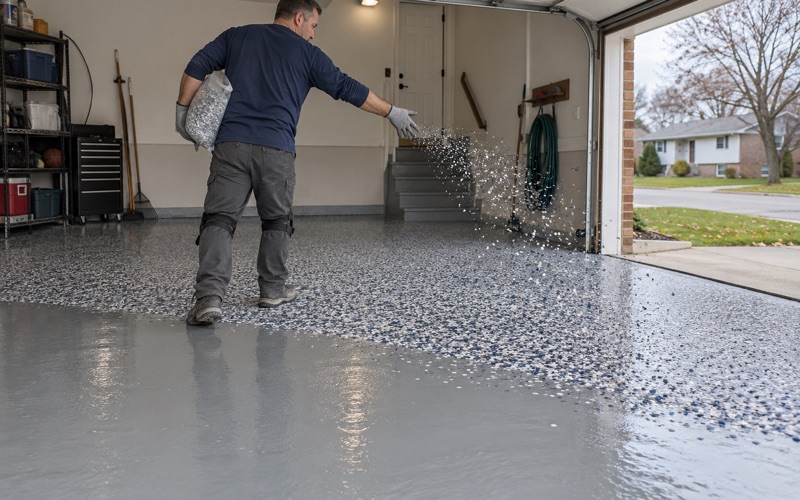
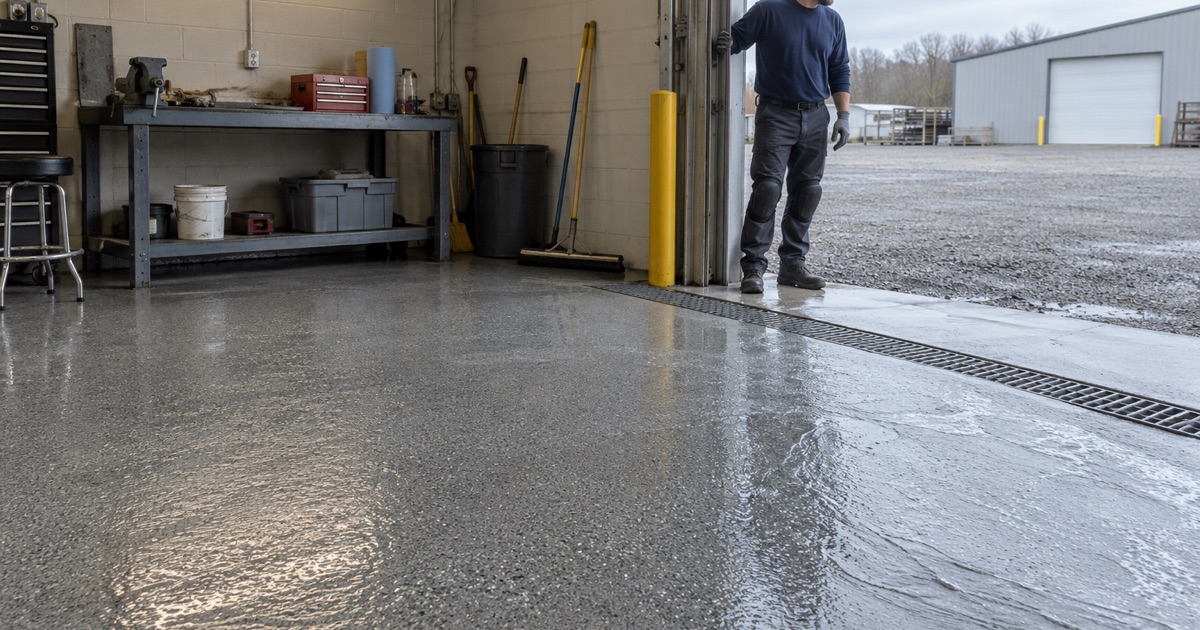
For wet cleaning and HEPA vacuuming, the target is a seamless, sealed surface with as few places for dust to hide as we can manage. That usually means a 100% solids epoxy base, broadcast with quartz aggregate where footing matters, and locked down with a tough topcoat. Joints get filled rather than left open, and the coating runs tight to walls and equipment bases.
Texture is a balance. A wet floor in a stone shop needs some grip, but a coarse profile holds dust the same way open concrete does. We tune the broadcast and the topcoat so the surface has enough tooth for footing while a squeegee and a HEPA vacuum still pass over it cleanly, and we would rather show a sample board than describe it.
Prep the coating can hold onto
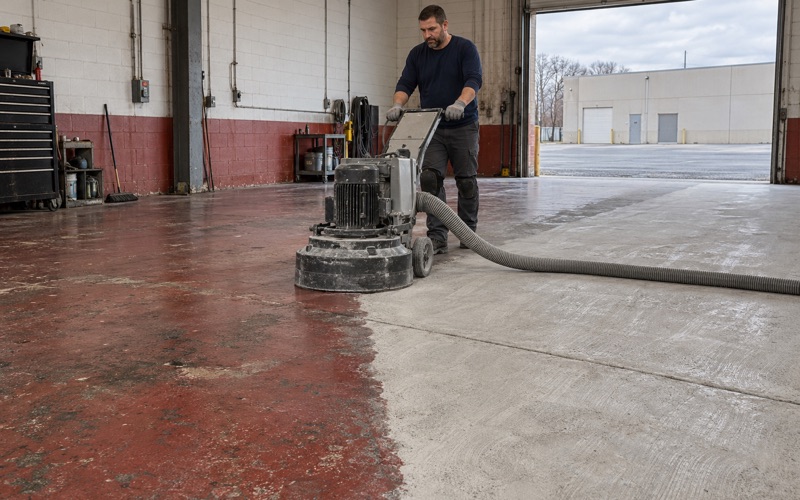
Stone shop slabs often carry years of slurry, sealers and residue, and an acid etch will not get through that reliably. We open the concrete with a diamond grinder or a shot blaster, aiming for a measurable profile on the ICRI CSP scale. Grinding dust is collected at the machine by the vacuum, not washed toward a drain, which matters more than usual in a building that already manages silica.
Moisture testing comes before the price is final. We use ASTM F2170 in-situ relative humidity probes or ASTM F1869 calcium chloride tests depending on the slab, because a shop that wet-cleans every day is also putting water on top of whatever is coming up from below. If readings call for it, a moisture-mitigation primer goes into the scope from the start.
Cracks, spalls and old coatings
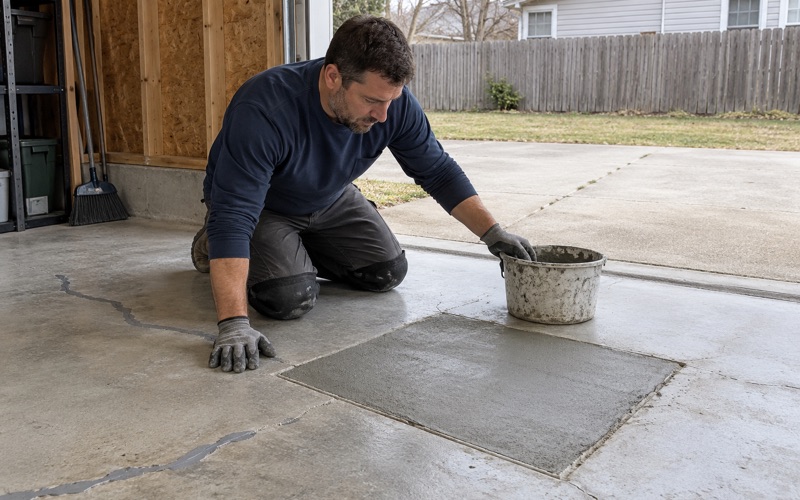
We map the slab before we quote it: cracks, spalls, saw-cut damage and any old coating that is peeling. Some floors are good candidates for a repair-and-coat job. Others have broken down far enough that patching would only move the failure, and we say so plainly rather than coat a slab that should be repaired or replaced first.
Our proposal names the product line, the number of coats and the finished thickness, so the owner can hold the floor to the paper. We also explain what the warranty excludes before the job is sold. Moisture is the first exclusion we name, and on a floor that is wet-cleaned daily, we make sure the owner understands exactly why it sits at the top of the list.
Grit, Stone and the Blast Booth Edge
Abrasion from spent grit
Spent abrasive acts like sandpaper underfoot. Every boot, cart wheel and pallet jack that rolls across it grinds the grit into the surface. A thin decorative coating would scuff through quickly in a lettering area, so we build thickness and lean on quartz aggregate and hard topcoats, with polyaspartic or polyurea finishes considered where their abrasion and chemical resistance suit the room.
Stone itself is heavy. Blanks, bases and finished monuments move on carts, dollies and forklifts, and an edge set down too hard can chip a brittle floor. Where heavy stone travels, we look at urethane cement or a thicker epoxy build that tolerates point loads and impact better than a thin film, and we put that choice in writing.
The booth threshold and the saw area
The edge of a blast booth is where coatings tend to fail first. Grit escapes under curtains and doors, piles at the threshold and gets ground in by traffic. We detail that line with extra build or a transition the crew can vacuum easily, and we talk through whether the booth floor itself should be coated or left as a replaceable wear surface.
Wet saw and polishing areas see constant water and slurry. There we pay close attention to slope toward drains, a sealed junction where the floor meets walls, and the right texture for wet footing. A good coating keeps slurry on top where a squeegee and rinse can move it, instead of letting it dry into the pores of the concrete.
Scheduling around a working shop
Most shops cannot stop for a week. We phase the work by area, so one bay or room is ground, coated and cured while production continues in another, with overnight and weekend windows when the building cannot spare a weekday. Cure times are set by slab temperature and dew point at the surface, not by the calendar, and a cold shop in winter may be told to wait.
Before anything is booked, we check the Village of Justice’s contractor registration and insurance requirements, since Illinois has no state flooring license to lean on. We also ask the Building Department at 8748 W. 82nd Place whether a coating job needs a permit, rather than guessing. Then the shop gets a written scope, a schedule by area and a floor it can keep clean the right way.
- 20+ Years of Floor Work
- Moisture Test in Every Scope
- Written Proposal, Named Products