Des Plaines Epoxy Flooring brings more than 20 years of slab work to epoxy flooring in Norridge, and the first question we ask about any floor is what it has to keep out. A garage slab resting on the ground mostly needs to resist wear and staining. A suspended concrete deck carrying cars has a much harder job, because anything that soaks through it lands somewhere else.
That difference shapes everything on this page. We treat an elevated parking surface as a waterproofing assignment first and a finish second, and we choose a flexible membrane system for it rather than the rigid decorative epoxy that suits a residential garage. Picking the wrong family of product is an expensive mistake, because the floor looks fine right up until the cracks start moving.
Every proposal we write names the product line, the coat count and the finished thickness, so a property manager or homeowner can hold the installed floor against the paper. Before a price is final we build a moisture test into the scope, and we explain what the coating warranty leaves out, starting with moisture, before anyone signs.
Parking Decks at Harlem and Irving
A mall that parks its shoppers upstairs
Harlem Irving Plaza, at 4104 North Harlem Avenue, sits inside the Village of Norridge, and it is the clearest local example of structured parking in this compact village. The center opened in 1956 as a strip mall on a former livestock farm. Between 1975 and 1979 the strip was enclosed and a parking garage was added, which put cars on concrete decks rather than only on pavement at grade.
A second garage followed after Best Buy relocated to the parking lot in 2001 and its original space was replaced with more structured parking. Today the center counts about 2,600 parking spaces, and the former Carson’s anchor was reworked into a large atrium and new entry for visitors arriving from the upper parking deck. Shoppers now step off a suspended slab and walk straight into the mall.
What we do and do not know about those decks
To be clear about the limits of this page, we have not inspected any deck at Harlem Irving Plaza, and we do not know what coating is on it today. We also have not established what sits beneath any particular level. The garages matter here because they show, in a place Norridge residents drive into every week, why an elevated deck is a fundamentally different kind of floor.
Norridge, incorporated as a village in 1948 and surrounded by Chicago together with Harwood Heights, is made up largely of detached houses built in the 1950s and 1960s. Structured parking is the exception in a village like this, which is exactly why it deserves its own explanation. Owners and managers of decks, ramps and rooftop parking levels need a contractor who will treat the structure, not just the surface.
Looking for epoxy-flooring closer to Franklin Park? See Franklin Park Epoxy-Flooring.
Why an Elevated Deck Is a Waterproofing Job
Water follows the crack to the steel
A slab on the ground can tolerate some water. A suspended deck cannot, because it is reinforced concrete spanning open air, and the reinforcing steel inside is what holds it up. When water works through a crack in the top surface it reaches that steel, and corrosion begins where nobody can see it. Rusting steel expands as it corrodes, and the concrete around it starts to crack and spall.
The same water does not stop at the steel. It continues through the slab to the level below, where it drips onto parked cars, stains ceilings and light fixtures, and collects on the lower deck. A coating that only looks good from above has failed the owner if the level underneath is wet after every rain. That is why our deck conversations begin with the question of what is below.
Why rigid epoxy is the wrong answer up there
Parking decks move. Temperature swings make the structure expand and contract, and vehicle loads flex the slab between supports, so certain cracks open and close all year long. A hard decorative epoxy, the kind with a full flake broadcast that performs well on a home garage slab, has very little ability to stretch. Laid over a moving crack, it simply splits along the same line and lets water back in.
A membrane system is formulated to bridge that movement, staying bonded and continuous while the crack beneath it works. Its base layers are softer and more elastic, and it is finished with a textured wear surface rather than a glossy one. On a deck, the floor’s real job is to keep water out of the structure, and every layer of the system is chosen with that job in mind.
Cracks that move get routed and sealed first
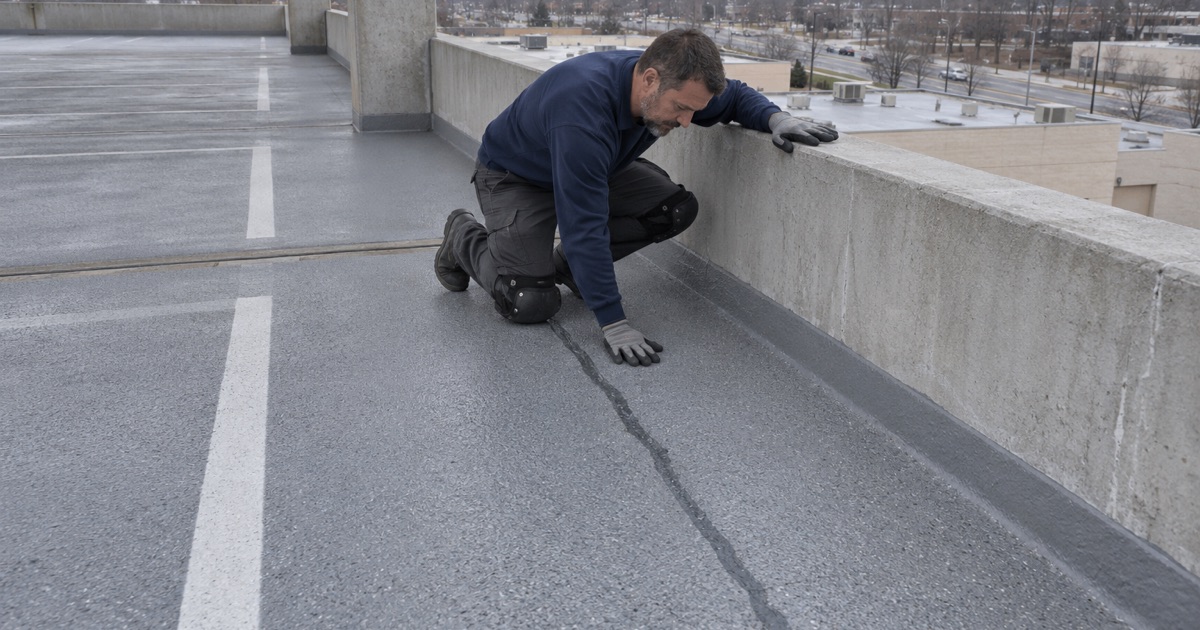
Before any membrane goes down, we map the deck. We record cracks, spalls, earlier patches and old coatings, then sort the cracks into narrow, stable ones and wider ones or those where movement is expected. When a deck has damage that a coating cannot fix, we say so in writing, because a membrane over failing concrete only hides the problem for a season or two.
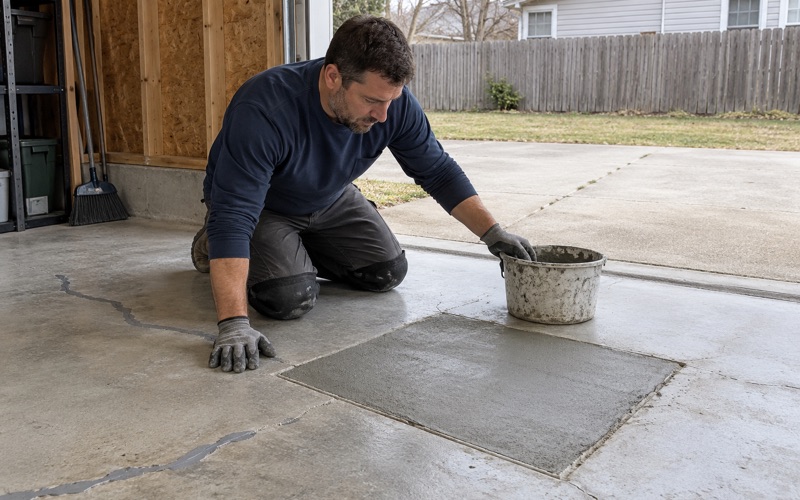
Wider cracks and cracks expected to move are routed open with a crack chaser and then sealed with an elastomeric sealant that can flex as the crack does. Narrow cracks get pre-striping, a band of membrane material laid along the crack line before the full base coat. Skipping either step leaves the membrane to fight the movement alone, and the crack line tends to telegraph back through the finished surface.
What a Traffic-Bearing Membrane Is Made Of
Preparation and moisture checks come first
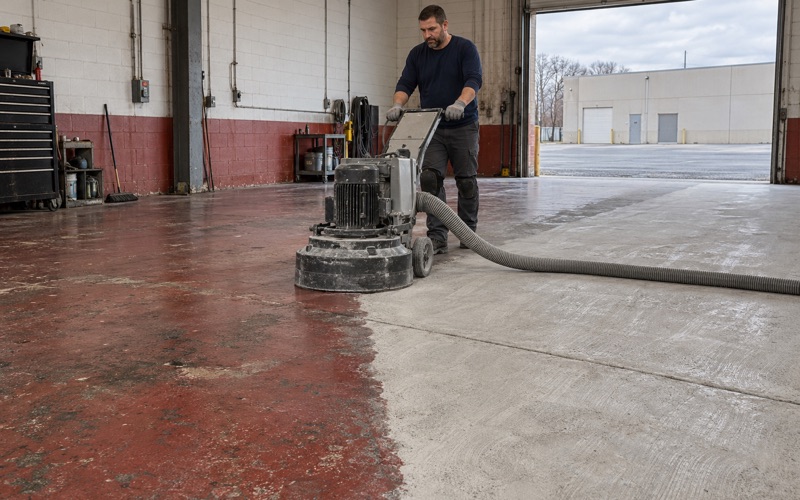
A traffic-bearing membrane is a layered system built to protect horizontal concrete by keeping moisture away from the reinforcing steel, and parking garages are one of its main uses. Like every coating we install, it starts with mechanical preparation. We open the deck with a diamond grinder or a shot blaster to a measured concrete surface profile and never depend on an acid etch to create the bond.
Moisture is checked before the price is settled. Depending on the slab, we use the ASTM D4263 plastic sheet test as a quick screen, ASTM F1869 calcium chloride testing for vapor emission, or ASTM F2170 in-situ relative humidity probes set into the concrete. A membrane applied over a damp slab can blister and lose adhesion, and moisture is the first exclusion we walk through in any coating warranty.
Primer, pre-striping and base coat
The primer goes down first and gives the membrane a bond to the prepared concrete. Over the primer and along the treated crack lines comes the pre-striping, then the base coat, which is the flexible waterproofing layer doing most of the work. Its thickness is set by the manufacturer’s system, and our proposal states it so the owner can check what was actually installed.
We schedule these coats by slab temperature and dew point rather than by the calendar. A deck exposed to open air changes temperature quickly, and a coat applied when the surface sits too close to the dew point can trap moisture or cure poorly. When conditions are wrong we wait, because a membrane that fails to bond has to be ground off and started over at the owner’s expense.
Aggregate wear coat and topcoat
For heavy-duty traffic, the system adds an intermediate coat with aggregate broadcast into it, followed by top coats that carry aggregate as well. That grit gives tires and shoes traction on a wet ramp, and it takes the abrasion of turning wheels so the waterproofing layer underneath does not wear through. Drive aisles and turning areas usually call for a heavier build than the parking stalls beside them.
The finished surface looks plain next to a showroom garage floor: a neutral textured coat with stall striping painted on top. That plainness is deliberate. On an elevated deck, the measure of a good job is that the level below stays dry and the steel stays protected year after year, not how brightly the surface reflects light.
Membrane on the Deck, Epoxy on the Slab at Home
Why a Norridge house garage gets a different system
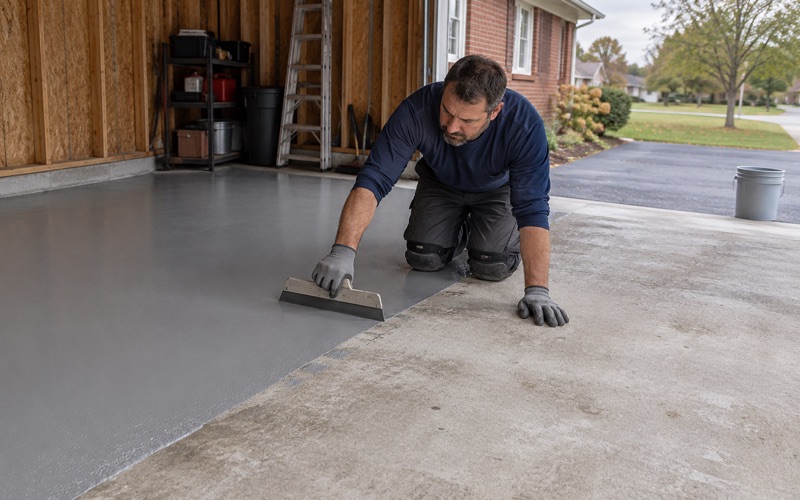
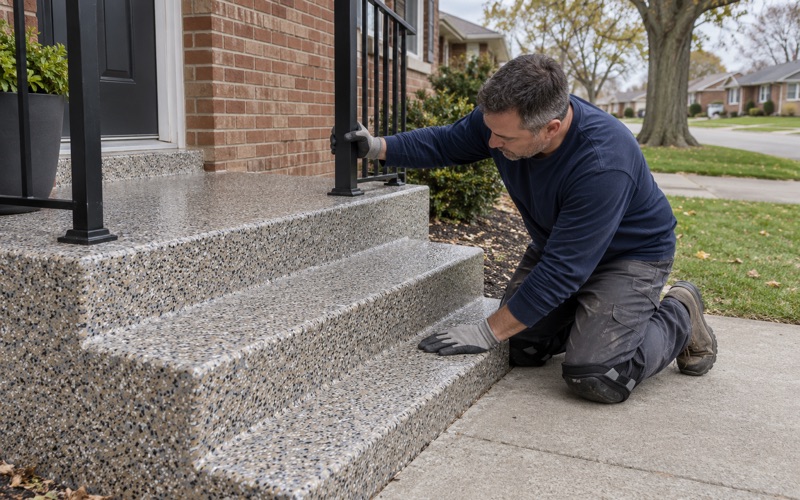
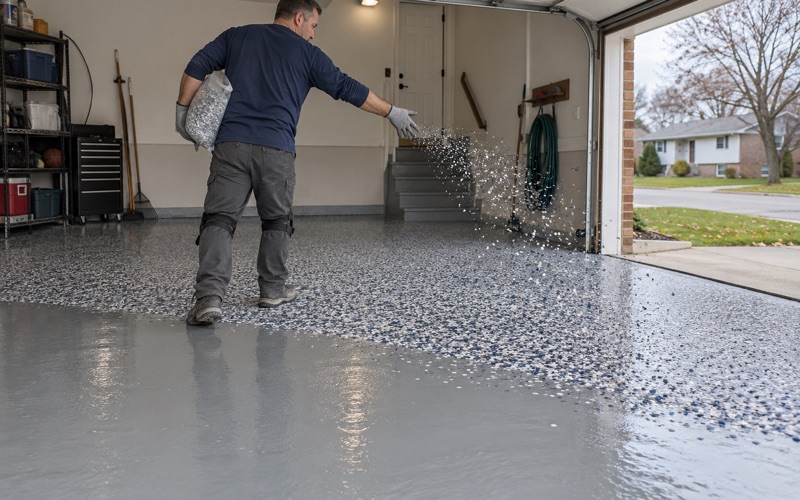
A house garage in Norridge is typically a slab poured on the ground, with no occupied level beneath it to protect. Water on that floor is a slipping and staining concern rather than a structural one. That is why a rigid system, such as a 100% solids epoxy base with a vinyl flake broadcast and a polyaspartic topcoat, is a sensible choice at home and a poor one on a parking deck.
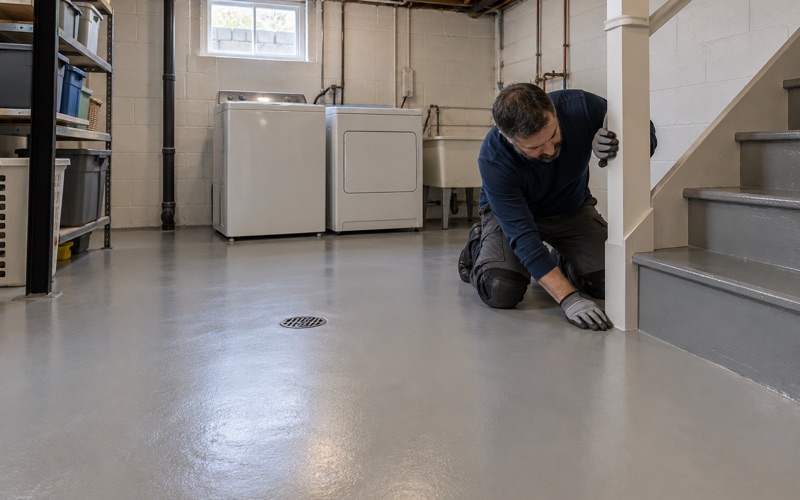
Garage slabs bring their own preparation needs. We still grind every slab, still map cracks and old coatings, and still test for moisture before quoting, because a slab on grade can push vapor up from below. If a garage floor is broken badly enough that coating it would waste the homeowner’s money, we say it needs repair or replacement first.
Drawing the line between the two
The dividing line is simple to state. If the concrete spans between supports with usable space below and carries vehicles, it is a waterproofing problem and calls for a traffic-bearing membrane. If the concrete rests on the ground, a rigid epoxy or urethane cement system makes sense, chosen for wear, chemical resistance and appearance rather than for crack bridging.
Some properties have both. A building with a podium deck over ground-level parking, or a rooftop parking level above a ground-floor slab, may need a membrane up top and a rigid coating below. We price them as separate systems in one proposal, each with its own product line, coat count and thickness, so nobody confuses one floor’s specification with the other.
Keeping a deck open while the work happens
Deck work rarely happens with the structure empty. We phase the job in sections so parking stays available, and we can work overnight and on weekends when a property cannot close a level. Grinding dust is captured by vacuums at the machine rather than washed toward drains, and each section reopens only after its coats have cured enough to carry traffic.
For a Norridge owner weighing deck work, the first visit covers the crack map, the moisture readings and an honest answer about whether the concrete is sound enough to coat. From there, the written scope spells out the routing and sealing, each membrane layer, the finished thickness and the warranty terms, so the decision rests on the full picture rather than a square-foot price.
- 20+ Years of Floor Work
- Moisture Test in Every Scope
- Written Proposal, Named Products