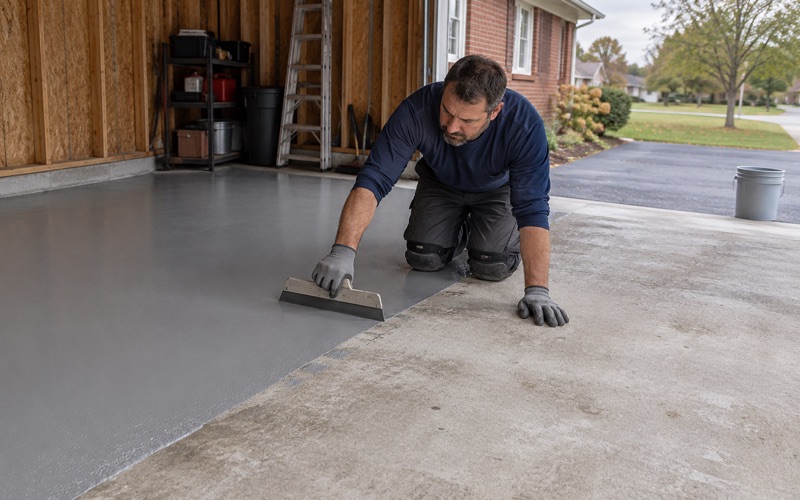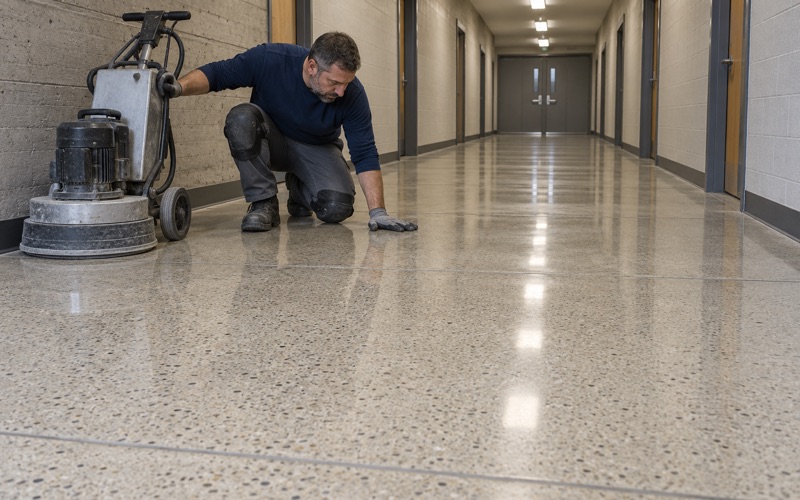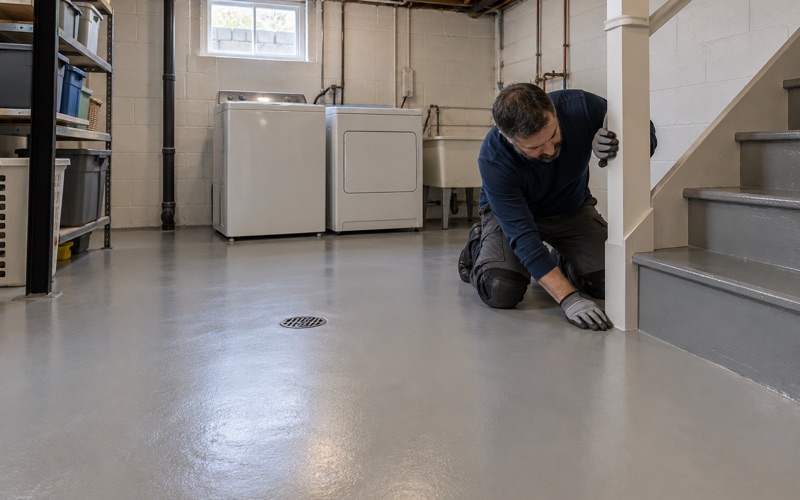
Des Plaines Epoxy Flooring has spent more than 20 years on epoxy flooring in Northlake and the industrial suburbs around it, and the floors that bring us here most are working floors: warehouses, staging rooms and shop bays where freight rolls across concrete every day. A coating on a floor like that is judged by what it does under wheels, not by how it looks on the first morning.
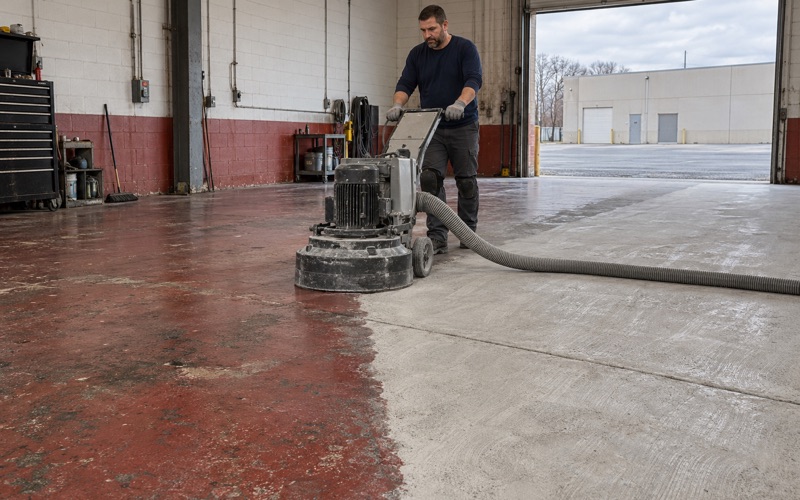
Our approach starts with the concrete rather than the coating. Every slab is opened with a diamond grinder or a shot blaster, never an acid etch, and we walk the floor to map cracks, spalled edges and any old coating before a price is final. If the slab needs repair or replacement before it is coated, we say so in writing.
The proposal you receive names the product line, the number of coats and the finished thickness, so the finished floor can be measured against what was quoted. We also explain up front what the coating warranty excludes, starting with moisture, because a floor that fails from below is not a coating defect and nobody should learn that after the job.
Trade-Show Freight and the Joints It Crosses
A Northlake Company That Moves Exhibits
Northlake is headquarters to Champion Logistics Group, a third-party logistics company that trade press describes as having particular expertise in transporting trade-show exhibits and retail environments. Its listed warehouse sits at 100 W Whitehall Avenue, and an industry profile reported 450,000 square feet of warehouse space used for consolidation, staging and preparation. A 2015 article described its Chicago headquarters as 400,000 square feet.
We have not seen Champion’s floors and do not work for the company. We name it because it shows what kind of freight moves through this city’s industrial blocks, and that freight sets the floor specification for any building handling the same kind of load. Exhibit crates, display fixtures and road cases behave differently on concrete than pallets riding on forklift forks.
Small Wheels Under Heavy Crates
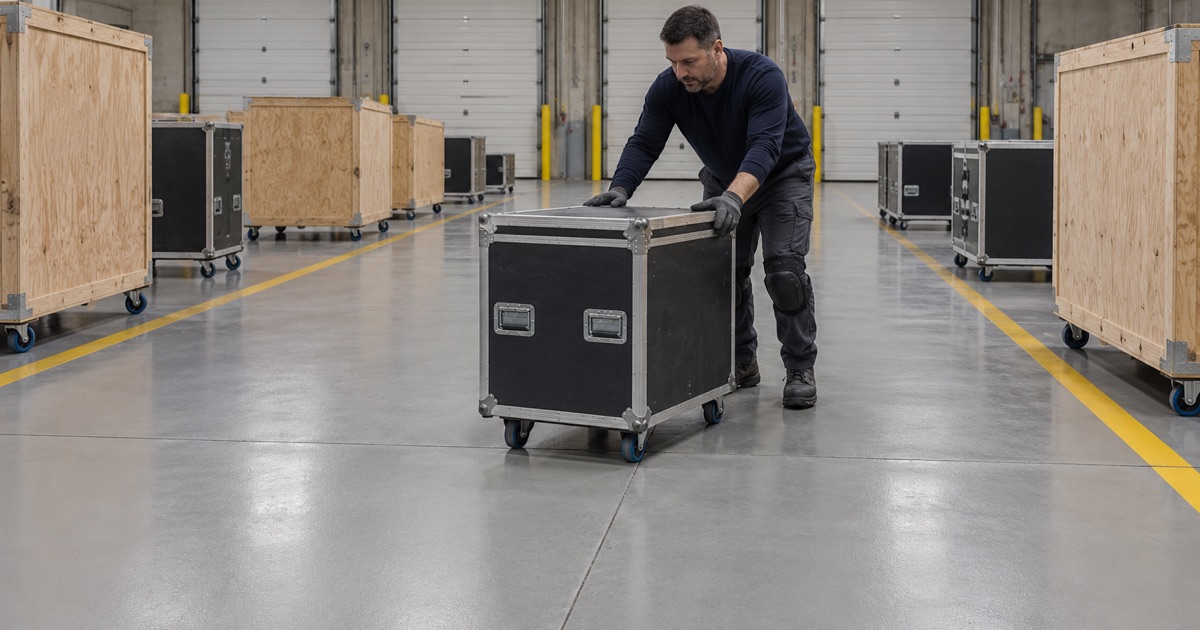
Trade-show and live-event freight tends to move as wooden crates on dollies and wheeled road cases riding small, hard casters, with pallet jacks doing the rest. A small hard wheel concentrates a heavy load on a very small contact patch. On a smooth stretch of slab that load is carried well enough, but at every saw cut and construction joint the wheel drops into the gap and strikes the far edge.
Each strike knocks off a little concrete. Repeated across thousands of crossings, the joint edge rounds over, then chips, then spalls into a widening trough that catches casters harder still. Crews start steering around the worst joints, carts tip, and a crate with a finished display inside takes a jolt it was packed to avoid.
Why Coating Over an Open Joint Fails
A coating laid across an open joint does nothing for it. The film bridges the gap for a while, then cracks along the joint line as the slab moves, and the first hard caster through peels the cracked edge back. Coating right up to an open joint leaves the same unprotected edge the wheels were already chewing on, now with a coating edge to lift.
Looking for epoxy-flooring closer to River Grove? See Epoxy-Flooring Services in River Grove.
Filling the Joints Flush Before Any Coating Goes Down
Mapping the Slab First
Our first visit is a survey. We map every saw cut and construction joint, note which are clean, which hold old filler and which are already spalled, and record cracks and any existing coating across the floor. That map goes into the written scope, so the joint repair is priced as its own line rather than discovered halfway through the job.
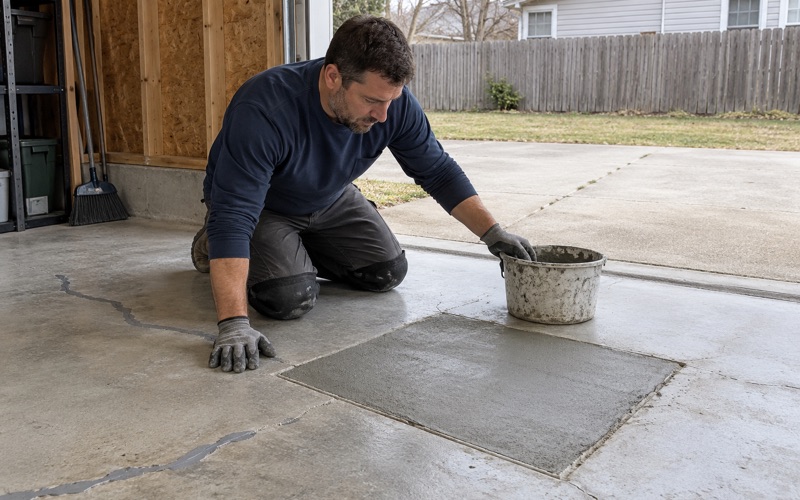
Cracks are handled on the same pass. Random cracks that cross a travel lane are routed and filled with the same semi-rigid material, while a crack that is still opening, or a slab section that rocks under a loaded jack, gets flagged as a repair or replacement before any coating is discussed. Coating a moving slab only produces a crack line in new resin.
Semi-Rigid Filler, Shaved Level
Joints on a wheeled-traffic floor get a semi-rigid filler, typically a polyurea or epoxy joint filler made to support the joint edge rather than a soft caulk that stays rubbery. We clean the joint to sound concrete, rebuild any spalled shoulders with a repair mortar, overfill with filler and shave it level once it cures. The goal is joints filled flush, so a caster rolls across without dropping.
Timing matters too. A semi-rigid filler is best installed once the slab has finished most of its drying shrinkage, which on an older building has long since happened and on a new pour can take many months. On older slabs we cut out failed caulk or crumbling filler from past repairs completely, since new filler bonded to old material fails along that seam.
Filler is not a permanent seal on a moving slab. As concrete keeps shrinking, a filled joint can open a hairline at one face, and that is expected maintenance, not a failure. We tell you up front which joints are likely to move and how a refill is handled, so a hairline in a year reads as routine rather than a surprise.
Opening the Surface for the Coating
With joints repaired, the whole floor is opened with diamond grinding or shot blasting to a concrete surface profile matched to the system, usually ICRI CSP 2 to 3 for a thin-film coating and higher for a thicker build. Dust is collected at the machine by a vacuum rather than swept or rinsed toward a drain. An etched surface never substitutes for a mechanical profile on a floor like this.
Dust, Staged Exhibits and a Coating That Holds Up
What Lands on the Floor
In an exhibit or display warehouse, a lot of the product spends time on the floor. Crates are opened, carpet is unrolled, graphics panels are leaned against fixtures and finished display pieces are checked before they are packed again. A bare or worn concrete floor can shed fine gray dust under that traffic, and the dust ends up on fabric, printed panels and painted surfaces that are supposed to arrive clean.
Sealing the floor so it stops dusting is often the first reason a staging building asks about coating at all. A properly bonded resin system locks the surface in place, so the floor gives off no powder under casters and sweeps clean. A lithium silicate densifier is a lower-cost option on a sound slab, though it hardens the surface without giving the color, lane marking or film thickness of a coating.
Systems That Suit Caster Traffic
For caster and pallet jack traffic we usually build on a 100% solids epoxy body coat, which goes on thick and supports point loads without denting. A quartz aggregate broadcast adds wear resistance and controlled texture where crates are dragged, and a polyaspartic or polyurea topcoat adds abrasion and UV resistance. On a floor that sees hot water washdown or heavy impact, urethane cement is the tougher choice.
A vinyl flake broadcast suits a showroom or a display preparation area where appearance counts, but we do not push decorative flake onto a high-traffic freight floor where it adds nothing to the job. The proposal states which system each area gets, along with coats and finished thickness, so a staging floor and an office corridor are not priced as the same product.
Moisture and Cure Before the Floor Reopens
Before we price the coating we test the slab for moisture, using ASTM F2170 in-situ relative humidity probes or ASTM F1869 calcium chloride testing, and a moisture-mitigation primer goes into the scope where the readings call for one. Cure is scheduled against slab temperature and the dew point spread at the surface, not the calendar, since a cold, damp slab invites amine blush and a weak bond.
Return to service is staged. Foot traffic usually comes back first, light carts next, and loaded crates and pallet jacks only once the system reaches its full cure. We give that schedule in writing so the building can plan inbound freight around it rather than learning about it at the door.
Staging Lanes, Marked Zones and Working Around the Schedule
Lanes and Zones on a Large Slab
A big open staging floor works better when it is marked. We can lay in drive lanes, crate bays, inspection zones and keep-clear areas in contrasting colors as part of the coating system, so the lines wear with the floor instead of peeling off like tape. Lanes are also the easiest way to bring caster traffic across joints at a right angle rather than running along them.
Phasing Around Shipments
A freight floor usually cannot close for a week. We phase the work in sections around shifts and dock schedules, with overnight and weekend windows when the building has to keep shipping, and we leave a working lane open while a neighboring bay cures. Trade-show freight also runs on a show calendar, so we ask when the busy outbound weeks fall before we set dates.
That planning matters on Northlake’s industrial blocks, where the development pattern the city reports is redevelopment of existing industrial sites rather than new land. An older building taking on new tenants often carries a slab with decades of joints, patches and previous coatings, and the survey is how we find out which of them will hold under a new coating and which will not.
Registration and Who Signs Off
Illinois has no state license for floor coating contractors, so the registration that matters here is the city’s. The City of Northlake Building Department requires every contractor and subcontractor to register, with a $100 license good for one year from issuance, a $10,000 bond and a certificate of insurance naming the city. We check those requirements before a job is booked and ask the department whether a given job needs a permit.
Northlake sits in Cook County, split between Leyden and Proviso townships, and takes its name from North Avenue and Lake Street, which meet on the city’s west border. A commercial fire-code question here goes to the Northlake Fire Protection District, a separate district rather than a city department. We pick products inside the Illinois VOC limits for floor and industrial coatings, which apply to whoever applies them.
When you call, we start with a walk of the floor, the joint and crack map, and moisture readings, and the written proposal follows from what we find. If the slab is ready, it lists the system, coats and thickness area by area; if it is not, it says what has to be repaired first and why.
- 20+ Years of Floor Work
- Moisture Test in Every Scope
- Written Proposal, Named Products