Polished concrete floors from Des Plaines Epoxy Flooring turn the slab you already have into the finished floor, for businesses and homes in Des Plaines, IL, serving surrounding cities including Prospect Heights, Schiller Park, Bensenville, Wood Dale and Norridge. With more than 20 years of diamond grinding behind us, we know how much of a floor’s character depends on what sits a few millimeters below its surface.
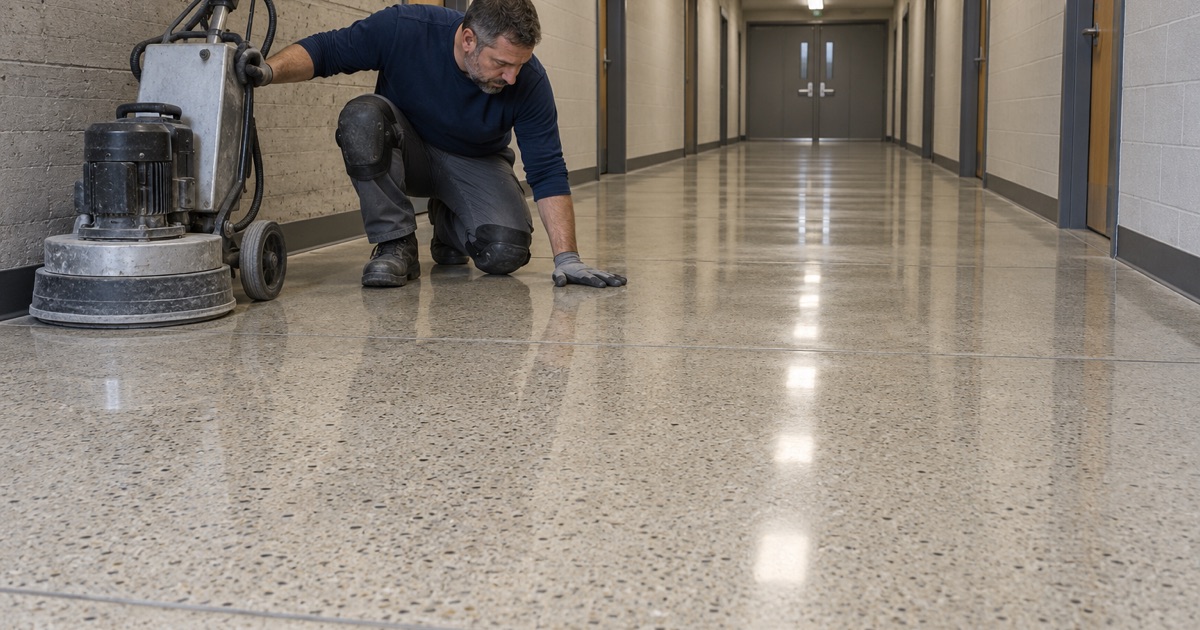
Polishing is a mechanical process rather than a coating. We grind the concrete flat with metal-bond diamonds, hone it through finer resin grits, harden it with a densifier and polish it to the sheen you choose. Nothing sits on top to peel, scratch through or lift.
Before we quote, we look closely at the slab. Cracks, patches, old glue and soft spots all show in a polished floor, so we map them first and tell you honestly what the finished floor will look like, including when a coating would serve you better.
Polished Concrete for Commercial and Residential Floors
Warehouses, Distribution and Light Industrial Space
Large distribution and light industrial floors around the airport corridor suit polished concrete because there is no coating for forklift wheels to wear through. Densifying hardens the surface against abrasion and cuts the dusting that bare concrete sheds under traffic.
We plan the grind around racking anchors, joints and operations, working in sections when a building cannot clear out. Joints along forklift lanes are filled with a semi-rigid filler so wheels do not chip their edges.
Retail, Showrooms and Offices
Showrooms and offices pick polished concrete for its clean look and low maintenance. Cleaning crews trade stripping and waxing for dust mopping and occasional burnishing, and the reflective finish brightens a space under existing lights.
Basements, Lofts and Home Interiors
At home, polished concrete works well in basements, lofts and modern interiors. It carries radiant heat well and suits slabs where moisture would blister a film coating, though water from a drain or a wall still has to be solved first. Area rugs soften it where people stand for long periods.
Choosing the Look: Aggregate, Sheen and Color
Cream, Salt-and-Pepper or Full Aggregate
How deep we grind decides how much stone shows. A light grind keeps the cream finish with almost no aggregate, a medium grind gives a salt-and-pepper look of fine sand, and a deep grind exposes the larger stone in the mix. Each step removes more concrete, so the choice is made before we start.
No two slabs expose the same way, because the stone, the troweling and the age of the concrete differ. A test area shows you the real result.
Matte, Satin and High Gloss
Sheen is set by the final diamond grit. A satin finish hides scuffs and suits most homes and offices, while high gloss reflects light strongly in a showroom or lobby. Gloss levels are described with industry polish classes, and we agree on the target before grinding.
Dyes, Stains and Saw-Cut Patterns
Penetrating dyes add color without forming a film, and saw-cut lines can create borders, grids or logos. We plan cuts around existing control joints so the pattern and the concrete’s own movement work together.
Polished Concrete Compared With Floor Coatings
Where Polished Concrete Wins
Polished concrete has nothing to delaminate, which makes it a strong choice for high-traffic floors where coatings wear through at aisles and doorways. It also breathes: moisture vapor moving up through the slab passes out of the surface instead of building pressure under a film. On a large floor, its long service life and simple cleaning often outweigh a higher first cost.
It also suits buildings that want to avoid future recoating. A coated floor eventually needs a fresh topcoat in its busiest lanes, while a polished floor is usually refreshed by burnishing or a light re-hone of the worn area.
Where a Coating Is the Better Call
Polished concrete is not right for every room. Commercial kitchens, food processing rooms and labs that see constant spills, acids or hot washdowns usually need a sealed epoxy or urethane cement system. Floors with heavy patching or wide cracks may look better under a coating than polished, where every repair shows.
Garages that take a winter of road salt are another case. Brine sitting on densified concrete can still etch and stain it, so most garage owners are better served by a coated, salt-tolerant floor.
Grind-and-Seal as a Middle Option
Where budget or slab condition rules out a full polish, a grind-and-seal floor lightly grinds the surface and applies a clear sealer. It brightens the concrete and controls dust for less money, but the sealer is a film that will wear and need renewal, so we explain that difference before you choose it.
Our Step-by-Step Polished Concrete Floors Process
Step 1: Slab Assessment and Test Grind
We check flatness, hardness, cracks, patches and old coatings, then grind a test area when the slab is uncertain so you see the real aggregate and color. That sample is what the exposure and sheen in the proposal are measured against.
Step 2: Coarse Grinding
Metal-bond diamonds flatten the surface, remove coatings and adhesive and open the concrete to the depth you chose. Dust is captured at the grinder by industrial vacuums.
Step 3: Repairs and Joint Filling
Cracks and joints are filled with materials suited to polishing, and pinholes are grouted so the surface reads as one piece. Repairs will always show a little in a polished floor, and we tell you where to expect them.
Step 4: Densifying
A lithium silicate densifier is applied to react with the concrete and harden the surface, which improves abrasion resistance and the final shine. It goes down after the coarse grind so it can penetrate the opened surface.
Step 5: Honing, Polishing and Guard
Resin diamonds refine the surface through progressively finer grits to the agreed sheen, and a penetrating guard can be added for stain resistance before the floor goes back into service.
Caring for a Polished Concrete Floor
Daily and Weekly Cleaning
Grit is what wears a polished floor, so dust mopping or an auto-scrubber with a neutral cleaner is the core of care. Spills of oil, wine, soda or acidic cleaners should be wiped up rather than left to sit, since densified concrete resists stains but is still porous. Walk-off mats at entrances catch winter salt and sand before they reach the floor.
Avoid wax and acrylic finishes on a polished floor. They hide the shine you paid for and create the same strip-and-recoat cycle that polishing is meant to end.
Restoring Shine in Busy Areas
Entrances, checkout lanes and forklift aisles lose sheen first. Periodic burnishing with a high-speed machine and a diamond-impregnated pad brings most of it back, and a worn area can be re-honed and re-guarded without regrinding the whole floor. We can set up a maintenance plan for commercial clients so the floor keeps looking the way it did on day one.
What Affects Polished Concrete Cost
Slab Condition and Removal Work
Coatings, tile adhesive and heavy patching add grinding time before polishing even starts. A clean, flat slab costs far less to polish than one that needs removal and repair.
Exposure Depth and Sheen
A deeper aggregate exposure and a higher gloss each add diamond steps. The proposal lists the exposure class, the final grit and any dye or guard, so the finished floor can be checked against it.
Phasing and Access in Occupied Buildings
Working around racking, inventory and staff takes more moves and more setup than polishing an empty floor. Night and weekend phasing adds labor but keeps a business running, and we price those choices openly so you can weigh downtime against cost.
- 20+ Years of Floor Work
- Moisture Test in Every Scope
- Written Proposal, Named Products