Des Plaines Epoxy Flooring brings more than 20 years of experience to epoxy flooring in Wauconda, with a particular eye for shop floors that get wet, oily and heavily loaded in the same afternoon. Marine service bays sit near the top of that list. A boat shop slab takes fuel drips, gear lube, lake water and the steel feet of stands and jacks, and a coating chosen for a dry car garage rarely holds up under all four.
Our first visit is about the slab, not the color chart. We map every crack, spall and patch of old coating, then write a moisture test into the scope before any price is final. If the concrete needs repair or replacement before it should carry a coating, we say so plainly rather than selling a system over a failing floor.
That matters for marine work because the floor is rarely dry for long. A hull pulled from the water drains for hours, a trailer drags in wet sand and weed, and the shop still has to stay open. The sections below walk through what a marine service floor actually faces and how we would build a coating to meet it.
A Park District Marina With a Seven-Bay Shop
Bangs Lake Marina on Liberty Street
The Wauconda Park District owns a working marina, which is unusual for a suburban park district. On November 9, 2021 its board approved buying the Wauconda Boat property at 231 E. Liberty Street on Bangs Lake for $1.7 million, financed over 20 years. The district said the purchase would protect public access to the lake while providing slip rentals, boat rentals, gas sales and marine service.
Today the property operates as Bangs Lake Marina, with fuel, a bait shop, boat rentals and a launch listed among its amenities. The district is rebuilding the site with a $600,000 IDNR OSLAD grant toward a project of about $2.5 million. That grant scope covers an accessible kayak and canoe launch, restrooms, a boardwalk and a path to downtown, not a service floor.
What a seven-bay service building represents
The purchase included a service building with seven bays, and the district leased four of them back to the seller at the time of the sale. We have not seen that building’s slab or finishes, and we are not describing its floor. What it does is put a clear picture in front of anyone who runs a marine shop around Wauconda: a multi-bay building where boats come in wet and leave serviced.
A shop like that is a demanding floor for any coating. Engines are drained, lower units are opened, hulls are washed and trailers are backed in and out all season. Whether the bays belong to a public owner, a private dealer or a homeowner with a lake boat in a detached garage, the same set of spills and loads decides which system will last.
Looking for epoxy-flooring closer to Warrenville? See Warrenville Epoxy-Flooring.
Fuel, Gear Oil and Two-Stroke Mix on a Shop Slab
What actually drips in a marine bay
A marine engine bay sees gasoline from tanks and fuel lines, two-stroke oil from older outboards, and lower-unit gear oil drained during routine service. Each one lands on the floor sooner or later, often under a boat where nobody notices it for a day. A coating that softens, stains or loses adhesion under those fluids turns into a peeling floor within a season or two.
For that exposure we usually start from a 100% solids epoxy base, which builds thickness in fewer coats and resists petroleum products well once fully cured. Over it we often specify a polyaspartic or polyurea topcoat for its chemical and abrasion resistance. Where a shop expects heavier chemical contact and hot wash water, urethane cement is the system we put on the table instead.
Writing the system into the proposal
Our written proposal names the product line, the number of coats and the finished thickness, so an owner can check the floor that went down against the floor that was quoted. On a fuel-exposed slab that detail matters more than usual. A thin roll-on coat and a broadcast system several coats deep look similar on day one and behave very differently after a summer of drips.
We also choose products inside the Illinois VOC limits for floor and industrial coatings, set out in 35 Ill. Adm. Code Part 223 Subpart C. Those limits apply to the person applying the coating, not just to the manufacturer. For a public or commercial owner who asks for product data before a job, we can show what was specified and why.
Cleaning up between services
A coated floor only helps if spills can be wiped up rather than soaked in. That is why we lean toward a dense, nonporous topcoat over a slab that will see fuel and oil. A broadcast texture still needs to be chosen with cleaning in mind, since an aggressive profile that grips a wet boot can also hold spilled gear lube in its valleys.
Lake Water, Weed and Point Loads
Wet hulls and trailers rolling in
Boats on Bangs Lake come out of the water carrying some of it with them. A hull drains across the floor, bilge water finds the low spots, and trailer tires drag in wet sand and lake weed from the ramp. On a bare or sealed slab that water carries grit into every joint, and on a poorly bonded coating it works under the edges and lifts them.
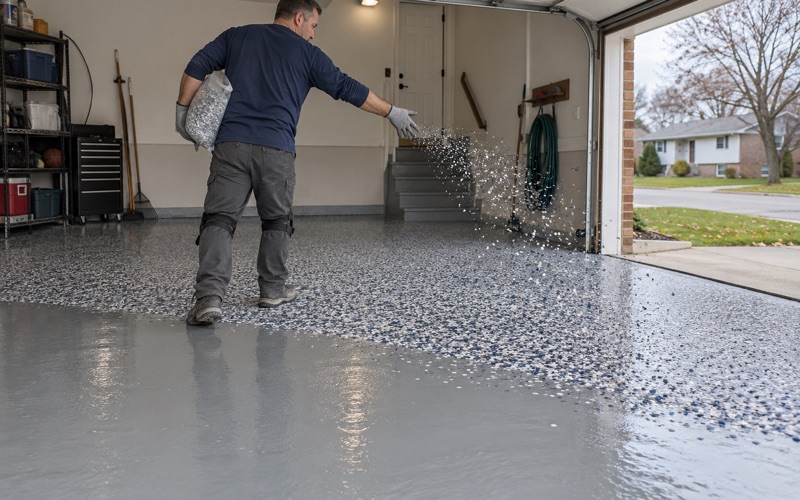
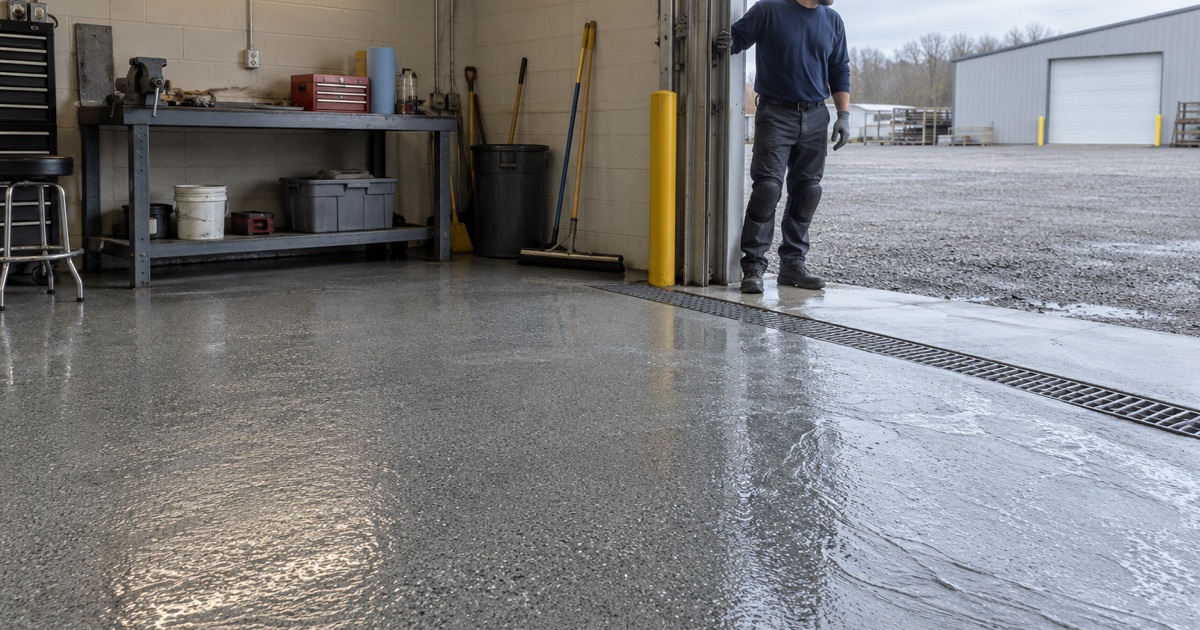
For wet floors we favor a quartz aggregate broadcast or a vinyl flake broadcast under the topcoat, sized to give traction without trapping debris. Quartz builds a harder wearing surface that stands up to sand ground under trailer tires. The texture is a choice we make with the owner, because the right grip for a wash-down bay differs from the right grip near a parts counter.
Moisture from below as well as above
Surface water is only half the story on a shop slab. Before any marine shop coating, we test the concrete itself with ASTM F1869 calcium chloride kits or ASTM F2170 in-situ relative humidity probes, often starting with an ASTM D4263 plastic sheet test as a first read. Readings above what the product allows call for a moisture-mitigation primer or a different plan.
We explain warranty exclusions before the job is sold, and moisture is the first one we name. A coating that fails because vapor pushed up from below is not treated as a product defect under most warranties. Telling an owner that at the estimate is far better than arguing about it after the floor starts to blister.
Boat stands and trailer jacks
A marine shop concentrates weight in ways a car garage rarely does. A boat on jack stands rests on a handful of small steel pads, and a trailer jack puts the tongue weight onto one narrow foot. Those point loads can crack a thin coating or dent a soft one, especially where the floor was never ground flat.
We handle that with thickness and preparation rather than hope. A higher-build 100% solids epoxy spreads the load better than a thin film, and a well-bonded system resists the edge chipping that starts around stand pads. In bays where stands sit in the same spots for months, we sometimes suggest load plates under the feet to protect the finish.
Preparing and Scheduling a Marine Shop Floor
Grinding to a real profile
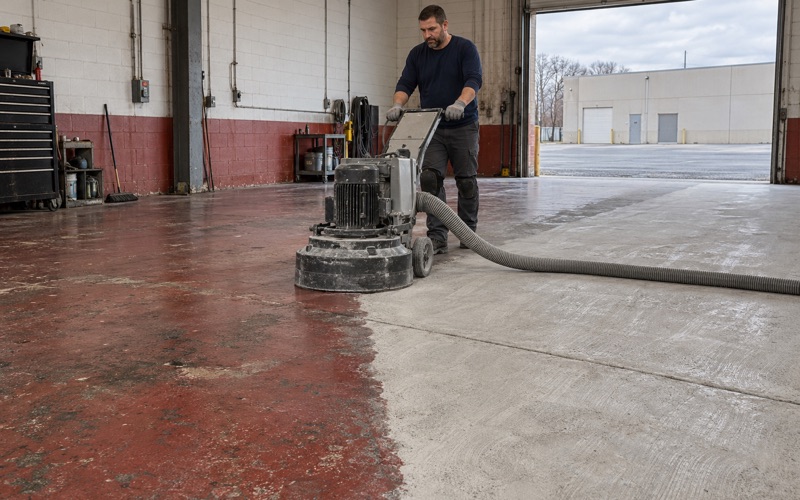
Every slab we coat is opened with a diamond grinder or a shot blaster, never an acid etch. A marine floor soaked with years of oil and fuel needs that mechanical profile even more, because contamination sits in the surface pores where etching cannot reach it. We grind to the ICRI CSP range the chosen system calls for, then check the profile before the first coat goes down.
Oil-soaked spots get degreased and tested before coating, and spalled areas near drains or door thresholds get repaired first. Grinding dust is collected at the machine with a vacuum rather than washed toward a floor drain. That matters near a lake, where nobody wants concrete fines or old coating residue heading toward the water.
Fitting the work between seasons
Marine shops keep a calendar of their own. Spring commissioning and launches fill the bays, summer brings repairs, and fall means winterizing and storage. The natural window for floor work is usually a stretch when boats are either on the water or not yet hauled, and we plan around that rather than asking a shop to shut down at its busiest.
Cure times are set by slab temperature and the dew point spread at the slab surface, not the date on a calendar. An unheated building in deep winter is told to wait, because epoxy cured too cold can develop amine blush and lose adhesion. When a shop cannot stop entirely, we phase the bays and work evenings and weekends so the rest of the building stays open.
Permits and paperwork before grinding
Illinois has no state flooring license, so we check the local contractor registration, bond and insurance rules before booking a job. In Wauconda that means asking the Village of Wauconda’s building and community development staff whether a coating needs a permit, rather than assuming the answer. For a homeowner job over the state threshold, a written contract and the Illinois consumer-rights pamphlet come before any grinding starts.
- 20+ Years of Floor Work
- Moisture Test in Every Scope
- Written Proposal, Named Products