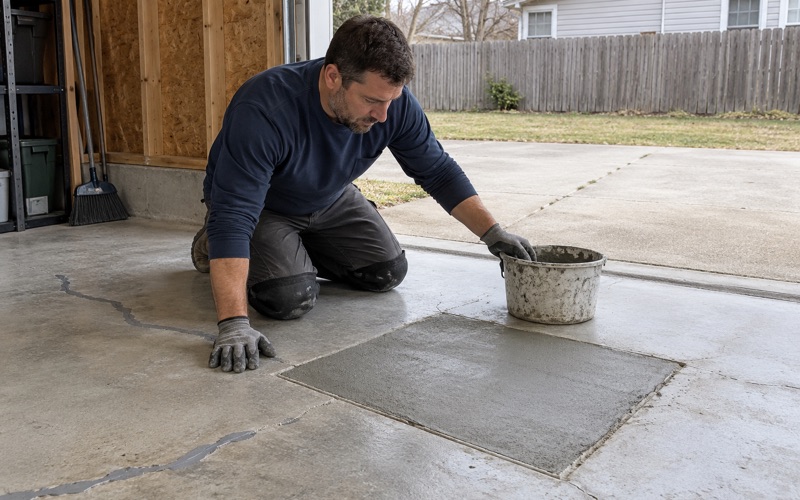
Des Plaines Epoxy Flooring brings more than 20 years of epoxy-flooring work in Winfield and the surrounding region to floors that take real abuse, from home garages to the service buildings behind a business. Every job starts with the slab itself: we map cracks, spalls and any old coating before a price is final, and we tell you plainly when a floor needs repair before it should be coated at all.
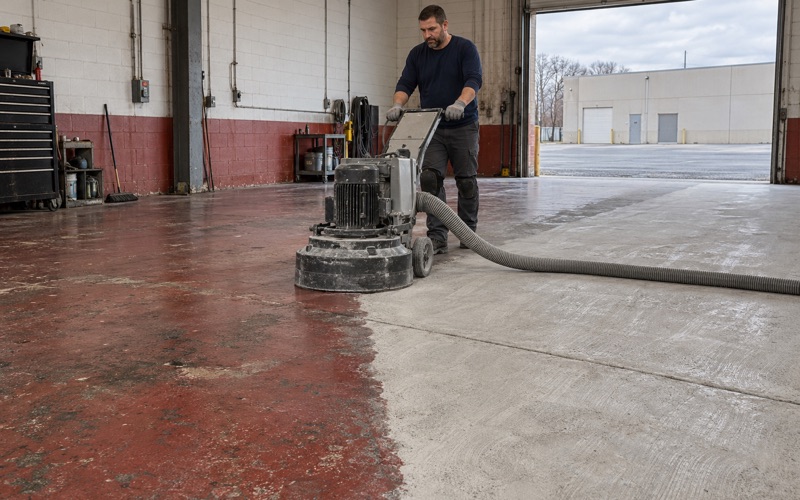
Preparation is mechanical on every floor we take on. A diamond grinder or a shot blaster opens the concrete to a measured ICRI surface profile, because an acid etch leaves too little for a coating to hold. A moisture test is written into the scope, and the proposal names the product line, the number of coats and the finished thickness so the result can be checked against the paper.
This page looks at one kind of floor that comes up in this village more often than people expect: the buildings around a golf course. Clubhouse entries, pro-shop aisles, cart storage and maintenance shops each carry a different load, and a coating chosen for a house garage is not automatically right for any of them. The sections below walk through what changes and why.
A Public Golf Course Inside the Village
Klein Creek Golf Club on the village’s own records
Klein Creek Golf Club sits at 1N333 Pleasant Hill Road, a public course of 18 holes and 6,700 yards with four sets of tees. It is a Winfield business by the village’s own accounting: the annual comprehensive financial report lists Klein Creek among the village’s principal employers in 2015, with 20 employees, alongside the hospital, the schools and several local restaurants.
We mention the course because the floors around a golf operation are a category of their own, not because we have worked there. None of the club’s floors were inspected for this page, and nothing here describes their condition. What follows is how the trade approaches clubhouse, pro-shop and service-building floors in general, applied to a type of property this village actually has.
Secondary listings describe the course opening in 1994 to a Dick Nugent design. The scale is what matters for flooring: a full 18-hole operation runs a clubhouse, a restaurant, event space and the service buildings that keep the turf in play, and each of those rooms puts a different kind of load on its concrete. That variety is why one product rarely fits a whole golf property.
Restaurant, pavilion and the rooms in between
The club describes a cozy clubhouse, a restaurant with a fireplace and classic Americana cuisine, and a large tented pavilion for bigger parties. That mix matters because one building serves golfers in spikes, diners in street shoes and event guests carrying food and drink across the same thresholds. A floor plan for a property like that is rarely a single product from door to door.
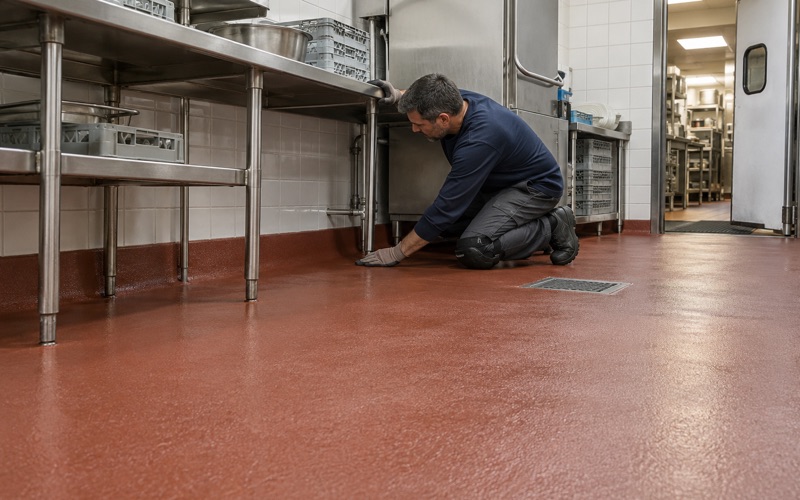
Kitchen and dish areas at any food-service operation fall under county food plan review through the DuPage County Health Department, and the FDA Food Code expects smooth, cleanable floors with coved junctures where the floor meets the wall. Those rooms usually call for urethane cement rather than a thin epoxy film. Dining rooms and lounges often suit a different finish entirely, and we say so rather than coating everything.
Looking for epoxy-flooring closer to Summit? See Epoxy-Flooring Services in Summit.
Cleats, Turf and Sand at the Clubhouse Door
What golf-shoe cleats do to a coated floor
Golf-shoe cleats concentrate a golfer’s weight onto a handful of small points, and they do it thousands of times a season along the same paths. Modern soft spikes are kinder than old metal ones, but they still grind, twist and pivot at the counter, the locker bench and the door. A thin, glossy coating shows that wear as dull traffic lanes within a season or two.
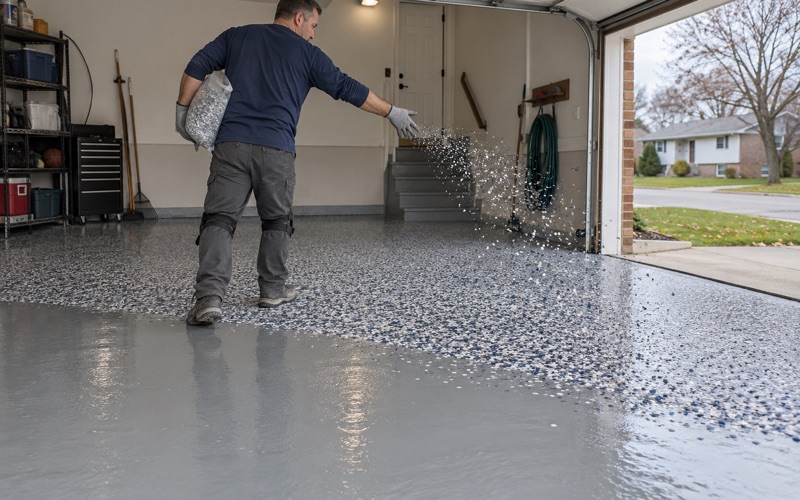
For cleat traffic we generally favor a thicker build over a thin roll coat: a 100% solids epoxy base with a broadcast aggregate locked into it, then a wear-resistant topcoat. The proposal states the finished thickness in writing. A floor that is going to see spikes should be specified for spikes from the start, because adding thickness later means grinding off the first system.
Pro-shop floors carry a second kind of traffic: display fixtures that get moved each season, bag carts rolled between racks and golfers trying on shoes. A vinyl flake broadcast hides scuffs and small debris well in a retail space, and it can be matched to a clubhouse color palette while still carrying the same tough topcoat as the entry.
Wet turf, bunker sand and fertilizer granules
Golfers come off a course carrying pieces of it on their shoes. Wet grass clippings, bunker sand and the occasional fertilizer granule ride in on soles and cart tires, and they collect just inside every entry. Sand is the quiet problem: underfoot it behaves like sandpaper, scouring a soft finish and turning a glossy entry into a dull, scratched one.
Fertilizer granules add a chemical element, since they dissolve in water left by wet shoes and sit on the floor until someone mops. A topcoat with good chemical resistance handles that far better than a bare sealer. We pair it with walk-off matting at the doors, because the best coating still benefits from catching most of the grit before it travels deeper into the building.
Texture you can live with
Wet entries need grip, but too much texture traps sand and makes mopping a chore. Quartz aggregate broadcast gives a controllable profile: a finer grade near the dining room, a coarser one at the doors where wet spikes arrive. We show sample boards before ordering material, so the owner chooses how the floor feels underfoot rather than discovering it after the coating cures.
Cart Barns and Maintenance Buildings Behind a Course
Fuel, oil and wet equipment
The buildings behind a golf course are closer to a fleet garage than a clubhouse. Mowers, utility vehicles and spray rigs come in wet, often coated in clippings and soil, and they drip fuel, hydraulic oil and grease where they park. Bare concrete soaks those spills up, and a stained slab can take years to stop bleeding through later coatings.
On a shop floor like that we look first at how deep old oil has gone, because contamination that has migrated into the concrete will push off any new coating. Grinding opens the surface, and sometimes the honest answer is a degreasing and test-patch step before anything is quoted. A 100% solids epoxy base with a chemical-resistant topcoat is the usual system once the slab is clean.
Charging rows and parked carts
Cart storage adds charging. Rows of parked carts mean cords, chargers, steady heat and whatever drips off a wet fleet overnight, all concentrated along the same walls. We do not assume what kind of batteries any particular fleet runs, since that changes what a floor has to resist, so it is a question we ask on the site visit before we name a product.
Tire traffic is the other factor. Carts and utility vehicles turn in place to back into their rows, and that twisting load lifts a weak coating at its edges. We map those turning lanes before writing the scope, and they get the thicker build, with joints and cracks repaired first so wheels are not rolling across an open edge.
Moisture and preparation under the shop
Service buildings are often slab-on-grade with no record of a vapor retarder beneath them, and wash-down water adds moisture from above. We test before we price, using ASTM F2170 in-situ relative humidity probes or an ASTM F1869 calcium chloride test, depending on the slab. If readings are high, a moisture-mitigation primer goes into the scope, and the warranty exclusions for moisture are explained before anything is signed.
Scheduling Floor Work Around the Golf Season
Off-season and between-event windows
A course does its busiest business when the weather is good, which is exactly when a floor contractor would most like to work. That tension shapes every schedule. Clubhouse floors are usually done in phases, a room at a time, with polyaspartic topcoats where a fast return to service matters, and shop floors are timed for weeks when the fleet can be parked elsewhere.
Events in a pavilion or restaurant add another layer of planning. We work backward from the booking calendar, leaving full cure time before tables, chairs and catering carts roll across a new surface. When a building cannot stop entirely, overnight and weekend windows let the work move forward without closing the doors on golfers or guests.
Cure times follow the slab, not the calendar
Off-season work brings cold slabs, and cold slabs cure slowly. We set cure schedules by slab temperature and the dew point spread at the surface, because coating a slab that sits too close to the dew point invites amine blush and a weak bond. An unheated cart barn in the depths of winter is told to wait or to bring in temporary heat.
Milton Township, but still Winfield
The Klein Creek clubhouse sits in Milton Township, and its mapped building coordinate falls inside the Winfield village line, even though a Census street-address lookup for the same address lands just outside it. For any commercial floor, we confirm which jurisdiction a building actually sits in before the job is booked, so the right office answers the right questions.
Inside the village, permit questions go to the Village of Winfield Building Department at 27W465 Jewell Road, and we ask before the job whether a coating needs a permit rather than assuming either answer. Illinois has no state flooring license, so we also check the village’s own contractor registration, bond and insurance requirements before a date goes on the calendar.
If you manage a clubhouse, a pro shop or a service building and want a floor planned around cleats, grit and fuel rather than a showroom sample, we start with a site visit and a moisture test. You get a written proposal with the product line, coat count and thickness spelled out, and an honest read on whether the slab is ready.
- 20+ Years of Floor Work
- Moisture Test in Every Scope
- Written Proposal, Named Products