Des Plaines Epoxy Flooring brings more than 20 years of work to epoxy flooring in Wood Dale, and the floors we are asked about most here carry machinery rather than foot traffic. A warehouse aisle that only sees pallets wears slowly and evenly. A floor that receives crated presses and machine tools fails in a different way, and the coating has to be chosen for that failure.
Every job starts with a walk of the slab. We map the cracks, spalls and any old coating, and we tell you plainly when concrete needs repair or replacement before anything goes on it. A moisture test is then written into the scope, so the price you approve already accounts for what the slab is doing underneath the surface.
Our written proposal names the product line, the number of coats and the finished thickness. On a floor that will see steel skids and machinery skates, that thickness is the line to hold us to, because it is what stands between a dragged skid runner and bare concrete. You can check the finished floor against the quote, not against a promise.
A Logistics Center Built Around Heavy Equipment
What moves through Nippon Express USA’s building
Wood Dale’s industrial character is easy to read from its freight. Nippon Express USA announced construction of a warehouse in the city in October 2020, began operations in January 2021 and held a completion ceremony for its Chicago Logistics Center on March 5, 2021. The building became the company’s US head office, relocated from New York, and it is shared with group company Associated Global Systems.
Trade press describes the cargo plainly: general cargo that includes electrical discharge machines, press machines and other heavy equipment, with repacking, inspection and cross-docking added for automotive-related customers. The city’s 2025 Annual Comprehensive Financial Report lists Nippon Express at 200 on its principal-employer table. We have not seen the floor in that building, and the company is not a customer of ours.
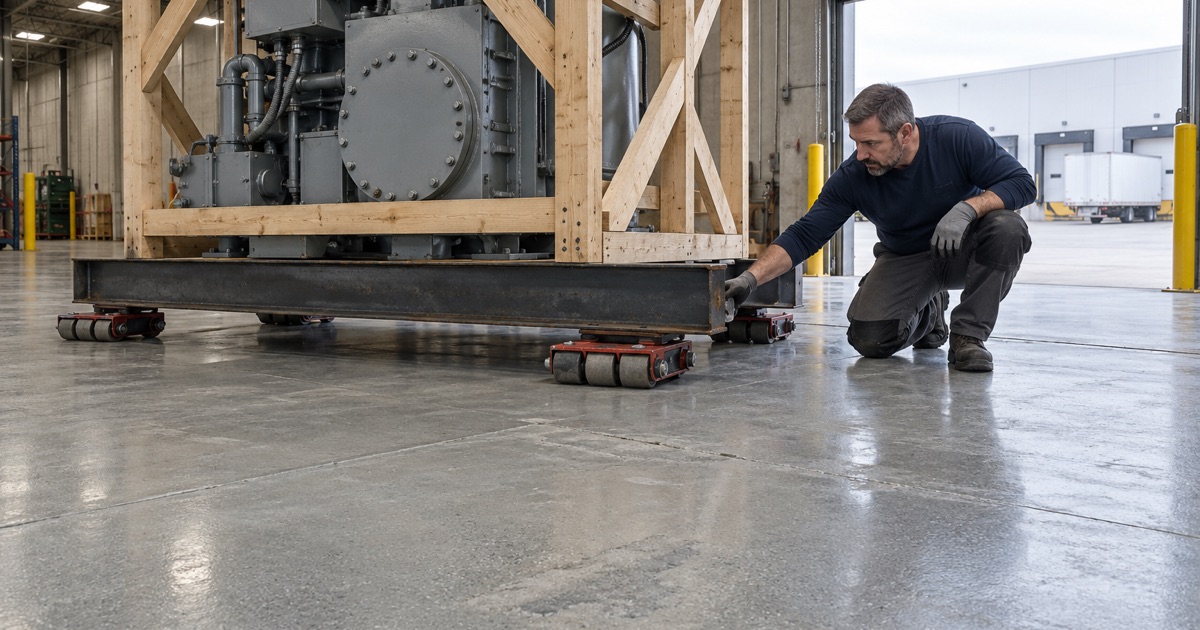
We use that facility as a reference point, not a reference job. The same kinds of machines move through tool rooms, rigging contractors and equipment dealers across the city’s industrial areas, and they arrive the same way: crated or bolted to steel skids, lifted by forklift, then walked into position on machinery skates and nudged the last few inches with pry bars.
Gouging under dragged steel
A press or an electrical discharge machine concentrates enormous weight onto a few small steel contact points. That is a different problem from the rolling forklift, pallet jack and dock plate wheel loads a distribution aisle sees all day. When a skid is dragged rather than lifted, the leading edge of its runner behaves like a chisel against whatever coating lies in its path.
On a thin coat that chisel plows a groove straight through to concrete. Once the edge of the film is exposed, the next pass catches it and peels a strip back, and the damage spreads from there. Many machine-floor failures begin as a single groove left by one careless move that nobody thought to repair.
Crushing under a skate
Machinery skates spread a load across small hardened rollers, which is exactly why they work and exactly why they are hard on floors. Each roller presses a tiny contact patch into the surface. A soft or brittle coating can crush, crater or chip under that point load, especially along a joint edge where the concrete has no support on one side.
Pry bars add a third mode. The toe of a bar levered against the floor to inch a machine sideways can pop a coating cleanly off a slab that was prepared poorly. Gouging, crushing and chipping share one remedy: a system with real thickness, bonded to a properly opened surface and built for the freight it will actually carry.
Looking for epoxy-flooring closer to Norridge? See Epoxy-Flooring Services in Norridge.
Thick, Impact-Tolerant Systems Versus Thin Coats
Why a thin coat is the wrong economy
A thin roll-on epoxy can look excellent on the day it cures and still be the wrong floor for machinery freight. Gloss tells you nothing about impact tolerance. What matters is how much resin and aggregate sits between a steel runner and the slab, and whether that layer can absorb a hit without cracking away from the concrete.
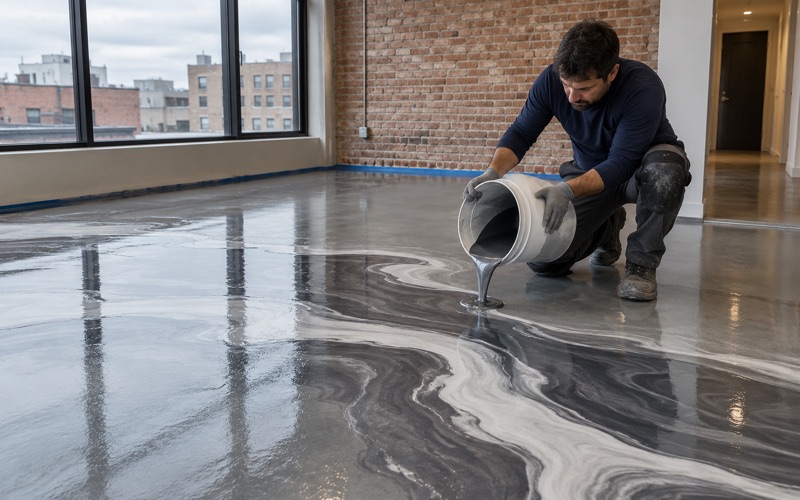
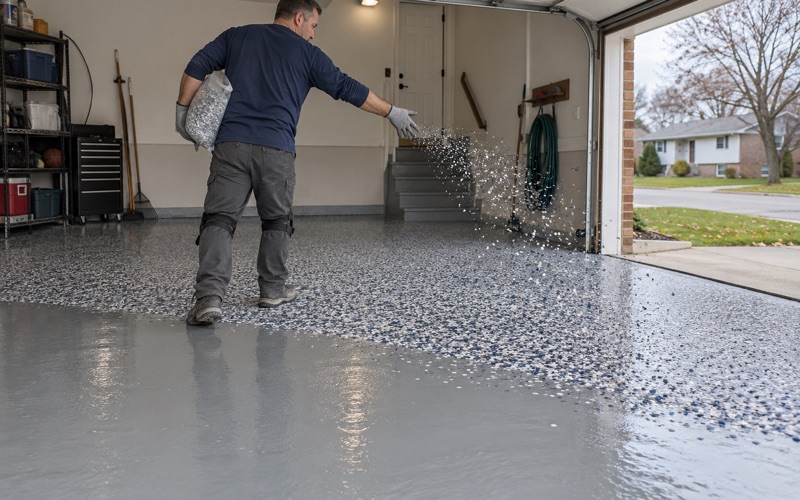
For heavy-equipment areas we usually look at 100% solids epoxy built up with a quartz aggregate broadcast, or a urethane cement system where impact and temperature swings are both in play. Each puts a dense, filled layer on the slab rather than a film. Where an area needs abrasion resistance more than impact resistance, a polyaspartic or polyurea topcoat may finish it better.
Preparation that lets the system hold
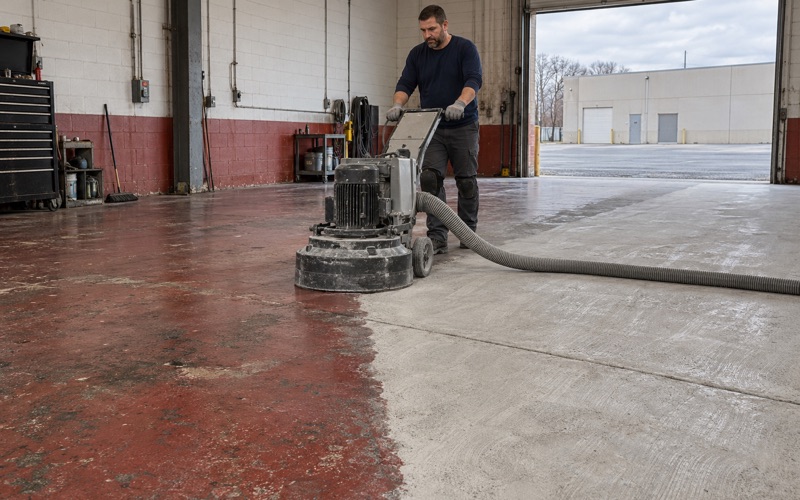
Thickness only helps if it stays attached. We open every slab with a diamond grinder or a shot blaster and never rely on an acid etch to create a profile. The target concrete surface profile is chosen on the ICRI CSP scale for the system going down, because a heavy broadcast floor needs a deeper profile than a thin sealer does.
A shot-blasted surface also reveals things. Weak surface paste, old coatings that release in sheets and soft patches near drains all show up in the first pass, and it is far better to find them before resin goes down than after a skid finds them. Grinding dust is captured by vacuum at the machine rather than washed toward a floor drain.
Moisture, temperature and cure
Before the price is final, the slab’s moisture is measured, typically with ASTM F2170 in-situ relative humidity probes or ASTM F1869 calcium chloride tests, depending on the floor. A slab pushing vapor through a coating will blister it from below, and moisture is the first exclusion we name when we explain what a coating warranty does and does not cover.
Cure is scheduled by slab temperature and the dew point spread at the surface, not by the calendar. A cold slab near the dew point invites amine blush on epoxy, a greasy film that weakens the bond of the next coat. A machine set down on resin short of full cure can print or crush it, so return-to-service dates come from measured conditions.
Joints, Grit and Repair After a Machine Move
Joints are where machine floors fail first
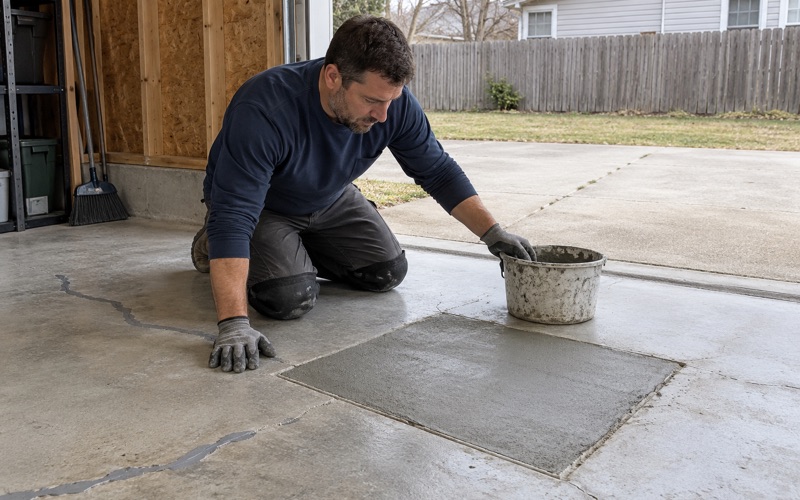
A sawcut control joint is the weakest line on a machine floor. When a skate roller drops into an open joint, it hammers the unsupported edge, and over time both sides spall into a ragged trough. Coating over that trough simply carries the damage up into the new system, so crushed joint edges are rebuilt before any coating goes down.
The filler then has to suit the traffic. A semi-rigid joint filler set flush with the floor lets hard rollers cross without dropping, while still allowing some slab movement. Where a joint is actively moving or its edges keep breaking, we say so in the proposal rather than promise a fill that will not last through the next machine move.
Grit is a cutting tool
Sand, metal shavings and broken crate fasteners caught under a skid turn a routine move into a grinding operation. A broadcast floor resists that far better than a thin film, but no coating likes it. Sweeping the travel path before machinery moves is the cheapest floor protection a rigging crew has, and we raise it on every heavy-equipment job.
Texture is a tradeoff here. A heavier quartz broadcast gives traction and hides scuffs, yet it also holds grit in its valleys. For skate paths we usually recommend a finish that keeps some texture without becoming a trap for debris, and we review that choice with the people who actually move the machines, not only with whoever signs the order.
Repairing after the damage happens
Even a thick system takes hits. When a gouge or chip appears after a machine move, the repair is cut back to sound coating, the edges are keyed into the slab, and the patch is built to the same system and thickness. Patching a heavy floor with a thin touch-up only creates a new weak edge for the next skid to catch.
On an existing floor we map the damage before quoting a recoat. If the coating has delaminated across large areas or the concrete is crumbling beneath it, we will tell you the slab needs repair or replacement first. A coating cannot fix failing structural concrete, and saying so at the start saves you from paying for a job that will not hold.
Repacking and Inspection Areas: The Cleaner Side of the Building
Different floors under one roof
The Chicago Logistics Center was described at its completion as handling repacking and inspections for automotive-related customers alongside cross-docking. That pairing is common in logistics buildings: one zone takes the heavy, dirty freight, while another is where goods are unpacked, checked and repacked, often at benches where people stand for an entire shift.
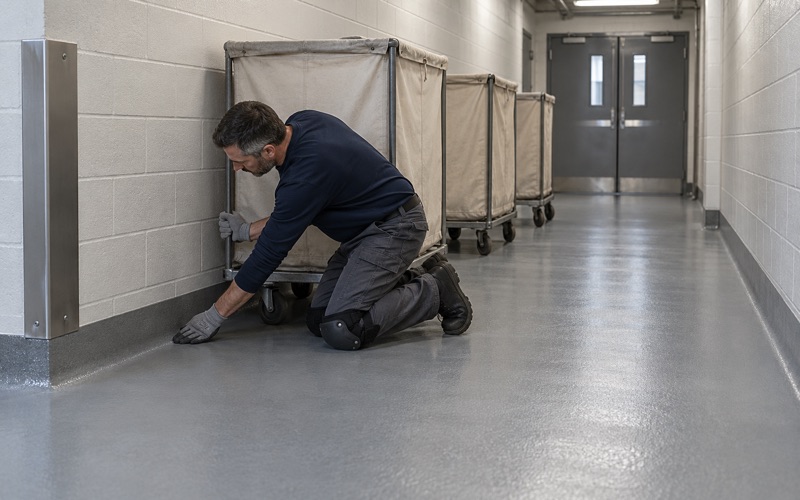
Those inspection and repack zones do not need the same impact armor as a machinery bay. They benefit from a smoother surface that cleans easily, a lighter color that helps people see small parts, and line striping that separates walkways from work areas. Zoning a building with different systems usually costs less than coating everything for the worst case.
Working around the dock schedule
Freight buildings rarely stop. We phase work around shifts and dock schedules, with overnight and weekend windows when a building cannot close, and we sequence zones so cross-dock lanes stay open while a repack area cures. The schedule is agreed in writing before the first grinder starts, along with the return-to-service time for each section.
We also select products inside the Illinois VOC limits for floor and industrial coatings, which bind the applicator as well as the manufacturer. In an occupied building that matters to the people working beside the job. If you run a machine shop, rigging operation or freight floor in Wood Dale, the first step is a slab walk and a written scope you can measure the finished floor against.
- 20+ Years of Floor Work
- Moisture Test in Every Scope
- Written Proposal, Named Products